

By Rob Rains
For the past eight years, Randy Flores has spent the spring months crisscrossing the country watching high school and college baseball players in advance of the annual amateur draft.
It’s a job he “absolutely” loves; being in charge of the draft for the Cardinals, even though the job always presents one travel challenge after another.
In past years Flores has found himself driving on a dirt road in Kansas when a small two-lane highway suddenly ended. He’s been lost in Ohio when the GPS didn’t work. He has lost his wallet at a game at LSU, later finding it on a parking lot.
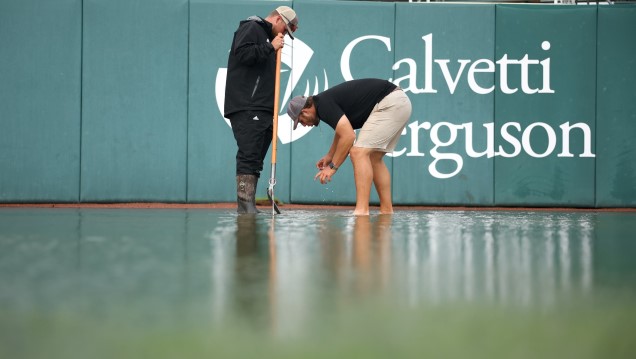
This year, Flores learned a new word – derecho – after a harrowing drive from the Dallas airport trying to get to a game in College Station, Texas.


The story of that tough day of travel, on May 16, is just one example of the obstacles that can sometimes get in the way of Flores and the Cardinals’ other scouts trying to prepare for the draft, which now is just a month away, beginning on July 14.
The importance of this year’s draft for the Cardinals cannot be overstated. As a result of their last-place finish in 2023, the Cardinals have the seventh overall pick – the highest they have drafted since they selected J.D. Drew with the fifth overall pick in 1998.
In the years that Flores has been in charge of the draft, since 2016, the Cardinals have not picked higher than 18th.
Trying to get more looks at players the Cardinals might consider selecting with that top choice was why Flores, who had been in Hattiesburg, Mississippi, was on a 6 a.m. flight out of Jackson, Miss., to Dallas, where he was scheduled to make a connecting flight to College Station – trying to out-smart the weather forecast.
Normally, it would have been an easy trip, getting into his hotel room with time to work for several hours before going to the game that nigh between Arkansas andTexas A & M.
The trouble began, however, when Flores’ plane pulled away from the gate in Dallas.
“We got on the tarmac and there was a line of jets that had priority ahead of us,” Flores said. “Over the next 45 minutes to an hour the storm started coming in. That led to two more hours on the plane on the tarmac, trying to wait for an opening. Finally at noon they canceled the flight.”
Flores went back to the terminal and rented a car and started his drive.
“I wound up pulling over three times because I couldn’t see,” Flores said. “One of them was at a private road perched on top of a railroad track because I was worried about flooding. The wind and rain was so hard that twice during the drive the side mirrors flipped in and hit the car like you were at a car wash.
“Those of us silly enough to stay on the road had our hazard lights on going maybe 25-30 miles an hour on a road that allowed you to go 65. It was unreal.”
Flores later learned from Twitter that the storm was called a derecho, which meteorologists describe as “an especially strong, long-lasting band of thunderstorms with straight-line winds of up to 100 miles per hour.”

Flores, like the rest of the team’s scouts, won’t really know the impact of their travel challenges until they see how the draft unfolds.
That trip started with Flores flying into Hattiesburg, where he said the airport was so small it didn’t have a car rental counter.
“The instructions from the car rental company were, ‘when you land, look for the gentleman in all black. He’s a security officer and is very familiar with our procedures. He will have your keys,’” Flores said.
On another trip this spring, Flores was at a game at LSU, and between watching batting practice and the start of the game, went for a walk, watching people in the packed crowd.
His phone rang, and not recognizing the number, he let the call go to voice mail. When Flores listened to the message, he realized he had left his scouting book on a bench during his walk.
“I leave my number in the book and say I will give a $100 reward to anyone who returns it,” Flores said. “Lo and behold it wound up being a nice couple who called me; he actually was also a USC alum. When I got off the road I sent him $100 on Venmo.”
Luckily for Flores, most of his scouting trips this spring went much smoother than those journeys, even though there were some differences in preparing for this year’s draft.
For the first three months of the college and high school seasons, the scouts followed their normal pre-draft process. That plan shifted at that point, however, to reflect the team’s higher selection in the first round and the fact the team’s second pick will not be until the 80th overall selection. The Cardinals forfeited their second-round pick in signing free agent Sonny Gray.
“Normally we have to be prepared for a very large bucket of players,” Flores said, knowing the team often has had four or five picks among the first 100 players selected in the draft.
Picking seventh overall, Flores said, does put more of a spotlight on the Cardinals’ selection then where their first pick normally falls, a dozen or so spots later.
“You are aware that you are in a different bucket,” Flores said. “You also still have to acknowledge that drafting is hard … One of the things we have to be honest about is the acknowledgement that there is risk involved, no matter what we do. Being able to accept that is something we have to stick to no matter if we’re drafting 27th or seventh.”
Flores also, however, has the trust in his scouts to know how hard they work – and the knowledge that whoever the Cardinals select with that number seven pick will be a player they are convinced is the correct choice.
It’s a challenge that he has come to embrace in the years that he has been running the Cardinals’ draft.
“You can go through the different personalities of each draft since 2016 and all of their uniqueness,” Flores said. “This year is certainly right up there as one of the most unique. We haven’t picked this high in a long time.
“I’m motivated in working with Gary (LaRocque, the farm director) our performance department, our baseball development staff and our team. We hope that together we have success this year.”
Flores will leave Monday to attend the MLB Draft combine in Phoenix, then will spend the next few weeks refining and tweaking the team’s list for this year’s draft – as well as beginning early preparations for the 2025 draft at showcase events, watching as national teams start summer play and the Cape Cod League gets underway.
“I like the fact we have more time and don’t have to speed through the process,” Flores said. “We want to really be convicted in what our board looks like. We need to be diligent about crystalizing our top 10.”
Follow Rob Rains on Twitter @RobRains
Photos of Texas A & M baseball field on May 16 courtesy of Texas A & M Baseball via Twitter