


Sally Tippett Rains
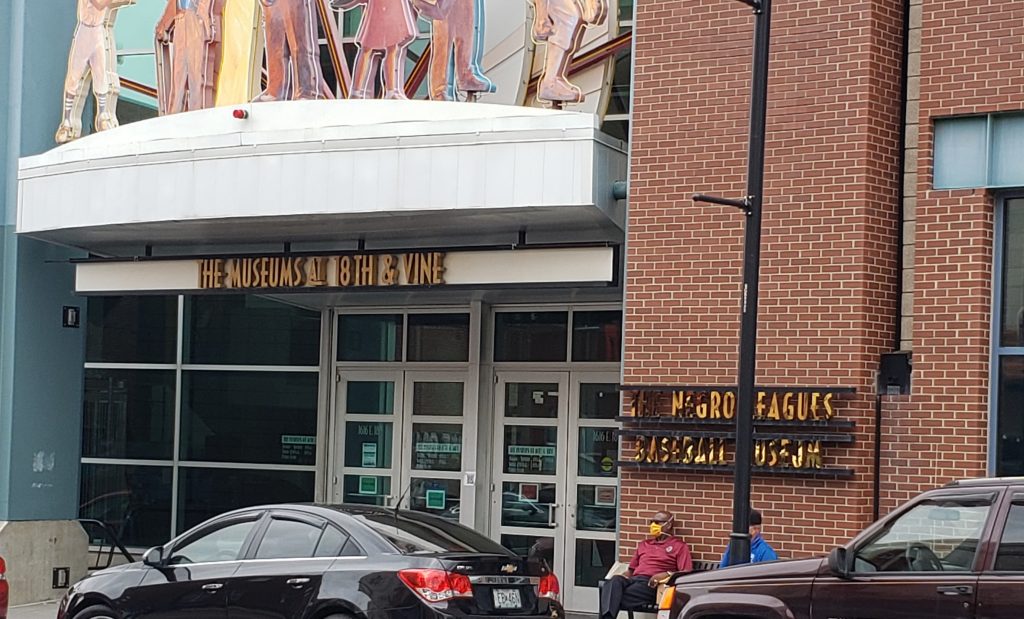
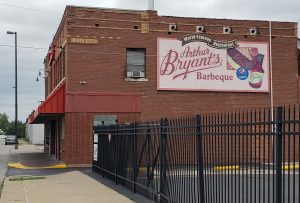
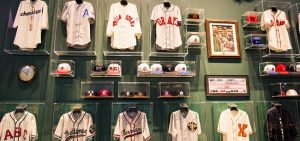
This week– the 100th Anniversary of the Negro Leagues– the best place to be was in Kansas City where the Negro Leagues Museum is—at the corner of 18th and Vine. When you think of Kansas City, one of its most famous citizens comes to mind—no not Arthur Bryant the Barbecue mogul– the late Buck O’Neil.
“Love and charisma immediately come to mind when describing this great man!” said former Higginsville Middle School principal Ray Sutherland, who like countless others will never forget the day they got to meet Buck O’Neil.
In January—before the pandemic had even been heard of, and long before the recent racial unrest, Major League Baseball and and the Major League Baseball Players Association announced plans to to make a joint donation of $1 million to the Negro Leagues Baseball Museum in honor of the 100th Anniversary.
If there had been a regularly scheduled season, as opposed to the shortened season that has not started yet, they were to have a league-wide commemoration scheduled for this week.
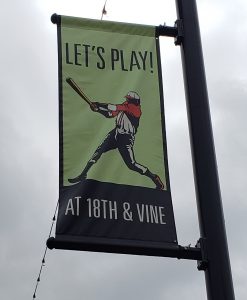

It was the late 1800’s and Moses Fleetwood Walker and Bud Fowler were among the first black players to participate in baseball, but due to racism and “Jim Crow” laws it would force them from these teams by 1900. They never gave up and they along with other black players decided to form their own teams and, “barnstorm” around the country to play anyone who would challenge them.
In 1920, Andrew “Rube” Foster—a former player, manager, and owner of the Chicago American Giants. held a meeting at the Paseo YMCA in Kansas City, Mo with other Midwestern team owners and that was the beginning of the Negro Leagues.
They chose the the Paseo YMCA in Kansas City for the press conference announcing MLB and MLBPA’s commitment to honor big names like O’Neil, Foster, Josh Gibson, Satchel Paige, Oscar Charleston, Buck Leonard, Toni Stone, Mamie “Peanut” Johnson, Connie Morgan, Jackie Robinson, Larry Doby, Ernie Banks, Willie Mays, Hank Aaron and Cool Papa Bell.

Though Kansas City holds a lot of Negro Leagues history, St. Louis has its own with James “Cool Papa Bell” Avenue.


Buck O’Neil, who is buried in Kansas City was a big part of the Negro Leagues. He was involved with the museum until his death in 2006.


Higginsville resident Ray Sutherland actually got to know Buck O’Neil. A good friend of his, Bill Schneider, who was a baseball enthusiast like Sutherland, called one day and told him about an event he wanted to go to. O’Neil was appearing at a book signing for his book “I Was Right On Time” in Kansas City.
“We both wanted to meet the legendary Buck O’Neil” said Sutherland. “Standing inside this little neighborhood bookstore in Brookside we were shocked when Buck made his entrance. He greeted everyone as he moved through the line and of course gave every lady a big hug.
“We thought we were going to meet an old man! In his 80’s and plentiful gray hair he wasn’t anywhere close to old!”
Sutherland decided to take a chance and that chance turned into the memory of a lifetime.
“When I arrived at his table to get my book signed, I thought why not and asked Buck if would come to Higginsville and talk with my students,” said the retired middle school principal. “He said he would love to and we set up a time and date. I immediately ordered Ken Burn’s Baseball documentary “Inning Five–Shadow Ball- 1930-1940.” This segment was about the history of the Negro League Baseball featuring commentary from Buck. The entire Middle School had a history lesson before his visit.”
Sutherland educated his students so they would know all that O’Neil and the other players from the Negro Leagues had gone though. O’Neil was true to his word and arrived in Higginsville on a March day in 1997. Higginsville is about 40 minutes from Kansas City.


Sutherland, shown with photo above, with O’Neil in the Higginsville Middle School gym, remembers having to move “boxes of stuff” before he could squeeze into the old car to depart for the first of several school presentations that were scheduled.
Quite a conversation took place at the final stop, which was at the Middle School.
“Before the assembly Buck and Bill P. from the local retirement home struck up a conversation,” said Sutherland. “Bill was born in 1912, on the day the Titanic sank and Buck was born in 1911. What a joy to watch and listen to living history. They would have talked for hours but Buck had a gym full of youngsters waiting to meet him.”
The day was still full of more surprises as O’Neill finished up his speech by asking everyone to join hands for a sing-along— and they did.
A room full of middle school students held hands and joined in singing “The Greatest Thing in All My Life is Loving You” , a hymn by Mark Pendergrass as O’Neil led the singing in response style.
“How did he pull that off?” retired principal Sutherland still wonders. “It was so inspirational and it brought everyone to tears.”
O’Neil stuck around and signed autographs for the kids.
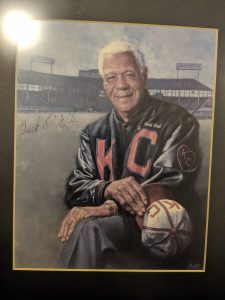

The photo shown left is Sutherland’s photo that O’Neil signed for him.
When Buck O’Neil got inducted into the Baseball Hall of Fame with 17 others he did the same thing– he had the entire audience including as he said “all you Hall of Famers” hold hands and sing that same song. Click on the video player below to hear his speech and see him lead the crowd in singing.

“Each time I watch that speech it brings me to tears,” said Sutherland.
It was in 2006, the Baseball Hall of Fame inducted 16 men and 1 woman who were instrumental in the success of negro league baseball.

The donation is also intended to spur additional contributions to the Museum via a special centennial fundraising platform. Fans can pitch-in their support by donating at nlbm.com/centennial.
This week MLB had planned a league-wide recognition of the centennial celebration. MLB players, managers, coaches and umpires would have worn a symbolic Negro Leagues 100th anniversary logo patch during all games. The logo, a derivation of the official logo created by the Negro Leagues Baseball Museum, also would have been featured on base jewels and lineup cards. Clubs would have also supported it with special activities at each ballpark.
Once baseball starts up, many MLB clubs may still continue their special 100th anniversary celebrations albeit in different ways.
The Negro Leagues Museum shut down along with everything else during the pandemic but is now open. From their website: The Negro Leagues Baseball Museum reopened to the public on Tuesday, June 16, 2020 with reduced hours and mandated limitations due to the COVID-19 emergency. Follow this link https://nlbm.com/nlbm-reopening-guidelines/ for detailed information on new procedures and how to purchase tickets.
For more information and our previous article about the MLB and MLPBA donation CLICK HERE.


Author
-

Sally Tippett Rains started her sports media career at KMOX Radio Sports (writing/producing for Bob Costas, Jack Buck, Bill Wilkerson) in the late 1970′s, early ’80′s then switched to book writing and charity work while raising their children.

She also wrote "Choose Happy; Find Contentment in Any Situation," which comes in Black & White or Color versions.

