


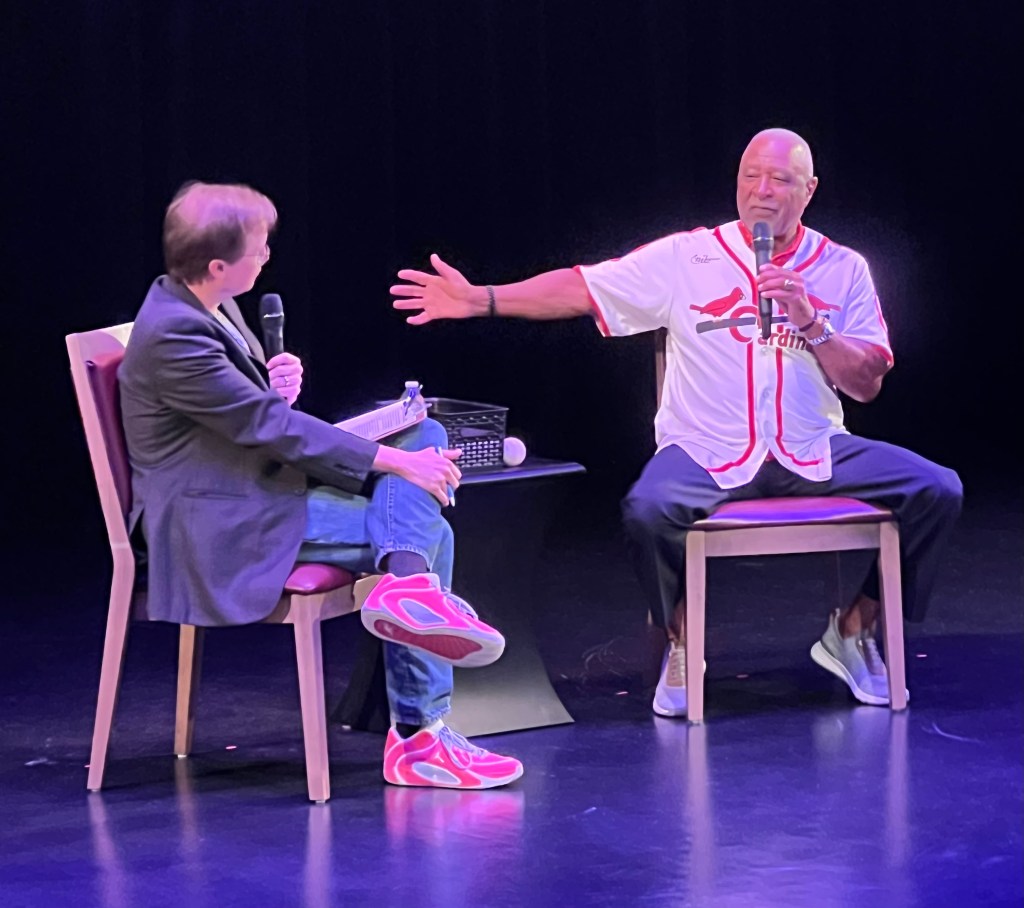
Ozzie Smith tells Missouri History Museum’s Adam Kloppe that it’s not a reach for the new crop of Cardinals to excel.
By Terry Lemons
Hall of Famer Ozzie Smith likes what he sees in the new crop of Cardinals players, saying the emerging talent holds the promise of returning the city to the excitement delivered by the great 1980s St. Louis teams.
Speaking Saturday at the opening of the Missouri History Museum’s special new baseball exhibit, Smith said he likes what he’s seen from the young Cardinals team, including Alec Burleson, J.J. Wetherholt and Masyn Winn.
“We have a good, young core of players right now,” Smith told several hundred people gathered at the opening day of “St. Louis At Bat: 100 Moments in Baseball History.”
The “Wizard of Oz” praised the steps he’s seen the Cardinals organization take, and he sees the potential for the team to return to the glory seen during his days playing shortstop on teams like the 1982 World Series champions.
“Things are turning over here now, and this organization’s trying to get back to that,” Smith explained, looking at developments through the lens of the 1982 season.
And Smith used first baseman Burleson as an example of the approach that harkens back to other great eras in the team’s history.
“One of the guys I’ve really enjoyed watching the last couple of years is Alec Burleson,” Smith said, generating loud applause from the Missouri History crowd.
He noted that Burleson led the league in RBI’s with 116 – the first time a Cardinal achieved that since Joe Torre’ delivered 137 RBI in his 1971 MVP season. Burleson is the fifth Cardinal all-time to lead the league. And his accomplishment came while hitting 26 home runs – tied for 35th in the majors.
“It’s so nice to be able see guys who don’t necessarily hit a lot of home runs but still are able to drive in runs,” Smith said. “You know, you watch guys now who hit a lot of home runs, and it’s pretty, but he doesn’t even drive in a hundred.”
As an example, Smith cited his long-time double-play partner Tommy Herr, who knocked in 110 runs in 1985 while hitting just eight home runs. “That,” Smith said, “is productivity.”
Smith was interviewed by Adam Kloppe, the Missouri History Museum public historian who spent four years working on the new baseball exhibit.
Naturally, the “St. Louis At Bat” exhibit covers the Cardinals, including the 11 World Series wins dating back 100 years ago this month to the team’s first championship in 1926. And moments of Smith’s legendary career pop up in the exhibit, including the 1982 World Series win.
But there’s a lot more to baseball in St. Louis than just the Cardinals as the exhibit’s successful opening weekend illustrated. The exhibit covers baseball history in stretching back into the 1800s, touching on the St. Louis Browns, the Negro Leagues and even women’s teams dating back 150 years ago. And other variants that St. Louis has embraced – including corkball, Wiffle ball and Beep baseball designed for the visually impaired.
Crowds wandered through the special exhibit hall during the opening weekend and enjoyed a variety of special events with appearances by Cardinals names like Kerry Robinson and Brad Thompson as well as local authors Ed Wheatley and Paige Hulsey.
For those who missed the opening weekend, there’s still plenty of time to catch the free exhibit. It will run through Labor Day 2027, and it’s anchoring a critical period for the Missouri History Museum.
The museum in Forest Park, which has drawn international praise for its 1904 World’s Fair exhibit, is changing its name next year to the St. Louis History Museum to better fit its role, said Sam Moore, the Missouri Historical Society’s managing director of public history. And with a $36 million capital campaign just $600,000 short of its goal, the museum will soon open another chapter. An ambitious new 12,000-square-foot exhibition space opening next year that looks at the city’s heritage through history.
And as the St. Louis At Bat exhibit dramatically illustrates, baseball is a key part of St. Louis history.
Terry Lemons is the author of: The Year St. Louis Became A Baseball Town
Author
-

He is the author of “The Year St. Louis Became A Baseball Town: The Cardinals, Babe Ruth & The 1926 World Series," published by Arcadia Publishing.


