

By Rob Rains
JUPITER, Fla. – T.C. Calhoun had about an hour left in his seven-hour drive from North Carolina to Morgantown, West Virginia last December when he flipped on the radio in his 2022 Honda Accord.
As the Cardinals’ area scout responsible for West Virginia, along with Virginia, North Carolina and Tennessee, Calhoun had a vested interest in that night’s draft lottery, which would determine where the organization would pick in the first round of this year’s amateur draft.
Calhoun had a meeting scheduled for the next morning with JJ Wetherholt, the reigning Big 12 Player of the Year who led the country with a .449 average as a sophomore, and a favorite to be one of the first selections in the draft.
While Calhoun listened, he learned that instead of getting one of those coveted top spots in the lottery, the Cardinals would be picking seventh.
“I was glued to the radio trying to figure out where we would be picking,” Calhoun said. “I was upset. I called one of our national crosscheckers and he and I laughed for the next hour saying that this trip would be a complete waste of time … I was not thrilled to find out we were now picking seventh and we probably had no chance of drafting JJ.”


“He and I both joked and laughed the whole time because we both agreed he probably wouldn’t be there at pick seven,” Calhoun recalled. “I left that meeting and headed to Knoxville, Tennessee to meet with the University of Tennessee players and I just thought to myself, ‘No way he gets to pick seven.’
“He checked every box, whether it was on the field or off the field.”
Wetherholt tried not to listen to much of the talk back then that projected him as the potential first overall pick, an honor that went to the Cleveland Guardians when they won the lottery.
“Those were like my first run-ins with teams and I didn’t know anything at the time,” Wetherholt said. “People were projecting me to go number one but I never really associated with that stuff for the most part.
“Honestly I had a lot of fun with all of the teams I interviewed with. Some teams were like, ‘We’re probably not going to get you,’ but it was still fun to talk and learn.”
On that morning in December when they met in an office in the West Virginia press box, what neither Wetherholt, Calhoun or anybody else knew was that an early-season injury would perhaps change the course of the first few picks in the draft.
“Almost too good to be true”
It was Feb. 19, West Virginia’s fourth game of the season, in the first inning of the second game of a doubleheader against Stetson. Wetherholt was on second, and while trying to score on a hit to right field, the throw was up the line. Attempting to avoid the catcher, he hurt his hamstring.
“I knew I was going to be out for a while,” Wetherholt said.
It turned out he missed West Virginia’s next 24 games, sidelined for six weeks, until he returned on April 5.
“I had to change my outlook of focusing on the day to day process of playing to just trying to rehab and get back into the swing of things,” Wetherholt said. “I was a team captain, and I still wanted to have fun and encourage the guys. The last thing I wanted to do was make it about me. Just because I was hurt didn’t mean I couldn’t do my role, which was to lead, so that’s what I did. I think it made me a better player.
“In an alternate universe maybe I go out and don’t get hurt, play a ton and am the first overall pick. Maybe I go out, play a ton and I’m the seventh overall pick. I have no idea. I didn’t really look into it.
“I’m a Christian and I believe in that and that God has an ultimate plan for me. As soon as that happened, I knew it was out of my control and something good would come from it.”
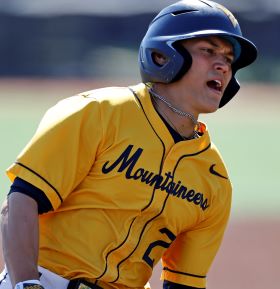

“He is just such a consistent person, his performance, his mindset, his approach, his intangible pieces are the best I’ve ever coached,” Sabins said. “The talent is there. The longer he plays and the more people see him you fall more in love with him.”
The Cardinals had scouted Wetherholt for three years, including watching him in the summer Cape Cod League. During that meeting in December, Calhoun got to know a lot more about Wetherholt than he observed watching him play.
“I got to know the amazing human being JJ was and heard all about him not being recruited out of high school,” Calhoun said. “I learned about his family, the work he had put in at West Virginia. It was almost too good to be true.”
Calhoun, who has been a scout for the Cardinals since 2016, was not at the game when Wetherholt was injured. What he did notice was how well Wetherholt played after returning for the final two months of the season, hitting .333 with eight homers, 30 RBIs and 25 runs scored in 36 games. He also struck out only 15 times in 111 at-bats while drawing 27 walks.
It didn’t change Calhoun’s opinion that Wetherholt deserved to be picked at the top of the draft. Even as the start of the draft in July was only minutes away, Calhoun still thought there was a good possibility that Wetherholt would be the number one overall selection.
When Cleveland took Travis Bazzana instead, there was a buzz in the Cardinals’ draft war room. The next critical pick was Oakland, selecting fourth. If the A’s passed on Wetherholt, there was a path developing that he could fall to seventh.
When Oakland drafted Nick Kurtz from Wake Forest, the chances increased that Wetherholt – against all of the odds months earlier – could still be on the board when it was the Cardinals turn to draft.
As he watched the draft, Scott II – who was a junior when Wetherholt was a freshman – also saw what was happening.
“I kept seeing people getting picked before him,” Scott II said. “Once the sixth pick was in and we were next, I was like, ‘Man he might be a Cardinal.’ Sure enough they called his name.”
Said Calhoun, “Luckily for us the stars aligned. We got our man. I’m looking forward to watching his career in a Cardinals’ uniform.”
For Wetherholt, what being selected by the Cardinals really meant was that he would be getting a chance to fulfill his childhood dreams.
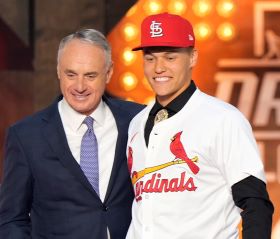

“I played a ton of sports growing up but baseball was just the one that honestly I liked practicing the most. That was a big thing for me. Football was my other big sport and I loved the games but I hated practice. I had no desire to try to get better. I just wanted to play the games.
“Baseball was kind of the complete opposite. I just fell in love with the process of trying to get better every day. Working with my dad in the cage or on the field … My dad would always yell at me if I struck out so I never wanted to strike out. Even here, we probably end up spending more time practicing than we do playing. I really got to love that part of it and I do and will forever.”
That was one of Wetherholt’s traits that both his first high school coach, Andy Bednar, and Sabins saw that attracted them to him at a very young age.
“I knew he was going to be a special player”
Bednar was the coach at Mars High School in western Pennsylvania when Wetherholt was a freshman and sophomore. He is also the father of David Bednar of the Pirates and Will Bednar, the MVP of the 2021 College World Series for Mississippi State, who now pitches in Double A for the Giants.
Just a few games into Wetherholt’s freshman season, he became the team’s starting shortstop – on a roster that would send several older players on to Division I baseball.
“We couldn’t keep him out of the there,” Bednar said. “Here we had this freshman, who was 14 or 15, playing with a lot of older guys and what stuck out to me was the kid didn’t miss a beat. We do a lot of pickoffs and a lot of stuff comes from our shortstop and he handled it like a champ. He didn’t miss a beat.
“I knew he was going to be a special player. Kind of the way he carried himself, his work ethic, the way he went about his business. He was different.
“He was a total gamer. You want your shortstop to be the guy who wants the ball to come to him, to be the guy who wants to be up in the big situations. He had all of those attributes even as a young kid.”
Wetherholt’s first exposure to West Virginia came through a summer camp. He made enough of an impression on Sabins at the age of 15 or 16 that the coach, an assistant at the time, made a special trip to go watch him in a summer game.
“We recruited him when he was really young,” Sabins said. “He was playing second base for Beaver Valley Red 15u and I think he was 5-foot-6 and weighed 145 pounds. At that time I second-guessed myself. I loved the instincts; I loved the hit skill – it stood out. He could drive the ball to the opposite field gap as a young guy.
“He had more juice than you would imagine for his size but college coaches and pro guys in general don’t recruit second basemen at a young level. Everybody’s a shortstop and physical monsters. He was just one of those rare cases of a highly skilled second baseman who if you watched enough baseball, you realized he was playing a little different game than most of his peers.”
Sabins’ mind was made up about Wetherholt when he made the trip to see him in a tournament about 30 minutes away from campus.
“The selling point was there was a righthanded hitter who hit a righthanded slider over the first baseman’s head, kind of a Texas Leaguer, off the end of the bat,” Sabins said. “I was honed in on JJ because we were trying to make a decision on him. I remember him sliding across the right field line on his belly full extension and I was like, ‘Wow, that guy covered a lot of ground in order to make that play’ and in high school baseball, the instincts and the anticipation needed to get that read was really different. It was one of those, ‘I don’t think that guy is supposed to be there, how did he get there?’ types of things.”
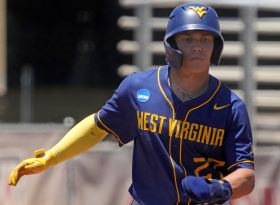

That stance did not surprise either Sabins or Bednar, who also is a math teacher at Mars High and had Wetherholt in his advanced algebra class as a sophomore.
“His heart was set on West Virginia,” Bednar said. “You see a lot of kids always looking for that one place better and he wanted to go to WVU in the worst way.”
When Covid hit in 2020, West Virginia could not bring incoming freshman onto campus early as they usually did so Sabins found a spot for Wetherholt to play in a college summer league.
“It was pretty unusual but during Covid it really was the only option because some of the leagues were still operational,” Sabins said. “JJ went to a team in Ohio and ended up hitting .400 as a high school kid. That’s when I was really shocked because we had a few players who were on our college roster that had gone to the same league and didn’t have success … For him to perform at such a high level, we believed we were into something there.
“He wasn’t the prototypical superstar, high-faluting guy out of high school. He really developed into a star. … He just wants it. He’s driven, he’s growth-oriented. He wants to learn. He’s one of the boys. He is really a very special kid.”
Scott II gave Wetherholt the nickname “Jumping JJ” during their one season as teammates because of Wetherholt’s performance in a team drill that measured explosiveness.
“He grinded and he worked his butt off and performed,” Scott II said. “He kind of fits the Cardinal mentality. He’s a great kid. He is going to put forth the work and the effort. He just has a knack for barreling a baseball.”
Sabins said he ranks Scott II as the best athlete to come through his program, while Wetherholt is at the top of the list when it comes to bat-to-ball skills.
“He’s got the most elite hit skill I have ever coached,” Sabins said. “He is the whole package. He’s a faith-based kid that stands for what he believes in and he brings others along.
“JJ invited me to go to the draft with him and walking back after he was drafted he called Victor on Facetime. It was cool to see two guys I got to recruit and coach who were celebrating at the highest level.”
“Life is kind of a blur right now”
Wetherholt made his professional debut on July 30 for the Class A Palm Beach Cardinals. He finished the regular season on Sunday with a .295 average for his first 29 games. In six games in September, Wetherholt was 14-of-28 with nine RBIs and had three three-hit games.
“Life is kind of a blur right now,” Wetherholt said. “The first month they kind of just told me to go play and learn and really haven’t given me too much feedback or filled my brain with, ‘You need to do this.’ I’m just taking it a step at a time, how to nail down the process better.
“I came in open minded. I didn’t really have expectations other than to go to work every day and try to get better. It’s been fun, it’s been challenging, which is good.”
What Wetherholt has found in his first weeks or playing pro ball is that the pitchers might have more consistent velocity than in college; that there are hitters who are very skilled and that no matter where a player was drafted or the size of his signing bonus, talent can come from anywhere.
“I’m really taking it day by day and focusing on the process,” Wetherholt said. “Here, it’s a whole new ballgame. Nobody cares what you did in college; it’s just what do you know?
“You can put some pressure on yourself so I’m just trying to find a way to find joy and peace in the process. I’m enjoying the work and when you go out on the field it’s time to compete, then wake up and do it all over again.”
And he’s loving every minute of it, just like he thought he would.
“There’s people who signed for no money who can get up on the mound and strike me out,” Wetherholt said. “That’s the game of baseball.
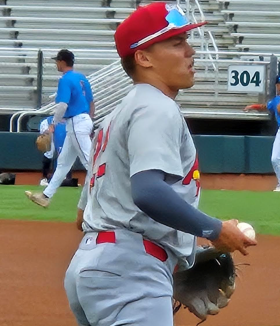

“Just doing everything well and understanding the game and believing in myself. My brain processes everything and is probably my biggest strength, processing information and just competing in the moment.”
Wetherholt turned 22 on Tuesday and will be exactly where he wants to spend the day – playing game one of the postseason as Palm Beach takes on Daytona Beach in the Florida State League playoffs.
What he won’t be doing is thinking about what happened, or didn’t happen, in the first round of the draft.
“I think he’s very humble and grateful for what has come his way,” Sabins said. “He has less of a chip on his shoulder than maybe some other athletes. He thinks what he has is a blessing and he’s going to make the most of his opportunity.
“I do think there were some opportunities and definitely a world that exists where he could have been the first overall pick. I don’t think that was far-fetched at all.”
It isn’t something Wetherholt is concerned about.
“I don’t go through life and work as hard as I do to say, ‘This guy doubted me,’” he said. “That stuff can motivate you. Six teams passed on me. But at the end of the day I would be stupid to try to prove a point to everybody that, ‘Oh that guy was the best player.’
“I’m doing this for my family and for me. I’m doing this for the people who believe in me. I always focus on the people who believe in me more than people who don’t believe in me.
“I’ve been the under-recruited guy and then the all-hyped up guy who is talked about 24-7. It’s cool to fly under the radar. It’s cool people passed on me because it gives me the chance to work my butt off and prove to myself that I’m a good player. I’m always going to focus on the people who have been good to me.”
Follow Rob Rains on Twitter @RobRains
Photos courtesy of Palm Beach Cardinals and by AP courtesy of KSDK Sports