

By Rob Rains
PEORIA, Ill. – It was early in Tai Peete’s career when he realized that a lot of what he needed to learn had nothing to do with baseball.
Drafted at 17 out of a suburban Atlanta high school, Peete made his pro debut with the Mariners’ rookie league team in Arizona six days before his 18th birthday, the first time in his life he was away from home, living on his own.
“There were some things I never even thought about,” Peete said. “I would come home and think, ‘Man, I’m so hungry’ – and realize I had to make my own food. There were some things that I had to learn.”
Peete has spent the last three years learning more about life, and himself, than he has learned about baseball. He believes it has been time well spent.
“I’ve learned how to approach certain situations or learned certain things that do affect you on the field,” he said. “It’s taken three years.”


“My first year was just kind of getting used to it and getting a routine down, something I can do every day,” Peete said. “My second year was about getting my approach. I can’t just go out there and think ‘hit the ball.’ It’s not going to work. So go out there and have a mental approach to the game.
“Now I’m going into my third year and I want to be able to put all three things together. The hardest question for any baseball player is what kind of a player are you? What kind of hitter are you? What kind of person do you want to be, to come to the field as? I think that’s something that every day I’m still trying to figure out.
“I know what kind of a hitter I am and what kind of player I am, but some things can change. I’m almost excited to see what kind of player I can turn out to be.”
So are the Cardinals.
“What if it’s me?”
Peete was at home on Feb. 2, two days before he was scheduled to leave for spring training in Arizona, when the first reports came out that the Mariners were acquiring Brendan Donovan from the Cardinals.
“The first thing I heard was that there were three players in the trade,” Peete said. “I had no idea, and then I saw that Jurrangelo Cijntje was part of it. I was talking to a teammate and we were going through, ‘What if it’s this guy,’ or ‘what if it’s that guy?’ I was like, ‘What if it’s me?’ And he was like, ‘Nah.’
“It turned out to be me.”
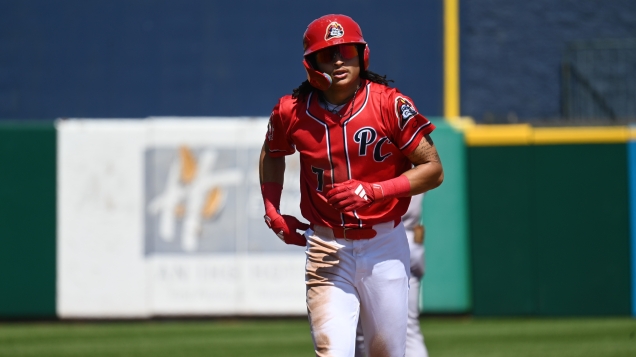
Even though the trade caught him off guard, Peete was happy to make the move to the Cardinals. He has spent the first part of this season with the high Class A Peoria Chiefs, where he is one of the youngest players in the Midwest League.
“I think a big thing about me is I love change,” Peete said. “When I was able to come over here, it’s a reset, the beginning of a new year. I have a lot of goals and aspirations, so to come to a new organization, it was a perfect time to refresh.”
The move has only reinforced Peete’s love of the game, and his desire to succeed, something a former first-round selection of the Cardinals, James Ramsey, saw in Peete from an early age.
Now the head coach at Georgia Tech, Ramsey watched Peete grow up and have success in high school when he was recruiting him. Instead of bringing him to Georgia Tech, however, Ramsey sent Peete off to pro ball with his good wishes, knowing it was the right move for Peete.
“I knew he was a special talent,” Ramsey said. “One thing that always sticks out to me with these kids in determining how successful they are going to be is, ‘Are they good at it because they love it, or do they love it because they are good at it?’ He was always working. He would leave the field and go to the cage. Then he would leave the cage and go play in the backyard with his little brother.
“I think he had that child-like love for the game. It’s not about talking guys in or out of signing. If I’ve got a feeling they are ready to handle it, it’s almost like my blessing.”
Peete considered his answer to Ramsey’s question. It’s the same answer now as he likely would have given three years ago if asked.


The work ethic was apparent early in spring training to both Ryan Ludwick, the Cardinals’ minor-league outfield coordinator, and Peoria manager Roberto Espinoza.
“The first day I saw him my eyes perked up for sure,” Ludwick said. “The kid is an incredible athlete, the way he goes about his business. I look at how a player works, and the effort and attention they put into their everyday work. He is fun to work with.
“He needs people in his corner to push him in the right direction because he is uber-talented. He’s so respectful. The way he goes about his business is so refreshing. I feel like we kind of got a steal.”
Espinoza brought up a word to describe Peete that was more in vogue years ago.
“There was an old term we used to use, ‘gamer,’” Espinoza said. “He competes very hard all the time. He is a great worker. I like the way he takes pride in his defense.
“In our meetings before games he always makes the right comments and pays attention, sharing his thoughts. He is very on point. He has been impressive.”
One of the traits that those around Peete mention as one of his best attributes is a high baseball IQ. Peete knows where that came from.
“A lot of it came from going to games or watching games with my dad on television,” Peete said. “I don’t think my dad and I have ever watched a baseball game without critiquing it. We can’t just watch a game. It was always, ‘Why did he do this?’ or, ‘I wonder what he was thinking?’ We never just watched the game.
“Playing MLB The Show, I always liked anyone who was breaking down the games. I like to see how other people think.”
Eric Peete has enjoyed that aspect of his son’s growth and development over the years.
“As a parent I love to see him thinking,” Eric Peete said. “We watch games or highlights and he notices the little details. He always had advance thinking, about the next play, or what he would have done in a situation. I think we’ve done that since he was like 12 years old. I’m really big on tendencies, that’s really where our conversations started, understanding why players do certain things at certain times.”
Tommy Gregg, a former major-league outfielder who also worked as a hitting coach in the minors for the Cardinals for several years, noticed that side of Peete’s game almost from the day he took over as his high school coach at Trinity Christian Academy when Peete was a sophomore.
“He has a baseball IQ that you can’t teach,” said Gregg. “I’ve seen a lot of good players and with Tai the looks just jumped out. He’s got size, agility, with how athletic he was. He’s got all the tools.”
Peete played the infield and pitched for Gregg, and started his career in the infield with the Mariners before they moved him to the outfield. It was another change that Peete welcomed, even if he knew it meant he was going to have to work even harder – which is exactly what he wants to do.
“I honestly think defense is more fun (than hitting) but don’t tell my hitting coach that,” Peete said. “I’m in control out there. At the plate you are not in control. Every time a ball is hit in the air, I think I can get it. Whenever a ball does drop, it hurts. I have to go back and see why I dropped it. How do I adjust?”
It was early on in his pro career that Peete realized he was motivated by failure – something that didn’t happen very often against high school competition.
“I learn more by my mistakes,” Peete said. “A big thing is being OK with failure. I needed to learn that. Honestly that’s life in general.
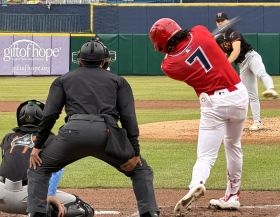

After hitting .217 but showing power with 19 homers last year for the Mariners’ high Class A team, Peete has gotten off to a good start to this season. In his first 27 games, he has 19 extra-base hits (11 doubles, three triples and five homers) while hitting .277. Hitting out of the leadoff spot, he has driven in 23 runs.
Peete knows it’s all part of the plan he has been following for years.
“I knew from a young age this is what I was going to do,” he said. “It was never a ‘want to’ or ‘I wish to be.’ It was always, ‘I’m going to be,’ and, ‘when I’m going be a baseball player’… I knew what my goals were.”
“I don’t focus on the good”
A perfect example of Peete’s mindset happened on April 16, in Peoria’s game at Wisconsin. Peete hit for the cycle in the Chiefs’ 24-7 win, but when he sat down after the game to enter his comments about the game in his “hitting book” Peete did not focus on the home run, triple, double or single.
Most of his comments about that game were devoted to his first two at-bats, when he took a called third strike and popped out to second.
“I just like to break down the at-bats,” Peete said. “It’s not like, ‘Why did you get outs? It’s what did you see in this area that put you in that position?’ For example, on the popout, I fouled off a fastball in the zone. ‘What made you miss that?’
“I don’t focus on the good. I take something from the good. For me, it’s good to look at the I-pads and see good or bad swings. I like to see if I’m working the middle of the field, and if I’m pulling my hips in. Those are the kinds of little things that I look at. It could be the best swing of the year or it could be the worst swing. I write it down.”


“It’s always good to have goals, but living in the moment is more important,” Peete said. “I have no idea what’s going to happen in a year and a half. I have no idea where I am going to be in a year and a half. Two years ago I thought I was going to be a big leaguer with the Mariners. You don’t know what’s going to happen.
“What is in your control is what happens right then and there. If I want to hit .300 at the end of the year, and I’m at .210, it looks like so far to go. An example is we were just in Great Lakes, and their scoreboard updates your statistics, but it’s behind me so I can’t really see it. I thought I was hitting .250 but I got a couple of hits and I looked up and saw my average was .290. I got there because I was doing what I thought I needed to do, not looking at the bigger stage.”
It’s that daily challenge that motivates Peete, which he knows is part of the process of growing up.
“I’m still a 20-year-old kid, but what I take pride in is that I want to come here and I want to compete,” he said. “At the end of the day it’s still a game to me, regardless of the business aspect. I truly enjoy it.
“The reward is out there (pointing to the field). The hard part is from 10 p.m. until 1 p.m. the next day, when you can get back out there. I don’t go home and stress about my swing or my approach or what I need to do the next day. I use that time to try to get myself together.
“I hate days off. I think days off are the worst thing ever. I’m excited to go play every day. When I have a bad day, I’m excited to get back out there.”
When there is a day off, Peete believes he is losing a chance to get better.
“I want to be a lot better today than I was yesterday,” he said. “I think that’s a good way of looking at it, building off one percent every day. If I come out of today thinking I didn’t get better than I was yesterday, than I’m losing time.”
That attitude does not surprise Peete’s father.
“One of the things I’ve always appreciated about Tai and something that a lot of people don’t realize is how high of a motor his has,” Eric Peete said. “He can go all day. He is extremely competitive.”


He has continued to pay attention to it since Peete started playing professionally too. They took up golf together – as long as Tai hit righthanded – and then switched to bowling as a way to stay busy but not overdose on baseball.
“As a dad when I watch him, I see the baseball highs and lows,” Eric Peete said. “There are slumps he has to fight through. But when he is at his best is when people start saying he can’t. That’s when he gets locked into a whole another level. I know it’s going to be an exciting ride.
“I’ve worked with him on a daily basis for a long time now, and have seen some of the things he’s capable of. This is just a glimpse of it.”
One thing that Eric Peete was happy about in his son’s career was the trade to the Cardinals, which moved his son out of the Pacific time zone.
“We talk or text every day,” he said. “One of the great things about St. Louis is that now those conversations aren’t at 2 in the morning after his game.”
Some of those conversations are about what happened in that night’s game, but other times it’s just about what is going on in Peete’s life, where he is still four months shy of his 21st birthday.
“I have high expectations and I know what I can do as a player and what I can be as a person,” Peete said. “Being able to keep myself to a high standard can help at times and it can also hurt sometimes. I’m growing up and getting older. Being in pro ball so early, I still consider it growing up because that’s what I’ve been doing.”
Follow Rob Rains on X @RobRains
Photos courtesy of the Peoria Chiefs and Sally Tippett Rains