
By Sally Tippett Rains
(Editor’s note: Driving back to St. Louis from Jupiter, Florida we took a different route so we could experience the Civil Rights history of Alabama. We wrote previously about Memphis, Tennessee when in that town for a Memphis Redbirds game, and for that article CLICK HERE. )
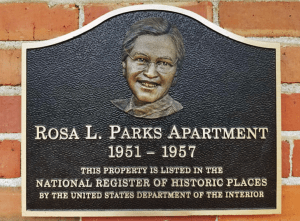 Somewhere in our memory is the story of Rosa Parks who refused to go by the rules and took a seat in the wrong area of a bus. It wasn’t that much trouble to take a new route back from Florida to go to Montgomery, Alabama to see where she lived and experience the history of the Civil Rights movement in that area. The Montgomery Housing Authority (MHA) owns and manages the historic home where she lived during the Montgomery Bus Boycott– in a public housing community known as Cleveland Court (currently called Parks Place).
Montgomery is about nine hours north of Jupiter, Florida and eight hours from St. Louis. It’s a trip worth making—not for the fancy hotels or great tourist attractions. It’s a trip worth making to learn about civil right history.
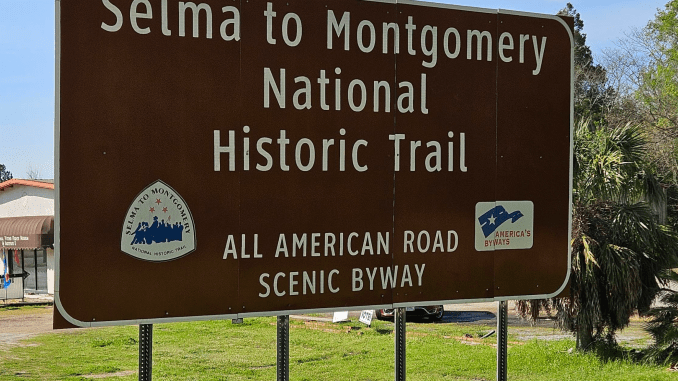
Established by Congress in 1996, the road between Montgomery Alabama and Selma, Alabama is called the “Selma to Montgomery National Historic Trail” and commemorates the people, events, and route of the 1965 Voting Rights March in Alabama, led by The Rev. Dr. Martin Luther King, Jr. Many people, both black and white were fighting for the right for blacks to vote.
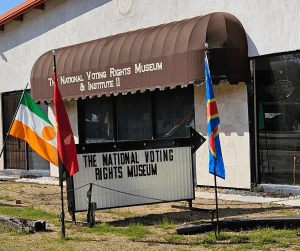 Today, travelers can connect with this history and trace the events of these marches along the 54-mile trail. There is even a Voting Rights Museum a few yards from the historic bridge the marchers crossed.
Many of a certain age lived through it, so these monuments and historical markers were not there in the 1960’s. We may remember many of the civil rights happenings from watching them on the news or hearing parents talking about them, but going there gives a new perspective.
While younger generations are learning about people like the Rev. Dr. Martin Luther King and Rosa Parks as historical figures who helped change the country, many remember when it was happening. Their parents remember hearing of the brave woman Rosa Parks and how her one single act put several things in motion along the civil right timeline.
While the 1950’s and 1960’s will always be remembered for some great Cardinals baseball and music, it was also a terrible and unrestful decade full of civil unrest.
There were three Cardinals World Series—1964, 1967, and 1968 and the Beatles made their first live debut in the United States on February 7, 1964, on the Ed Sullivan Show. There were many civil rights activists gunned down in the 1960’s.
Even though there were black players like Bob Gibson and Lou Brock involved in those great World Series teams of the 1960’s players who came to St. Louis were not allowed to stay at certain hotels like the Chase and they were not allowed in certain areas, often having separate restrooms and worse seating on public transportation. (See article previously published about families who housed the black baseball players who could not stay in hotels CLICK HERE.)
March is Women’s History Month and one of the women who made a big impact in the world as far as civil rights, was Rosa Parks.
Everyone has heard of Rosa Parks but when you go to Montgomery, Alabama and stand on the street corner where this brave lady boarded the bus for her history-making ride, it is then one realizes the impact of this one small gesture. Besides famously sitting in the “white” section of the bus, she also participated in the Selma-to-Montgomery March which crossed the Edmund Pettus Bridge 10 years later.
The Alabama Travel website says, “the Edmund Pettus Bridge, spanning the Alabama River in in Selma has become one of the most iconic symbols of the modern struggle for civil and voting rights in America. It is also a focal point for the 54-mile route now memorialized as the Selma to Montgomery National Historic Trail.”
 After one crosses the bridge into Selma, it is as if it is still the 1960’s. The bridge has not been updated or repaired, maybe the rust has been left to remind us of the significance of that bridge 57 years ago.
In a way it can remind the visitor of Plains, Georgia, a town with much history, yet the townspeople have not modernized it or corrupted it for tourism—except in both cases a small souvenir shop.
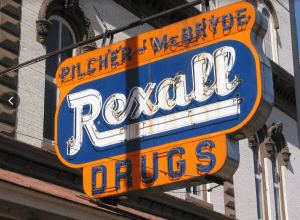
There is still a Rexall Drug Store sign in Selma which really lends itself to the nostalgia of yesteryear, as the Rexall Drug Stores in the U.S. have been close since 1980, though the chain is reportedly still goin in Canada.
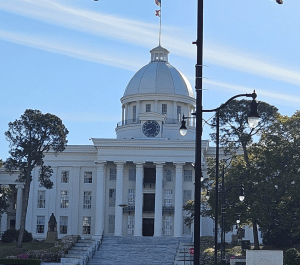 The Rosa Parks bus stop in Montgomery, Alabama is 52 miles from the bridge. Taking the trip by car reminds us of how long that must have felt for those who marched. Selma is not a suburb, it is a completely different town. Montgomery is the state capitol of Alabama. The capitol played a big role in the March as it ended there.
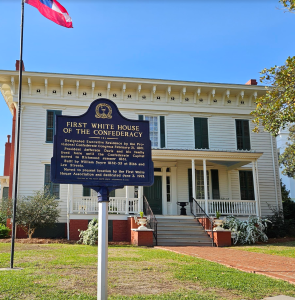 Montgomery, Alabama holds much civil rights history and there is even Civil War history. The “First White House of the Confederacy” is located there.
In the spring of 1861, the newly formed Confederate government rented the home shown right, as an executive residence for Confederate President Jefferson Davis and his young family.
The Women’s History Museum in Seneca Falls, New York tells the story of Rosa Parks this way: “On December 1, 1955, Rosa Parks boarded a bus in Montgomery, Alabama. Instead of going to the back of the bus, which was designated for African Americans, she sat in the front. When the bus started to fill up with white passengers, the bus driver asked Parks to move. She refused. Her resistance set in motion one of the largest social movements in history, the Montgomery Bus Boycott.”
Rosa Parks was born Rosa Louise McCauley in 1913 in Tuskegee, Alabama. Growing up in Tuskegee she would not have imagined that town making history and she being at the center of a controversy at that time and that both would benefit civil rights for the black race.
 Growing up in that area she saw much racial discrimination and the man she married when she was 19– Raymond Parks the town barber– had working to end civil injustice as a common bond. She was elected secretary of the Montgomery chapter of the National Association for the Advancement of Colored People (NAACP).
That historic bus ride was not a random thing that happened because she wanted a better seat, she worked hard and calculated when was the best time to do it, knowing the possible consequences. Some tell the story that she was a seamstress in a store and after a long day at work she was too tired to walk further to the back of the bus where blacks were told to sit.
On further examination of history it is found that she was one who helped organize the Bus Boycott. She later spoke of the event.
“People always say that I didn’t give up my seat because I was tired, but that isn’t true. I was not tired physically, or no more tired than I usually was at the end of a working day. I was not old, although some people have an image of me as being old then. I was forty-two. No, the only tired I was, was tired of giving in.”
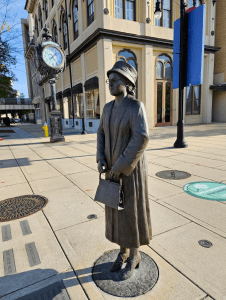 That courageous act got her jailed for refusing to give up her seat and she lost her job but that along and the subsequent Montgomery Bus Boycott led to the integration of public transportation in Montgomery.
The monument for Parks is a life-size statue. Seeing her little body with her coat on and purse in her hand standing on the corner as if waiting for the bus to come, is very moving and more inspiring than a grand monument in front of a museum could ever be.
According to Biography.com after the bus boycott, Parks attended the March on Washington in 1963 and in 1965 witnessed the signing of the Voting Rights Act.
She lived until 2005 and what changes she experienced in her lifetime. Most of her life was devoted to continuing the cause even when she and her husband moved to Detroit and later to Virginia. She was awarded the Presidential Medal of Freedom and the Congressional Gold Medal.
The Three Marches
The 1960’s were an uneasy time for blacks and whites trying to achieve civil rights.
In 1963 Rev. Dr. Martin Luther King, Jr. was arrested in Birmingham and that same year Medgar Evers a civil rights leader and the NAACP field secretary in Mississippi was shot. Civil rights demonstrations, protests, and boycotts occurred all over the country culminating in the “March on Washington” where King gave his “I Have a Dream” speech.
Other violence happened including four young girls being killed while attending Sunday School when a white supremist group bombed their church in Birmingham.
President John F. Kennedy who had supported civil rights was assassinated in 1963 and battles ensued with wins along the way including the 24th Amendment to the Constitution of the United States which abolished the poll tax, which had been instituted in southern states after Reconstruction to make it difficult for poor black people to vote and President Lyndon B. Johnson signed the Civil Rights Act of 1964, making segregation in public facilities and discrimination in employment illegal.
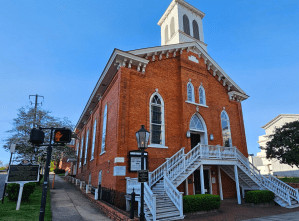 This set the backdrop for the other incidents that took place in the Montgomery-Selma area.
King preached at the Dexter Avenue Baptist Church with is now called the Dexter Avenue King Baptist Church and is shown in the photo, left. Planning meetings were often held in the church basement.
In 1965 one of those meetings resulted in King starting a voter registration drive and Malcom X was killed. That was also the year of the Watts riots and there was violence erupting all over.
The Selma-to-Montgomery March was for voting rights. It set off a chain of events which included three “marches.”
On March 7, 1965—which has come to be known as “Bloody Sunday”—about 600 civil rights marchers headed east out of Selma on U.S. Route 80. They made it six blocks to the Edmund Pettus Bridge.
 State and local lawmen, who wanted them off the bridge, gave them a “two minute warning” and in about one minute and a few seconds they advanced and began attacking them with billy clubs and tear gas. That violence on the part of the police drove them back into Selma and stopped the march.
Two days later on Martin Luther King, Jr., led a “symbolic” march to the bridge.
Then civil rights leaders sought court protection for a third, full-scale march from Selma to the state capitol in Montgomery. The road between Selma and Montgomery is much the same today as it was then. The Edmund Pettis Bridge in Selma is still a working bridge and major thoroughfare.
There is a sidewalk on either side of the bridge and people who make the pilgrimage often walk the bridge to literally walk in the footsteps of those who were involved in any of those three marches.
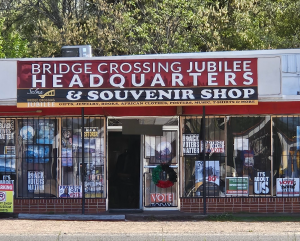 Just before the entrance to the bridge is the Bridge Crossing Jubilee Headquarters Souvenir Shop. There did not seem to be any other commercialization. The first week in March they held an event they called the Jubilee, commemorating the 59th Anniversary of Bloody Sunday and the Voting Rights Act. The mission of the Jubilee is to “commemorate the struggle and celebrate the victory.”
There is a park commemorating the march on one side of the street and a museum on the other side. There is a long mural depicting historic scenes in the parking lot.That is also where the Voting Museum is.
There were two tour busses in the parking lot of the Museum. We met some of a group of students who had traveled 10 hours by bus from a Dallas community college to learn about the history of the Civil Rights Movement along the Selma to Montgomery trail.
“It was very interesting,” said one of the students. “But also very sad and very heavy.”
A lot of efforts have been made over the years, some resulting in violence, injury and death, but as a result, this group of students, consisting of whites, blacks and Asians are all traveling together on the same bus… sitting anywhere they want– and all able to cast their vote in November.
It was worth the trip to see and remember all that has been done in order to accomplish that
For the complete biography of Rosa Parks from the Women’s History Museum, CLICK HERE. https://www.womenshistory.org/education-resources/biographies/rosa-parks

Drury Hotel Montgomery, Alabama
Address: 1124 Eastern Blvd, Montgomery, AL 36117
Use the promo code: SPORTS for your special STLSportsPage.com discount

