
By Sally Tippett Rains
The Cardinals were in Birmingham, Ala., Thursday night to play the Giants at historic Rickwood Field in a game honoring the stars of the Negro Leagues. Andre Pallante got the win for the Cardinals as St. Louis beat San Francisco 6-5. For the game story CLICK HERE.
It was a night to remember both for the fans at the game and also those who watched it on TV. Willie Mays had been set to attend until he recently cancelled and then the week of the game he passed away. Mays’ son Michael Mays said that his dad had said he would try everything to be able to make it to the game– and then he looked up to the skies feeling the presence of his famous father in the ballpark. There were many memories both of the Negro Leagues and of Willie Mays in specific as he had started his career at Rickwood Field.
He played for the Birmingham Black Barons, and then spent the rest of his career in the National League (NL), playing for the New York / San Francisco Giants and then the New York Mets.
 A St. Louis native has personal memories of Willie Mays. Virgal Tyrone Woolfolk of Innsbrook was raised in Wright City. His aunt and uncle ran a boarding house in St. Louis that housed the black players and also entertainers who came to St. Louis who were not allowed to stay at the Chase Park Plaza Hotel due to segregation.
His aunt and uncle, and cousins offered their home for a bed, a meal and even some dancing and drinking. Woolfolk’s family lived in the country and would bring fresh vegetables out to the house for the guests and his parents worked there in the evenings or weekends.
While the parents were in the house working– preparing the meals, cleaning up, changing sheets in the bedrooms etc., the kids were just playing in the yard and he remembers how friendly Willie Mays was to him.
“I played catch and stick ball with Mr Mays in the front yard.”
Here are memories from Virgal Tyrone Woolfolk of Willie Mays:
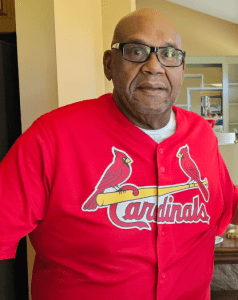 Memories of meeting and playing “Stickball” in the streets of St Louis with the immortal Mr. Willie Mays, the “Say Hey Kid” of baseball
“It was around 1963 or 1964 and Momma and Daddy had worked all week at the ammunition plant at Weldon Springs driving daily early in the morning from Wright City. It’s now a Friday afternoon, and after working hard all day, they assemble all us children to prepare to go into the St Louis the next day to bring choice food from our garden, and meat from the smokehouse in the shed behind our small house on J Road. At the time, “State Highway J” was a dirty gravel road, with the residents near us having no running water and using outdoor toilets. Daddy has spoken to his sister, my aunt Roberta ensuring essential items he procured and brought, while still bringing a wife and five children in the old Buick.
I really don’t know when I understood, knew or appreciated who Willie Mays was. I guess like most kids, when an older kid liked something, did something, and thought it “was cool”, then it registered in your mind it or he have/had value, and worthiness in your sphere of thinking. And so it was when we arrived the next morning on that hot day either in June or July to bring all the goods to my Aunt Roberta and uncle Lonnie’s house. We pulled up, and it was hard to find a place to park because all these kids are outside with their baseball gloves and bats and chatting “ Come play ball with us Willie.” There had to be at least 100 kids outside, but to me it looked like the whole world was there.
Daddy was finally able to maneuver the car to park and we started taking things up the steps to Aunt Roberta’s house. And still in the background all these kids were chatting “ Come out and play ball with us Wille.” It was about 10 am in the morning and just starting to get warm and a little muggy as happens here in St Louis in the summer.
After we had all the goods in the house, Aunt Roberto told me to go upstairs and tell Mr. Mays dinner “not lunch” would be ready at 11:30. Back in the day I was growing up, we had breakfast, dinner and supper. So out the front door, and then I went through the other entrance in the front of the house, and up the stairs and then turn to your left and knocked on the door. He was shaving. I repeated word for word what I was told, and he said, “Okay”, and smiled. He also said, ‘tell them kids I will be down at 10:30, but I am only going to play for 45 minutes and then I need to eat and get ready for the game.” And off I go. After was downstair at the entranceway, I yelled at the kids, what he said, and was met with great applause–for I had spoken for the King.
Wearing a nice knitted shirt and slack with those buckles on his shoes that were stylish back in the day, and after shaking hands with all the kids and the “no autographs” rule was established, he went about the talk of determining where first, second, third base and home plate would be. Then this kid produced a tennis ball, another had just an old rubber ball, and although there were bats, Willie Mays used a broom handle and hit the first pitch that would be a home run.
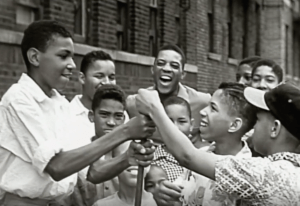 Evidently Mr. Mays liked to play stickball with kids. (The photos here are of Mays playing stick ball with some kids in New York)
In my nearly 70 years old “little kids eyes,” I can still see that dirty brown rubber ball sailing down the street and am still in awe and wonder.
As my dad told me, stickball was a game developed by poor black children that didn’t have the funds for a real baseball balls, bats and gloves, and/or where it was too far away to play at a ball field, or where they were not allowed in certain neighborhoods and wanted to play baseball.
Although it was a black urban game played in big cities like New York, after the war many soldiers brought the game back to the Midwest and the South. So on that warm sticky day, first base was a fire hydrant, second base was a manhole, third base was our Buick and homeplate was at the end of the block. Now, if you could hit a little rubber ball with a broomstick at night with the streetlights on or when the sun was out and it was bright, you were some kind of player.
 Mr. Mays played with the kids in the street for the allotted time he said he would. Then he went indoors and ate and then got ready for the game. Other black players who could not stay at the hotels– usually the Chase– with their white counterparts were there and eating also.
Willie Mays, Roy Campanella before his accident, Ernie Banks, Hank Thompson, Satchel Paige and others all stayed at my Aunt and Uncle house. My aunt and other ladies like my mom would clean up afterwards and Aunt Roberta would pay everyone who helped.
Now when we were kids there were Twelve Commandments. The “Ten Commandments Moses brought down from mountains, and the two extra “Commandments for black children” especially those growing up in my era – “Be seen and not heard” and “Stay out of grown folks’ business.”
So, when we were in the rooms with adults, we were to be invisible, and you only listen and observed. Now remember, this was the time of the beginning era of civil rights nationwide. The older black men were in the room talking to Willie Mays about civil rights and what was going on across the country. Mr. Mays had seen it all and lived it all having played in the “Negro Leagues” and starting at Rickwood Field in Birmingham, Alabama, having also played baseball while in the Service and then being one of the first primetime players in the major leagues, beginning in 1951.
This was about four years after Jackie Robertson broke the” colored line” in baseball playing for the Brooklyn Dodgers. It was said a white sportswriter by the name of Barney Kremenko coined the phase for the Dodgers after other phases like the “Magnificent Mays” failed. And because of his youth and exuberant style of ball playing and his habit of greeting people with the phase “Say Hey” he was known has the “Say Hey Kid”. And it was the “Kid” part that did not set well with many of the black men in the room. Many who had been Veterans in WW2 and Korea and felt the label was racist and a racial epithet like being called “Boy”.
Years later I was in the Navy and stationed in San Francisco heading out for Yokosuka, Japan. A group of us Sailors went to the old ball park in San Francisco and there was Willie Mays hitting the balls and showing the younger player “how to get at it” four years after he retired from baseball. I saw him again at a function near Los Angeles hosted by Bobby Bonds, who of course was Barry Bonds ‘s dad for a children charity near Riverside.
Mr. (Bobby) Bonds had been a teammate with Mr. Mays and had players of his fame and caliber help raise funds for his nonprofit. This was in 1996 if I recall and that is the last time I had the great pleasure of talking with Mr. Mays.
I re-introduced myself as the kid whose aunt and uncle ran the boarding house where he stayed in St. Louis. He remembered seeing me when he would stay there. We laughed because he said, “you were the little chubby boy running up and down those stairs making noise.” I guess I did because I was allowed on that side of the house and the bigger kids in the neighborhood would give me a dime or quarter to see if he was awake and let him know they were waiting for him to come out to play “Stick ball.”
A quarter was big money back then. It could buy you a Vess soda, Swift hot dogs and Krey pototo chips at Sportsman’s Park. Life was good.”
To read more about Woolfolk and his family lodging the players, CLICK HERE.
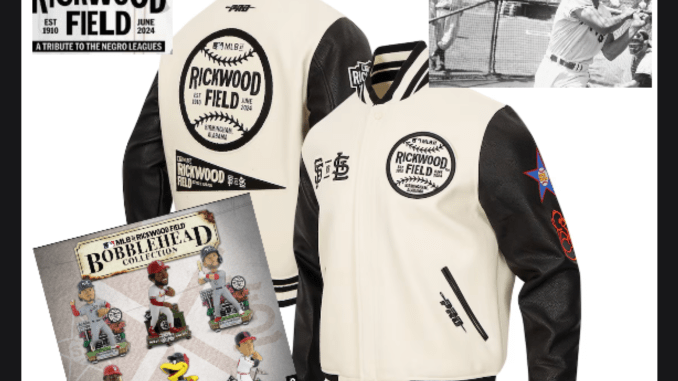
Commemorative Rickwood Field game merchandise:
Foco
Foco recently released a bunch of brand-new Cardinals bobbleheads commemorating the Rickwood Field game tonight. CLICK HERE
These Cardinals bobbleheads are part of two different collections: Our Legends of the Park Hall of Fame Mini Bighead Collection and our Rickwood field game collection.
The Mini Bighead collection features Lou Brock and Ozzie Smith posing atop Hall of Fame themed bases. Each of these bobbleheads stands at 4.5in, retails for $40, and are numbered out of 144 to increase the collectability. CLICK HERE
In the Rickwood Field Game Collection, current players, old-timers, and fredbird are featured in various action poses atop a unique Rickwood Field themed base.

To see the whole collection of Foco commemorative Rickwood game items: CLICK HERE
Fanatics
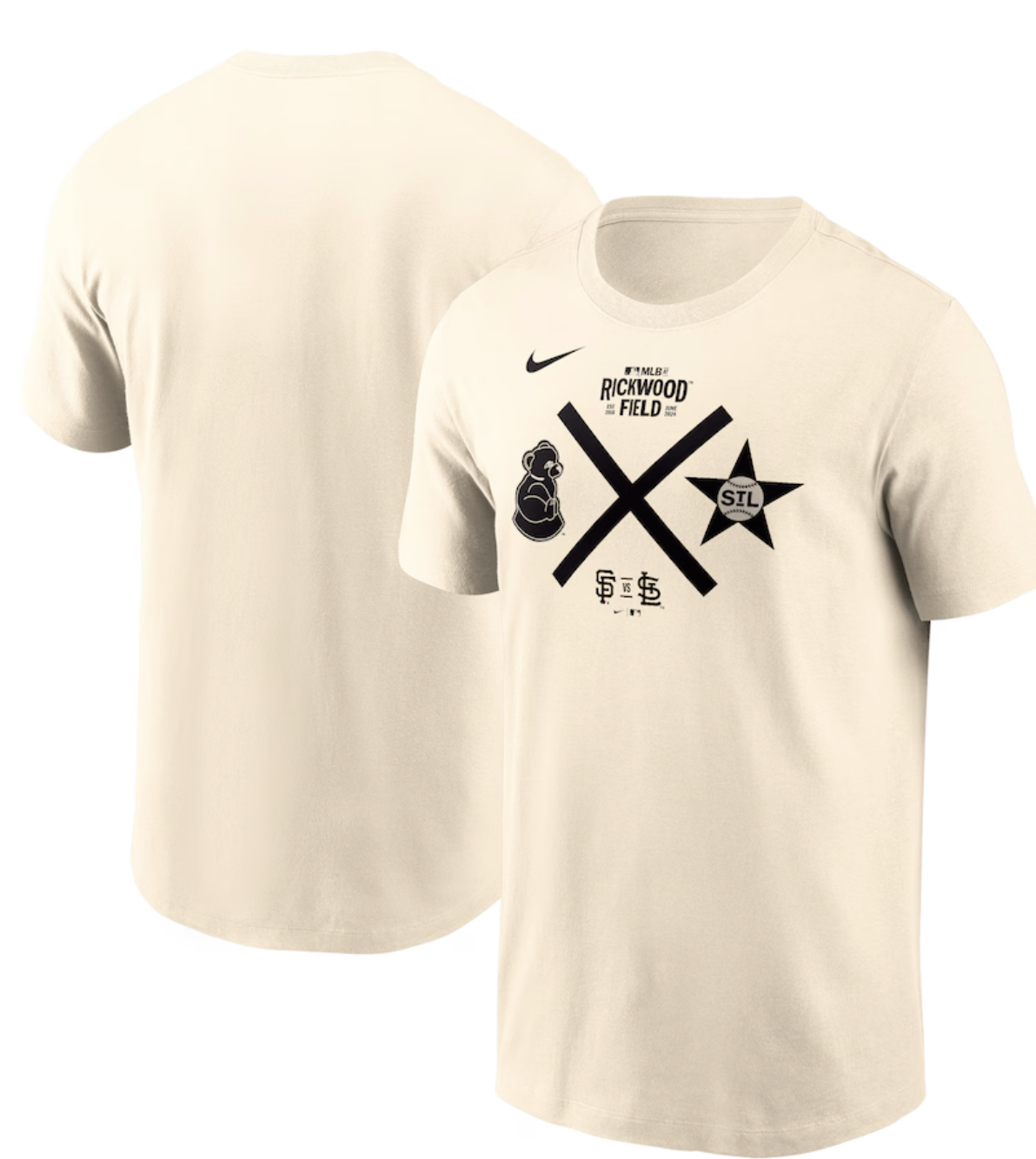
Jackets and T-Shirts from the Rickwood game CLICK HERE
Paul Goldschmidt Rickwood Cardinals uniform CLICK HERE
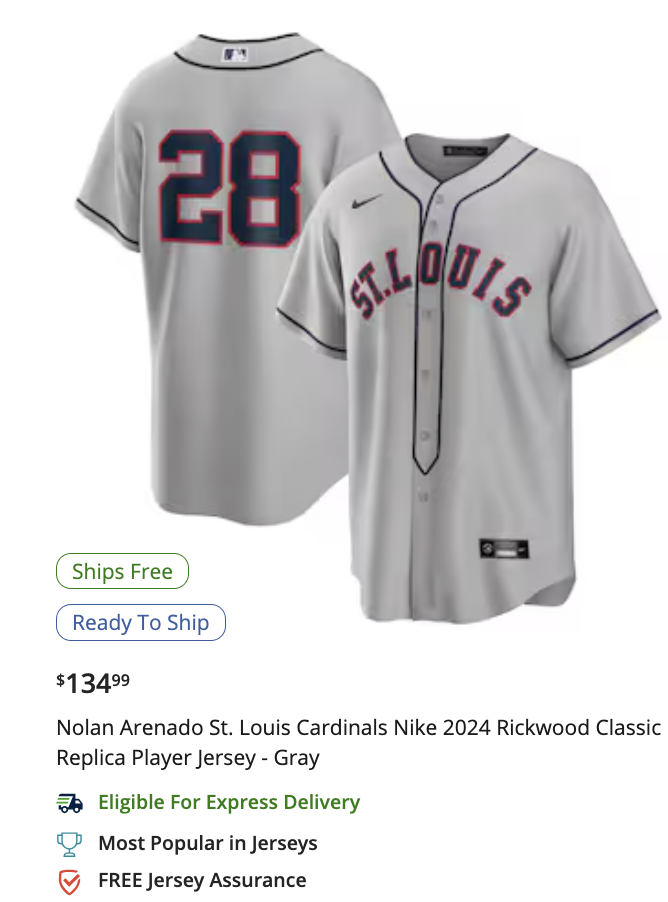
Nolan Arenado Rickwood Cardinals uniform CLICK HERE
Rickwood game hat: CLICK HERE
Jacket CLICK HERE


