
By Rob Rains
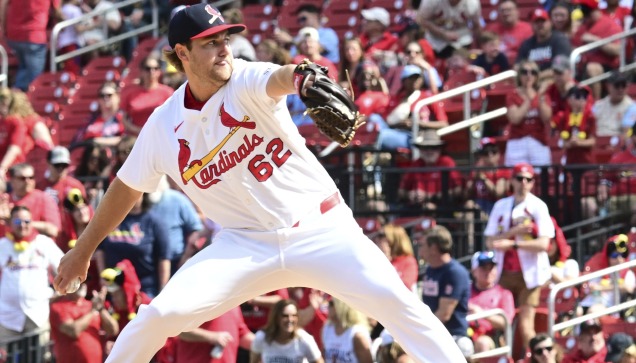
There were days, and sleepless nights, not that long ago when Kyle Leahy wondered if his baseball career was going to end in the minor leagues.
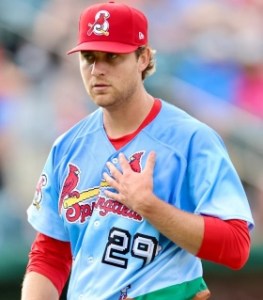
He was struggling back in 2021, often going home to an apartment he shared with teammates in Springfield following another poor performance. Getting through those nights often was harder for Leahy than when he was getting hit hard during a game.
“There were definitely some dark times, some sleepless nights, some times when I wondered,” Leahy said. “As bad as some of the results were, as bad as some of those games were, it wasn’t the results on the field that kept me up at night even though it did add to it … The late nights get later when you are not pitching well.
“What was really driving me crazy was knowing that I wasn’t getting everything out of myself and that there was more in the tank. I wasn’t showing my best self to the world, to the game, to my teammates, to my coaches, to everybody.”
It didn’t help Leahy that his apartment wasn’t an inviting source of comfort either.
“There were squirrels and raccoons and who knows what else living in our walls,” Leahy said. “It was not luxury living.”
 While waking up after those long nights offered the promise of a new day, of another game, of a fresh start, for Leahy, it often only produced more stress.
“There were days where the last place I wanted to be was at the baseball field, which is crazy,” he said. “But at the same time, deep down, I knew I still wanted to go to the field. I knew there was more there. I knew that wasn’t how I was going to end my career.
“What’s so frustrating sometimes is you bust your butt as hard as you can and you still don’t get the results on the field. That’s a dark feeling when you’ve given it your all and there’s nothing to show for it.”
In the back of his mind, despite his struggles, Leahy’s dream of playing in the major leagues was as alive as it had been when he first started playing the game as a young boy growing up in Colorado.
“Until they told me it was over I wasn’t going to believe it was,” Leahy said. “There’s always some fight left in you.”
Did Leahy really think back during those dark days that four years later he would be one of the Cardinals’ most effective relievers?
“The weird thing is I would have been like, ‘Yeah, I can do that’,” Leahy said. “At the same time, I would have been like, ‘I don’t know how I’m going to get there.’ I just always hoped I could get it out of myself. But trust me, there were some dark times when I didn’t know how.”
The story of how Leahy rose from that dark place to get to where he is today, enjoying success in the major leagues, is a testament to his own determination and the help he received from others in the Cardinals’ organization.
It started with a look in the mirror.
“What I’ve always said to myself is I just need the chance,” Leahy said. “I’ve always been fighting uphill. I just need that chance. I might not figure it out right away but I will give everything I can to figure it out.
“I had to believe in myself. You have to start there. Nobody else is going to believe in you if you don’t believe in yourself.”
How a Cardinals’ scout found Leahy
One of the first people in the Cardinals’ organization who was attracted to Leahy was Mauricio Rubio, who in 2018 was the area scout covering Arizona, Utah, New Mexico and Colorado.
Early that spring, Rubio had identified a pitcher on the Colorado-Mesa team that he wanted to see. It wasn’t Leahy.
“They had another righthander on the team who was popping up a little bit,” said Rubio. He made plans to go see that pitcher, JR McDermott, in a doubleheader when Mesa was on a trip to California.
McDermott was supposed to start game one, and Leahy was the scheduled starter for the second game. For a reason Rubio didn’t know, the two were switched, and Leahy started the first game.
“He was 88 to 91 and there were some signs that the slider was in there,” Rubio said. “He was big and physical and had some arm speed. I thought he probably was going to be able to throw harder.”
Intrigued by what he saw, Rubio made plans to go see Colorado-Mesa, a Division II school, again later in the year, when they played at Colorado School of Mines. This time he specifically was going to watch Leahy.
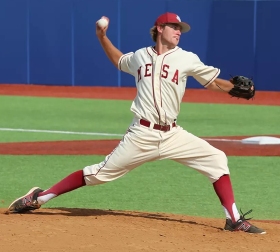 “He was touched up a little bit in the first inning because of an infield single and a bunt single,” Rubio said. “I think he gave up four runs but then he was on cruise control.”
Rubio liked Leahy enough to recommend him for the draft and the Cardinals selected him in the 17th round. McDermott went undrafted.
Rubio credits Leahy for helping in his own development as a scout even though Leahy didn’t know that happened.
“One of the things I learned from him that helped my development was that his fastball was pretty hard to see,” Rubio said. “I did weigh that, but not as much as I should have.”
Rubio also was reminded that scouting a player sometimes includes looking for abilities that are not as easy to see while watching a game.
“Makeup becomes very important,” Rubio said. “I think a lot of times the evaluation becomes a little constricted. Teams go to a game and see sort of the same thing. A contributing factor has to be how you weigh a person’s work ethic and how you weigh a person’s competitiveness. Clearly Kyle’s was at the top of the scale.
“His college coach, Chris Hanks, always brought up how hard of a worker he was, how studious he was. He’s incredibly quiet. But if you’ve ever watched a duck go across a pond, the top half of the duck is completely calm with not a lot going on. If you look underneath the water, that’s where the real work is happening. The flippers are going.
“That’s kind of how Kyle is. It’s easy to misread his quietness. He likes mountain biking, hiking, skiing. He’s intensely competitive and competes against himself often. Can you improve on your last time? He was great for me to learn from.”
Leahy was sent to Johnson City to begin his pro career in rookie ball, and moved up to the low Class A levels in 2019. Just as his career really was getting started, however, he and all other minor leaguers found themselves with no place to play in 2020 when the minor league seasons were cancelled because of the pandemic.
“I just got a year older basically in terms of my career,” Leahy said. “It was not ideal to lose a year of development. I built a mound in my backyard and had a high school kid who came and caught me. I threw the whole summer and worked on everything I could but I didn’t get any game reps, so that was tough.”
When the minor league teams resumed operations in 2021, Leahy – who was about to turn 24 – was assigned to Double A Springfield.
He didn’t know how long of a season it was going to be.
“The arm was always there”
Jose Leger was the Springfield manager in 2021, and he liked Leahy’s raw talent.
“The arm was always there,” said Leger, now the organization’s assistant field and roving baserunning coordinator. “The mechanical quality of the pitches were there. Throwing strikes was never an issue for him.”
What was a problem was how many of his pitches were getting hit. Night after night, Leger and pitching coach Darwin Marrero watched Leahy struggle.
“It’s hard to ignore the fact he was getting hit around so many times, day after day,” Leger said. “It was really tough for him. We felt for him.”
Many of those nights, Ivan Herrera was catching Leahy.
“He always had good pitches, it was just a matter of learning how to use them,” Herrera said.
As was the case with the team’s staff and other teammates, Herrera said it was tough watching Leahy endure that season.
“Everybody is going to struggle in this game,” Herrera said. “When you struggle is when you have to choose what kind of player and person you want to be. He chose to get better. He was grinding. He never gave up.”
By the time that year was over, the numbers were pretty ugly – an 0-8 record with an 8.20 ERA. In 86 2/3 innings, Leahy allowed 130 hits and walked another 44 batters and hit three more – meaning he was averaging more than two baserunners per inning.
“He didn’t pitch with confidence,” Leger said. “You could tell.”
Said Leahy, “It’s hard to have confidence when you are really struggling but I think for me I’ve always just leaned on your training and trusted that. Anytime something went bad I Just said, ‘I’ve got to go back to the drawing board and rebuild and figure out how to get better.’
“I definitely took my lumps. It was definitely a struggle. I tried to get bigger, faster, stronger, throw harder, make nastier pitches. That’s where I started and it grew a little from there.”
 Leahy also grew mentally – from conversations with Brian Alazzawi, the organization’s mental skills and well-being coordinator.
“Brian has always been a big help with a bunch of us,” Leahy said. “That’s where trusting your training kind of comes from. He always says you are going to be way more confident in yourself regardless of results if you believe in everything you’ve been doing and everything you’ve been training for.
“Having somebody reiterate those things to you gives you a different perspective.”
Alazzawi is a retired Navy Seal who started working for the Cardinals in 2020 following a recommendation from Paul Goldschmidt, who he met years earlier when Goldschmidt and some teammates on the Diamondbacks visited the Seals in San Diego.
“What sets Kyle apart is he finally started to understand that it’s not about the outcome,” Alazzawi said. “It’s about process. He was like, ‘If I’m not seeing the results or not feeling the way I’m supposed to feel, it’s a failure.’ My conversations with Kyle have been that he should look at failure as an opportunity to grow; see mistakes as a way to continue to refine.
“Kyle kind of took it on himself to dig in and challenge his behaviors, the attitude … I can’t help but think back about how miserable he was at times about where he was in his career.”
Leger saw Leahy begin to change when he returned to Springfield for the 2022 season.
“Darwin Marrero always believed in him and was an advocate of what he saw in Kyle,” Leger said. “He always said, ‘There’s more there; he can be good.’ He was right.
“His preparation changed. His mentality changed. We started seeing something then. It took about a year and a half to start believing more in himself. It took a little bit of success for him to start seeing he had more in the tank and become a better pitcher.”
“A different demeanor”
Leahy’s improvement picked up in 2023 to the point where he was promoted to make his major-league debut. He rode the 1-55 shuttle between Memphis and St. Louis throughout much of 2024, but logged enough time with the Cardinals to come to the realization that he could pitch, and succeed, at the major-league level.
He was determined to take the next step in his career – remaining on the roster – this season.
“We had great conversations this spring,” Alazzawi said. “He went into this spring with the mindset that the job was already his. A lot of guys have the mindset that they are fighting for a job. I think one thing that set Kyle apart this spring was that he wasn’t fighting to get it, he was fighting to keep it.
“I think there’s a difference in that mentality; go out and do what he knows how to do.”
Leahy did not allow a run in 11 spring training innings, spread across seven games, issuing only one walk and striking out 13. He made the opening day roster.
Already this season Leahy has had a streak of nine consecutive innings, over seven games, without allowing a hit. In his nine games he has worked 13 innings, allowing three runs on four hits. He has walked three and struck out 13 of the 46 batters he has faced.
It’s safe to say Leahy’s confidence level is a lot higher now than it was four years ago.
“There were definitely people within the organization who always believed in me, otherwise I wouldn’t be here,” Leahy said. “Baseball is a weird game. At every level you learn a different part of it and you adjust and hopefully you get here.
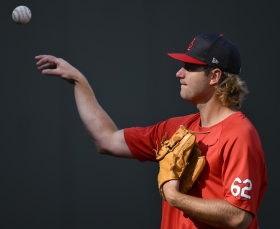 “Maybe when it’s all said and done it will be more enjoyable to have gone through that (his struggles). I think all of those struggles have formed sort of a relentless pursuit of the impossible perfection. I may have had a few good outings right now and had some success, but it’s not like I didn’t give up zero runs. I didn’t strike everybody out. There’s always room for improvement.
“Had I not had those struggles and learned how to pick myself up after getting knocked down, and being a good self-evaluator about what I need to improve on … now I know when things get off how to get past it.”
Leahy knows the people who stuck by him during the struggles are as happy for his success as he is – if not more.
“A lot of guys have an easier path to the bigs, but some have a little bit of a rougher path,” Leger said. “That was his case. He’s one of the stories that makes you proud. He’s a good example for others in the organization and the industry that if you go out there and give your best, you never know, it may happen.”
Added Rubio, “It’s been impressive. I’m proud of the kid.”
So is Alazzawi.
“I’m super proud of him and I hope he is proud of himself,” Alazzawi said. “I’m confident he will continue to do the work. There’s definitely a different demeanor about him. I would say he’s more confident, more capable in how he presents himself. He’s not the kind of guy who is going to beat his chest, but I think being around him, you feel an energy about him.”
One thing is definitely different about the Leahy of 2025 compared to who he was four years ago. These days – everyday – he can’t wait to get to the ballpark.
“Hopefully when it’s all said and done I can look back and say I wouldn’t change it for the world,” Leahy said. “I think I’m on the right trajectory to be able to say that one day but I still have a lot more that I want to accomplish.”
Follow Rob Rains on X @RobRains
Photos by the Associated Press, Springfield Cardinals, Colorado-Mesa Athletics

