
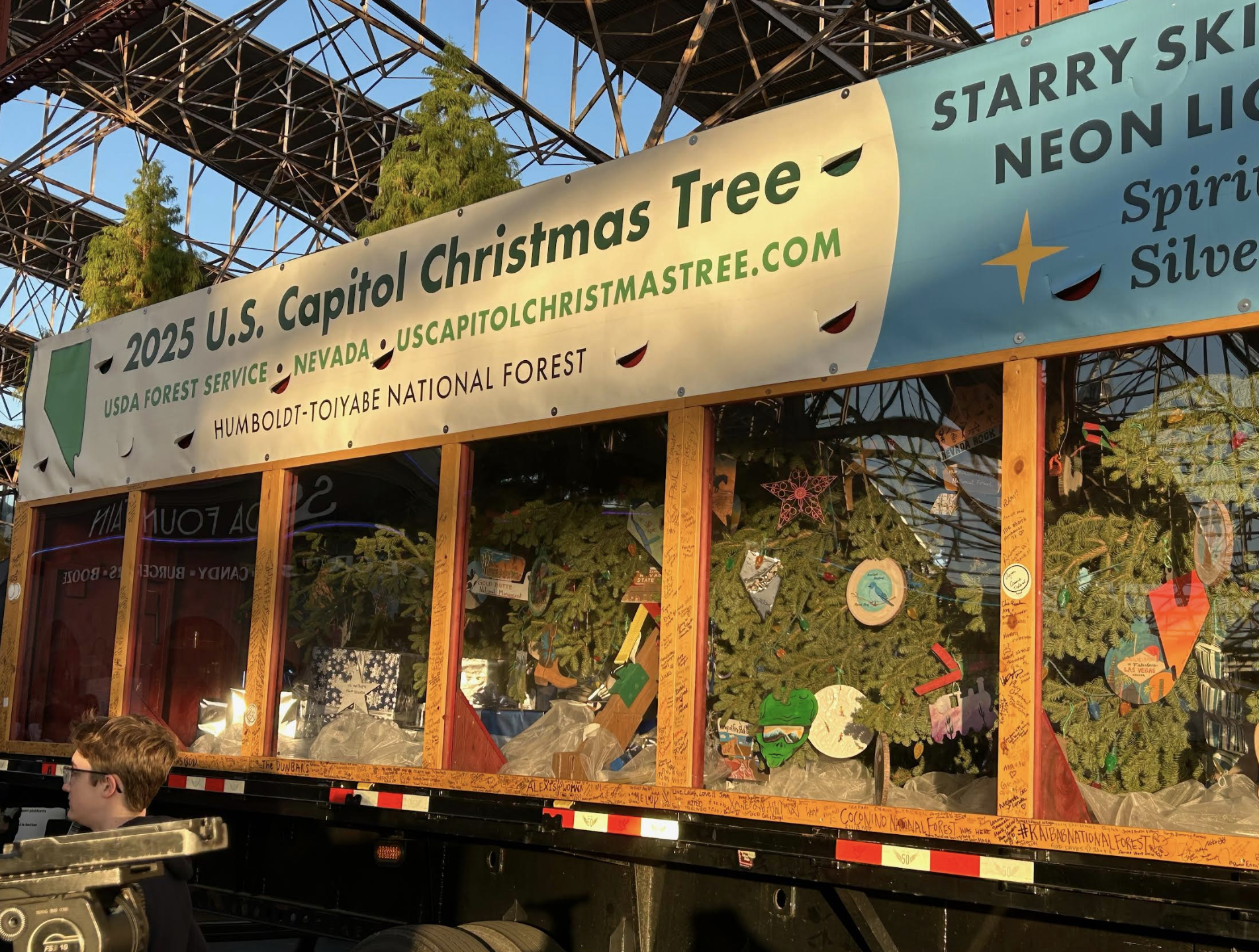
The U.S. Capital Christmas Tree, named the Silver Belle, the 53-foot red fir tree harvested from the Humboldt-Toiyabe National Forest in Nevada, has been making its journey to Washington D.C. When it made a stop at St. Louis Union Station, it allowed visitors a chance to see what’s called “The People’s Tree” looks like up close along with its thousands of handmade ornaments by Nevada school children and seniors.
Like anyone looking for a best Christmas tree, the staff at Humboldt-Toiyabe National Forest set out to locate the perfect tree. They selected ten trees that fit what they called the most Christmassy shaped trees they could find. As Courtney Ghiglieri, Humbolt-Toiyabe Interpretation, Education and Outreach Team Leader explained, the final selection was made by the U.S. Capital’s architect.
When asked how the Silver Belle was handled to keep the tree fresh Ghiglieri said, “We’re treating this tree the same way you would treat your own live Christmas tree at home. We water it. Its’s fitted with a water bladder that we fill up every morning and every night.”
The family Christmas tree you select is just as important as the nation’s Christmas tree and should be given the same care as the Silver Belle. The National Christmas Tree Association has a number of tips on how to select and care your tree. They have an extensive website of infoation on the different kinds of trees and all the fine points of gowning, recycling and keeping trees safe. The following are recommendations on selection and care of a live tree, which begins with deciding the size of the tree you need.
Begin by measuring your space. Be sure you know what size (height and width) you need. Measure the ceiling height in the room where the tree will be displayed. The trees in the field look small when the sky is the ceiling. Measure the width of the area of the room where the tree will be displayed. A tree that will fit in the room vertically may be entirely too big horizontally.
Think about what type of decorations. Some tree species have more open foliage, stiffer branches or longer needles. Research the characteristics of the different species in our tree varieties section, then find a farm near you that has the species you are looking for.
Do a branch/needle test for freshness. Run a branch through your enclosed hand – the needles should not come off easily. Bend the outer branches – they should be pliable. If they are brittle and snap easily, the tree is too dry. Also look for other indicators of dryness or deterioration as excessive needle loss, discolored foliage, musty odor, needle pliability, and wrinkled bark. A good rule-of-thumb is, when in doubt about the freshness of a tree, select another one. If none of the trees on the lot look fresh, go to another lot.
Ten Christmas tree care and safety tips
1: To display the trees indoors, use a stand with an adequate water holding capacity for the tree. As a general rule, stands should provide 1 quart of water per inch of stem diameter. Devices are available that help maintain a constant water level in the stand.
2: Use a stand that fits your tree. Avoid whittling the sides of the trunk down to fit a stand. The outer layers of wood are the most efficient in taking up water and should not be removed.
3: Make a fresh cut to remove about a 1/2-inch-thick disk of wood from the base of the trunk before putting the tree in the stand. Make the cut perpendicular to the stem axis. Don’t cut the trunk at an angle, or into a V-shape, which makes it far more difficult to hold the tree in the stand and also reduces the amount of water available to the tree. Drilling a hole in the base of the trunk does NOT improve water uptake.
4: Once home, place the tree in water as soon as possible. Most species can go 6 to 8 hours after cutting the trunk and still take up water. Don’t bruise the cut surface or get it dirty. If needed, trees can be temporarily stored for several days in a cool location. Place the freshly cut trunk in a bucket that is kept full of water.
5: Check the stand daily to make sure that the level of water does not go below the base of the tree. With many stands, there can still be water in the stand even though the base of the tree is no longer submerged in water.
6: Keep trees away from major sources of heat (fireplaces, heaters, heat vents, direct sunlight). Lowering the room temperature will slow the drying process, resulting in less water consumption each day.
7: Use of lights that produce low heat, such as miniature lights, will reduce drying of the tree.
8: Always inspect light sets prior to placing them on the tree. If worn, replace with a new set.
9: Do not overload electrical circuits.
10: Always turn off the tree lights when leaving the house or when going to bed.

