By Rob Rains
Whitey Herzog, the architect of “Whiteyball” and the manager of the Cardinals’ teams during one of the best eras in franchise history, has died. He was 92.
“Whitey spent his last few days surrounded by his family,” a statement from Herzog’s family said on Tuesday. “We have so appreciated all of the prayers and support from friends who knew he was very ill. Although it is hard for us to say goodbye, his peaceful passing was a blessing for him.”
Herzog’s last public appearance had been at the Cardinals’ home opener 12 days ago, when he was introduced to the crowd along with the other Hall of Famers present while he was sitting in the stands.
Herzog’s legacy in St. Louis began when he was hired by Cardinals owner Gussie Busch on June 9, 1980, replacing Ken Boyer after previous stints managing the Rangers, Athletics and Royals.
When he learned in a couple of months all of the moves that he thought would be necessary to rebuild the Cardinals, Herzog turned over the managing duties to Red Schoendienst and traveled to the minor-league clubs to learn more about the players in the organization. After the season ended, he persuaded Busch to also make him the general manager. Herzog often joked that carrying both titles at the same time let him “go to sleep and have a meeting.”
Through numerous trades, Herzog quickly turned the Cardinals into a pennant-contending team that won the 1982 World Series.
“He gave us the leadership that we needed,” said Keith Hernandez. “He made some drastic changes when he took over but in that first spring training that he was there, in 1981, you just knew that you had a manager who was taking charge. He taught us the little things that win ballgames.
“I really feel he was the dominant force in turning around and gathering the talent on that team and pointing it in the right direction.”
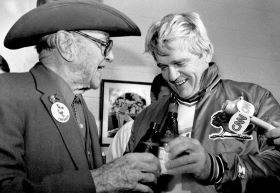 Realizing that the Cardinals would be better off taking advantage of the astroturf field and big dimensions at Busch Stadium, Herzog designed a team that was built on speed and defense instead of a team that relied on hitting home runs. Playing that style led the Cardinals to also win the NL pennants in 1985 and 1987 before losing each year in the World Series in seven games.
Inspired by that style of baseball, which came to be known as “Whiteyball” the fans flocked to Busch Stadium, setting attendance records year after year, which Herzog always said he believed was one of his greatest accomplishments.
As news spread on Tuesday about Herzog’s death, many fans remarked on X, formerly known as Twitter, about how growing up in that era helped them fall in love with baseball and the Cardinals and is the reason they are still passionate now, four decades later, about the team and the game.
The news also spread to Herzog’s former players and coaches.
“Another angel is in Heaven,” said Vince Coleman. “If it wasn’t for Whitey there would never have been a Vince Coleman. Whitey would often come to me and tell me that I had stolen his wife’s heart.”
Former Cardinal pitcher John Tudor also had a fond relationship with Herzog.
“He meant a lot to me and a great many others,” Tudor said. “I am going to miss not ever seeing him again. He looked and sounded good when I saw him opening day. In hindsight it makes me glad he was able to be there one last time.”
Former Cardinals pitcher and current broadcaster Rick Horton said he received numerous messages on Tuesday from friends outside of baseball who knew how much he valued his relationship with Herzog.
Some of those people were among those who met Herzog at the Cardinals’ fantasy camp over the years.
“Whitey was just a down to earth guy who could mix with anybody and loved to tell stories,” Horton said. “That’s a treasure for those people who went to fantasy camp and got to spend time with him.
“He was just so available to people at places like fantasy camp. We would sit around at lunch and he holding court. That’s one of the special thoughts I have about him.”
Almost strangely, Horton thought, was that he doesn’t have a lot of memories about talking baseball with Herzog from his days as a player.
“I realize that was part of his managerial genius,” Horton said. “He allowed his pitching coach to be the pitching coach and his hitting coach to be the hitting coach. He managed the whole thing but he trusted the people around him and he learned things his way. Most of the conversations I had with him while I was playing had more to do with fishing than anything else. I wasn’t even good at that but that was what he wanted to talk about.”
One example of Herzog’s managing acumen that Horton recalled Tuesday happened when Scott Terry, another relief pitcher, was in the bullpen after being traded to the Cardinals.
“Ken Dayley was telling Scott that Whitey was going to call down and get him up in about the fifth or sixth inning,” Horton said. “’He wants to get you in the flow and will try to get you in the game.’The bullpen phone rang about two minutes later with the word to get Scott Terry up.
“He looked at Ken and said, ‘How did you know?’ The answer was that Whitey was very good in letting people know what their job was and when they might need to be ready to go. Several times when he came to take the ball from me on the mound, particularly when I was starting, he would tell me on the mound right away, ‘You’re going to throw on the side in two days and start against Pittsburgh on Tuesday.’ Especially in games that weren’t so good the idea was for us to turn the page, basically his way of supporting you and backing you up and keeping you from dwelling in the moment. I very much appreciated that from him.”
Horton said there are a lot of lessons he took from playing for Herzog that he has gone on to use in life after his playing career was over.
“Whitey was old school but he was not going to be like an Earl Weaver or Tom Lasorda and have players challenge him,” Horton said. “There was no challenging Whitey. Honestly what he was very good at was that he got the respect of the older players like Bruce Sutter, Bob Forsch, George Hendrick and others.
“One of the first days I was in St. Louis somebody wanted to do an interview and I got on the field about two minutes after 5. Sutter met me on the foul line and asked what time it was. I said 5:02. Then he asked, ‘What time were you supposed to be on the field for batting practice?’ I said 5 o’clock. He said ‘You need to understand that 5 o’clock is Whitey’s time. You owe that to him.’
“He wasn’t talking to me as if he was mad at me. He was just extending Whitey’s leadership. He said don’t ever be late again. The message was received. He (Herzog) helped me in so many ways, all lessons I have taken from Whitey.”
In a message posted on X, Ozzie Smith said, “A sad day for Cardinal Nation. We all knew the day would come, but we’re heartbroken. We’ve lost Whitey. We Loved and Adored the “White Rat”. Whitey touched many lives as a Father, Husband, Coach, Mentor, and Friend. My Life was changed because of him. May he rest in Peace.”
What stood out about Herzog to many of his former players and coaches was how Herzog managed a game, his ability to see innings in advance how the game was going to be played. He passed along those lessons to coaches such as Hal Lanier, Jim Riggleman and Nick Leyva, all who left St. Louis to become major-league managers elsewhere.
“I have a nice pension because of Whitey Herzog,” said Riggleman. “I would have never managed in the big leagues if Whitey had not put me on his staff. Working for Whitey was like back in the 1960s or 1970s working under Bear Bryant at Alabama. Somebody might come grab you to be the head coach of their football team because they figured maybe you learned something from Bear. I think Nick and I reaped the benefits of working under Whitey.
 “He was just so tuned in to managing a game strategically. Before we ever used the word bench coach, I guess that’s what Red was. But nobody stood next to Whitey during a game and said, ‘Hey Whitey what do you think about this?’ You just left Whitey alone. He was over there by the steps, leaning on the railing, totally focused on every pitch and engrossed in the game, putting a plan together on how he was going to use the bullpen. There was no need to somebody to make a suggestion or anything. He was on top of everything.”
John Stuper pitched for Herzog and then went on to coach baseball for 30 years at Yale.
“I basically patterned my coaching style after Whitey,” Stuper said, “running the bases, testing the defense. He was the best in my view maybe in baseball history of running a pitching staff. I tried to do this at Yale – you would never see Whitey’s pinch-hitters get in the on-deck circle and take 10 minutes to loosen up. He had told them two innings in advance that if this happens and this happens you’re going to be hitting for this guy. He was amazing like that.
“That’s what I tried to do. I never tried to get caught without a reliever ready or to have a pinch-hitter ready. I learned that from him. I know it’s an old cliché that he was playing chess and everyone else was playing checkers but as a player, you sat there on the bench and I can never remember going, ‘Why the hell is he doing that?’ You just said, that’s pretty smart.”
Hernandez said that when he was on the Cardinals and later on the Mets, going through their intense rivalry against the Cardinals in the mid 1980s as an opponent he gained even more respect for Herzog.
“You couldn’t beat him on the field as a manager,” Hernandez said. “He was terrific and was one of the main reasons why that team had such a great run. He’s in the Hall of Fame, as he deserves to be.”
Added former Cardinal Tom Herr, “Whitey was a leader of men who allowed his men to be leaders.”
Stuper also shared another special moment that he shared with Herzog.
“The Cardinals brought me in in 2021 and I threw out a first pitch and then afterwards I was in a suite and it was just me and Whitey,” Stuper said. “We watched six innings of the game and what a joy that was. I realize I played for him and I played in the big leagues and stuff but you were sitting beside one of the greatest managers of all time. You were just talking baseball. I will remember that for a long time.”
Herzog managed the Cardinals until 1990 when, after Busch’s death, he was frustrated by ownership questions and the direction of the franchise and resigned. In his 11 years with the team. Herzog had a record of 822-728.
Overall, in 18 years as a manager, Herzog led his teams to six division titles, three league pennants and one World Series title. He was elected to the baseball Hall of Fame in 2010.
Herzog, a native of New Athens, Ill., who often talked about coming to games at Sportsman’s Park to watch Stan Musial, Red Schoendienst and the other Cardinals’ stars in the 1940s, also played in the majors for eight years, all in the American League. After his playing career he went on to coach and serve in a variety of positions in player development with different teams before becoming a manager.
“Whitey was beloved in St. Louis,” said Hall of Famer Ted Simmons. “A patriarch, in many ways like a King. He will be missed by everyone.”
Herzog is survived by his wife of 71 years, Mary Lou, children; Debra, David and Jim and their spouses; nine grandchildren and 10 great grandchildren.
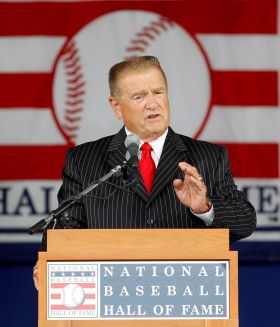 “Whitey and his teams played a big part in changing the direction of the Cardinals franchise in the early 1980s with an exciting style of play that would become known as “Whiteyball” throughout baseball,” Cardinals chairman Bill DeWitt Jr. said in a statement. “Whitey loved the Cardinals, their fans, and St. Louis. He will be sorely missed.”
Commissioner of Baseball Robert Manfred, Jr. said in a statement, “Whitey Herzog was one of the most accomplished managers of his generation and a consistent winner with both ‘I-70’ franchises. He made a significant impact on the St. Louis Cardinals as both a manager and a general manager, with the Kansas City Royals as a manager, and with the New York Mets in player development. Whitey’s Cardinals’ teams reached the World Series three times in the 1980s, winning the Championship in 1982, by leaning on an identity of speed and defense that resonated with baseball fans across the world.”
In a statement from the Baseball Hall of Fame, Jane Forbes Clark said, “Whitey Herzog devoted his lifetime to the game he loved, excelling as a leader on and off the field. Whitey always brought the best out of every player he managed with a forthright style that won him respect throughout the game. His passion for the Hall of Fame was evident each time he returned to Cooperstown, and we will forever miss his smile and warmth. We extend our deepest sympathies to his wife, Mary Lou, and his family.”
Herzog’s funeral arrangements are pending.
Photos by AP courtesy of KSDK Sports
Follow Rob Rains on Twitter @RobRains
Sign up for Rob Rains free newsletter: CLICK HERE.

Photo collage courtesy St. Louis Cardinals/MLB For more photos: CLICK HERE.