By Rob Rains
On nights when he couldn’t sleep, a young Matthew Liberatore would get out of bed, walk downstairs and find his dad Anthony sitting in the living room.
“He’s a night owl and I’m a night owl and he would make me a glass of milk and then we would sit down on the couch at 1 in the morning and talk for two hours,” Liberatore said. “Sometimes it was meaningless stuff but 90 percent of the time it was life-lesson conversations, philosophical stuff.
“From 8 to 18, it’s some of my best memories with him and some of the things that have really shaped me into who I am today.”
 Across the country from where Liberatore was growing up in Arizona, a young Victor Scott II was waiting in the driveway when his father, Victor Scott Sr., came home from his job as a police detective in Atlanta.
“He either had a basketball in his hand or was wearing a baseball glove,” Scott Sr. said. “I was still in my suit and tie and he was like, ‘Let’s go, one on one.’ I was out there and hadn’t even made it into the house yet.”
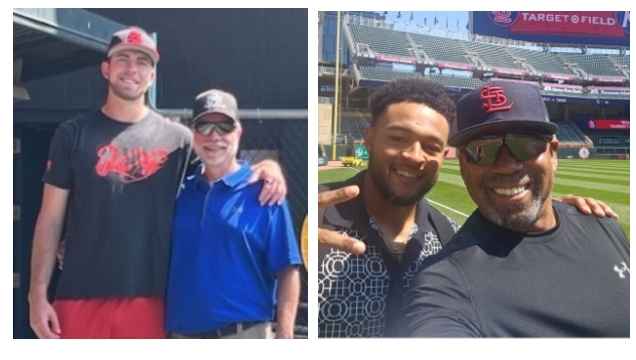
As both fathers have watched their sons grow up to become major-league baseball players with the Cardinals, they are proud of what their sons have accomplished, but more important to both is how their sons reflect the way they were raised.
Both of these sets of fathers and sons are well aware of their special relationships, which they appreciate not just as Father’s Day approaches but every other day of the year as well.
“We would sit and talk for hours”
Anthony Liberatore spent a lot of time with Matthew because of baseball, serving as one of the coaches on Matthew’s club team throughout high school. He was in the dugout when his oldest son hit his first out-of-the-park home run.
One summer when Liberatore was in high school, they spent five consecutive weeks on the road together, came home for a week and went back on the road for two more weeks.
“We clicked emotionally, intellectually and we share a similar sense of humor,” Anthony Liberatore said. “We enjoy each other’s company.”
He remembers those late nights sitting together in the living room.
“Sometimes we would sit up until the late hours even when he had school the next day and I had to work,” Anthony Liberatore said. “We would sit and talk for hours. Sometimes it was about stuff that was important that was going on in his life, sometimes even in mine, and sometimes it was about stuff that wasn’t important at all or was about nothing in particular.”
It was during many of those chats, after Liberatore’s mom Lauri had gone to bed and while his younger brother Luke was sleeping, that his dad passed along many of his philosophies about what he considered important in life.
Liberatore has relied on one of those opinions in the early days of his professional baseball career – that there are two types of people in the world.
 “Those that make life happen and those who let life happen,” the elder Liberatore said. “It’s something I’ve repeated often over the years. It was something I believed long before I had kids or was even married. It was something I shared with both of our kids as they got old enough to understand the concept.”
As he was going up and down from the minor leagues to the Cardinals, and then dealt with the uncertainty of whether he was going to be a starter or reliever, Liberatore remembered his father’s discussion.
“I probably didn’t understand it when he first said it,” Liberatore said. “That was an adult conversation he kept having with me until I saw the light go on and it really clicked, when I was in high school.
“When I was going up and down it would have been very easy to be a victim of those circumstances and just say ‘woah is me’ and feel sorry for myself. There were moments when that started to creep in but what I ended up realizing is that I had a lifetime of training on how to deal with those things and that was the first time I really had to put those things into practice.
“It was a testament to the way I was raised and the lessons I have learned through playing the game and dealing with life, and it’s served me very well.”
Matthew said that his father, who owned a plumbing and air conditioning business before he sold it a few years ago, always asked him after a game or practice if he had fun – that was what was most important to him.
“He never once got mad at me, which I think made it easier to feel like I was doing it for myself and not for him,” Matthew said. “I knew some kids growing up who resented the way their parents treated them because of the way they performed. Those kids burnt out and didn’t fall in love with the game for the right reasons.
“He always tried to treat me like I was an adult. … I didn’t always understand when he said, ‘I want you to play not because I want you to be good at the game but because of what the game does for you in your life.’ As I got older and especially now I see the parallels this game has to everyday life, the life lessons that it teaches you – your ability to trust yourself and place your trust in others, your ability to deal with failure and own up to it and stare it in the face and grow from it.”
Those were the kinds of topics Anthony Liberatore and his son discussed in those late-night chats.
“I didn’t realize how valuable they would be because a lot of things I didn’t have to put into practice at that age, so it was good to have that understanding, but I hadn’t really faced any significant amount of failure by that time,” Matthew said. “Looking back on it now, those conversations were what got me through the last couple of years.”
Anthony Liberatore knew how special those conversations were, and he really wasn’t prepared for them to end.
“When Matthew got drafted by Tampa Bay, we flew to Florida and his ticket was one way,” Anthony Liberatore said. “We had spent so much time together traveling for baseball, practices twice a week, tournaments, talking every night. I remember coming home from that trip to Florida and leaving him behind.
“I came home that night and my wife went to bed and I sat in my usual spot in the living room and I was all by myself – and I cried. In a sense I had lost my best friend. … All of a sudden in an instant it was over. I didn’t realize it until I got back home how drastically things were going to change for me.
“It wasn’t sad tears. It was just the situation had changed. Kids grow up.”
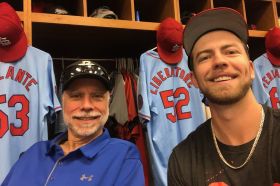 Over the years Anthony Liberatore also told his boys that “The job of every parent is to raise a child who doesn’t need them.”
When Matthew graduated from high school, he made his dad a shadowbox which includes pictures of the two together. It also includes that quote on a little piece of paper.
“On senior day, all of the kids threw their dads a baseball,” Anthony Liberatore said. “Matthew had written on the baseball, ‘The job of every parent is to raise a child who doesn’t need them and nobody’s done a better job than you.’”
That baseball still sits on Anthony Liberatore’s desk in the family home in the Phoenix suburb of Surprise. He sees it every day.
“Many years ago, when I was working for a company in New York, the former owner came around and we were talking one day, long before I had kids, and he said to me that his kids were his life’s greatest joy. That really stuck with me,” Anthony Liberatore said.
“What is most important to me is seeing my kids having success, whatever path they choose. They are my life’s greatest joy. Our younger son just graduated from the University of Arizona and had multiple job offers and accepted a position and is on the right path. The same is true for Matthew. It’s awesome that he’s a major league baseball player, it’s super exciting and a life that a lot of people only dream of. But whatever he chose, the reward for me is that he’s happy, he’s successful and he’s going to lead a good life.”
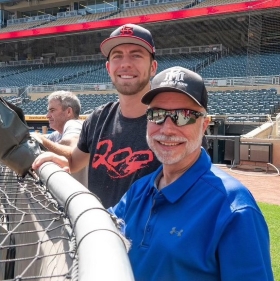 Matthew gave a speech at his team’s baseball banquet when he was a senior in high school that saluted his mother as well. I said, “She was the best behind the scenes act that anybody had ever seen,’” Liberatore said. “She didn’t get any credit for it. But without her doing it, I don’t know whether I would be where I am today.”
What does Liberatore think is the best way he can thank his parents?
“By relentlessly continuing to pursue the things they gave me the avenue to do,” he said. “Probably my favorite thing about both of them is their endless support and love regardless of who I am as a baseball player.
“This is what we get to do, but not who we are. It’s easy to lose sight of that sometimes but they were always good at grounding me because that’s not what life is about. They care about me as a person, not as a baseball player.
“I know at the end of the day that if I called my dad and said, ‘I don’t want to play anymore’ he would still love me just the same, and that’s a very freeing feeling.”
“He was always just like, ‘Let’s go’”
Victor Scott II was asleep in his upstairs bedroom when he heard the garage door going up – and quickly woke up, remembering he had told his dad he would go with him to work out at the gym before his dad went to work and he went to school.
The clock on his dresser read 4 a.m.
Showing off his speed even then, Scott II got up, threw on some gym clothes, raced downstairs, out the door – and caught up with his dad before he got out of the neighborhood.
“He was like, ‘I told you I was leaving,’” Scott II said.
His dad picks up the story.
“I knew he was coming and I pulled out really slowly and stopped the car at the cul-de-sac at the end of our block,” Scott Sr. said. “I heard him yelling, ‘wait up.’”
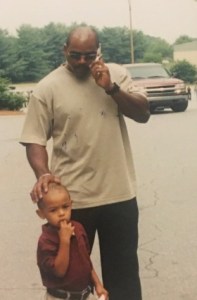 Those early-morning workouts were part of Scott II’s routine as he grew up – as was the instructions he received from his dad after he got back home and got dressed for school.
“He always told me, ‘Never look down on anyone unless you are picking them up,’” Scott II said. “That just means basically never downgrade somebody or undermine somebody – always treat everyone with respect. That was something he taught me from a young age.”
Scott Sr. said that was indeed the case, with both Scott II and his older sister, Seianna, in part because that was the way he had been raised.
“I always told him and my daughter to respect people and their property and respect yourself and your family,” Scott Sr. said. “That’s the way I respected people when I was an officer. The respect I gave to the man who lived under the bridge was the same that I gave to the man who had a multi-million-dollar house. They got the same respect from me.”
In his line of work, Scott Sr. often had to deal with a lot of tough situations. When he got home, however, those thoughts were quickly forgotten.
“We had some real bad days but he (his son) never knew it,” Scott Sr. said. “When I got home he was always just like, ‘Let’s go.’ If you can’t separate them you are going to have issues.”
The days that Scott II remembers often included his dad pulling up in the driveway and Scott II wanting him to hurry and get ready so they go to a local park to work out, where his dad hit him a lot of fly balls.
“He would say ‘Dad let’s go,’” Scott Sr. said. “It was 30 degrees outside. He was 12 years old. He was ready to go practice.”
What Scott II also remembers is that during those days at the park, his dad told him he needed to drop and give him some pushups if he failed to catch one of those fly balls. That started when Scott II was about 10 years old.
“That was more about concentration than anything,” Scott Sr. said. “When you put a little pain to something, you think about it a little bit more. You won’t make mental mistakes. He was like, ‘Come on dad,’ and I was like, ‘You missed that ball. You’ve got to give me some pushups.’
“Vic always had that work ethic. He didn’t mind working. He wanted to get out to the field and go out and practice … I never had to push him. It could be 30 degrees outside and he was like, ‘Let’s go.’ I would tell him load the car up and let me know when you’re ready.
“One thing about him was that he was a joy to work with. You could see the development as he got older.”
 Scott Sr. even saw that again last winter, after his son returned home following the season, which he split between the major-leagues and Triple A.
“When he came home he was laser focused,” Scott Sr. said. “He didn’t like how he played last year. He had a whole new focus on what he needed to work on. It was January and he wanted to go work in the park.
“One day it was about 25 degrees and the wind was blowing. My hands were stinging. I thought, ‘This is crazy,’ but I never let him know it and we kept playing. I was trying to catch his throws and the ball was stinging my hand. A lot of them I just let them go by me. I was like, ‘I’m not catching that.’
“He worked and worked and worked. I would spray the ball all over the place right to left. He worked.”
The only difference from the childhood workouts is that Scott Sr. didn’t have to instruct his son to drop and do pushups if he didn’t catch one of the fly balls.
The way his father, and his mother Mary as well, helped raise him is why Scott II considers his father his “superhero.”
“On the sports side he just pushed me to be the best I could be at whatever sport I was playing, and he was going to be there to help me,” Scott II said. “He’s the biggest role model I have in my life.
“I always looked up to my dad because I thought he was the best. I still do. … He was always there, from one step to another, from the first time I picked up a ball until now. He’s been there every step of the way with whatever I needed help with.”
When Scott Sr. listens to that compliment, he smiles. He knows it’s a reflection of how he and his wife Mary raised their children, with a foundation of faith, and that mantra to treat everyone with respect.
“We’re family people and I always remember how my dad treated me with nothing but love,” Scott Sr. said. “Vic was always a special individual. People just love to be around him and never wanted to leave his side. He always had that spirit about him.”
Scott II also knows his son was listening when he talked – about the importance of having a foundation based on faith, to the life-lessons he taught as well as about how to catch fly balls.
“I grew up in the church,” Scott II said. “Without that foundation it’s hard for me to operate on a daily basis. The ability to be grounded within my faith has allowed me to take strides in my life to become who I am now.
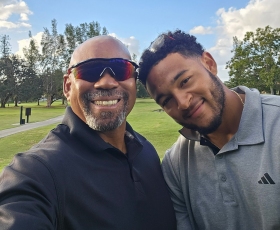 “Sometimes the lessons you learn as a kid you really don’t know when it’s going to come into play and you can implement them in your life. Some of the things he taught me along the way, they happen now as an adult, about how to handle somebody or a situation. I reflect on things now, and still ask him questions.”
Added his father, “We were in church every Sunday, giving God the praise. We are grateful. When you have that foundation, no one can knock you off it.”
On Father’s Day on Sunday, Scott II will be thankful that he has such a close relationship with his father.
“I don’t think there is any gift or anything like that that can repay my dad for everything he’s done,” Scott II said. “I just say, ‘Thank you’ and love on him every day.”
Photos courtesy of Liberatore and Scott families
Follow Rob Rains on X @RobRains