By Rob Rains
JUPITER, Fla. – Late at night, Casey Chenoweth would drive his 12-year-old car, a 2004 Buick Regal, into the parking lot of a 24-hour Lifetime Fitness facility in suburban Phoenix and try to make himself as comfortable as possible.
For about two months in the fall of 2016, with virtually no money but a dream that he didn’t want to abandon, Chenoweth drove to the parking lot, or occasionally to a Walmart parking lot, where he slept in his car.
“Everything I owned was in the car,” said Chenoweth, who was making a small amount of money giving hitting lessons to a pair of brothers, enough only to buy food and gas.
Despite what seems like an immense hardship, Chenoweth was not deterred by his situation. In fact, he had the opposite feeling.
“The craziest part about it is every time I go back and think about it, I was actually super happy and felt like I was in a really good place,” Chenoweth said. “I felt like everything I was doing, at least at that moment, was getting me closer to where I wanted to be.
“It was weird. I felt an immense amount of gratitude in life. I was surrounded by people who were challenging me to grow. It was a fun and exciting time. It almost didn’t feel like I was sleeping in my car.”
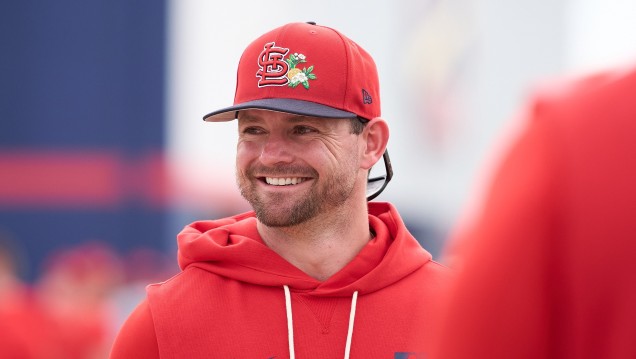
 Sitting in a lounge area in the expansive Cardinals’ spring training facility, Chenoweth knows that he never would be where he is today – beginning his new job as an assistant hitting coach in the major leagues – if not for his past experiences and the people he met along his journey who helped him when he needed it most.
“It’s a credit to him and his determination,” said Alan Zinter, who became one of Chenoweth’s mentors. “I would say most people couldn’t do what he did. It would just be disheartening and hard to stay focused and stay positive.
“It’s a credit to him and who his parents are and the way they raised him and the values that are instilled in him as a human being. Right away you could see it. To do it in the face of the adversity that he was facing at the time is a credit to who he is.”
At the time, Chenoweth still was hoping to fulfill the childhood dreams of a boy from Shaver Lake, a town in northern California that was so small he was one of eight kids in his eighth-grade class. His mother was one of his teachers in sixth, seventh and eighth grade. After playing in junior college, then two years at a small college in Oklahoma, Chenoweth had played independent league baseball before moving to Arizona to try to network and “be around” as many people in baseball as possible.
It was a leap of faith that Chenoweth was determined to pursue and some of the people he was around back then had no idea about where he went when they left the workouts and returned to their homes.
As Chenoweth spent those nights in his car, his phone would ding with one of several reminder messages that he had set up to help him maintain a positive focus. Those reminders are still on his phone today.
“Fail magnificently and keep moving forward,” was the first daily reminder message, followed by “Casey you are loved more than you will ever know.” The third reminder message read, “It’s not a matter of IF, it’s just a matter of WHEN. Keep moving forward.”
There is a reason those messages are still on Chenoweth’s phone. He doesn’t want to forget that period in his life. The positive attitude that drove him a decade ago is still a big part of who he is today.
“They’ve been a huge part of my whole journey,” Chenoweth said.
“I saw a lot of potential”
One of the people Chenoweth met back then was Arnold Flores, who owned a construction company in the area and sponsored youth teams that included his two sons. They were among the first kids Chenoweth was giving hitting lessons to when Flores found out that Chenoweth had no place to stay except his car.
“He was going to the gym and taking showers there,” Flores recalls. “It took a little bit to get it out of him because men have a tendency to have a little pride and not act like they need help.
“I saw a lot of potential. He helped all the kids, including my sons Xavier and Xzavian … He was hungry. He was chasing the dream and working on his game while he was working with the kids. It was awesome to sit and watch him.”
Flores invited Chenoweth to stay at his house, trying to free him from the burden of sleeping in his car.
“I’m glad I was there at the right time,” Flores said. “Everything happens for a reason. God put me in his path to guide him and lead him in the right direction. You don’t quit. You run into some roadblocks, walls, and you have to figure out how you are going to get over them or go under them.
“He had the drive. One way or the other he was going to make it in baseball … When you wake up every morning you’ve got a choice. He had that drive to get better. Every day he was there working.”
Flores was not the only one watching what Chenoweth was doing, unaware at the time of his personal obstacles. That’s when he met Damion Easley, a former major-leaguer who owned the D-Bat training facility, and Zinter, at the time the minor league hitting coordinator for the Giants. Chenoweth was working with Zinter’s son, Michael.
“He always just seemed to be around,” said Easley, who now is an assistant hitting coach with the Diamondbacks. “When he first started coming around, we didn’t have any spots available. He didn’t even really ask for a job at that point and time but you could tell he was interested in hitting and learning.”
There was a group of major leaguers working out at the facility, as well as kids, and Chenoweth was able to watch and learn – all the time talking about hitting to anyone and everyone.
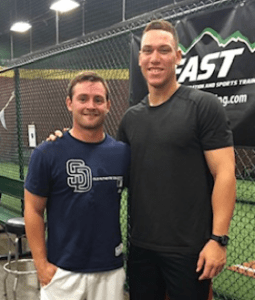 Chenoweth was there the day Aaron Judge dropped by to hit. A 16-year-old kid who also was there that day, whom Chenoweth did some work with at the time, was Nolan Gorman.
Chenoweth’s college degree was in kinesiology, and he loved studying how the body moves and a hitter’s swing. While he was dissecting and looking for ways to improve his own swing, he was offering tips and suggestions to both pros and kids alike.
Easley was impressed and offered him a deal – he would let him hit and work in the cages in exchange for Chenoweth moping the floors at night and helping out at the front desk. It was a deal Chenoweth quickly accepted.
“I loved the passion and enthusiasm that he always had,” Easley said. “He always had a good attitude.”
That was something Zinter noticed as well when he watched Chenoweth working with his son.
“I really liked the way Casey was treating the kids,” said Zinter, now a minor-league hitting coach with the Royals. “You could tell he was very intelligent and had a passion for the game.”
While he was finding working with hitters appealing, Chenoweth’s dream was still to play. On Feb. 20, 2017, he had a tryout with the Texas Rangers. He went 3-of-4, including a home run.
“I thought it was the best day of my life and my dream was coming true,” Chenoweth said. Instead, he was told he should go back to an independent league team.
He played that summer for the Eastside Diamond Hoppers in the United Shore League in Utica, Michigan. When the season ended, Chenoweth made the long drive back to Arizona, where this time luck was on his side. There was an opening at D-Bat, and Easley gave Chenoweth enough money so he could pay for an apartment.
He was about to get even better news when his phone rang one day. David Bell was calling.
Bell had left the Cardinals coaching staff in October 2017 to become the Giants director of player development. The organization had an opening for a hitting instructor at the lowest level in their farm system, in the Dominican Republic, and Bell wanted to find out if Chenoweth would be interested.
Zinter had recommended Chenoweth for the job. About the same time, Chenoweth met Brant Brown, then the hitting coach for the Dodgers, and he arranged for Chenoweth to also have an interview with them.
Bell had Chenoweth fly to San Francisco for the interview.
“Alan had highly recommended him and said he was young, hadn’t done this, but really believed he could be good,” Bell said. “We kind of identified what at least at the time for us was a real unique challenge we were going to present him with.”
During the interview, Bell asked Chenoweth, ‘How’s your Spanish?’”
Chenoweth replied that he had taken four years of Spanish in high school and answered, “decent,” which, he would soon find out, turned out to be an incorrect response.
The two went out for coffee after the formal interview and continued talking. Bell said the Giants wanted Chenoweth to go work as a hitting coach at their academy in the Dominican Republic, filled with young Latin players, and he would also live at the facility.
It was a month after Chenoweth’s 25th birthday. As he considered the offer, Zinter reached out to him.
“He told me, ‘I know you want to play in the big leagues, but don’t let the hopes of your playing career get in the way of what your coaching career could be,’” Chenoweth was told. Zinter added, ‘You can still make it to the big leagues.”
Chenoweth called Bell and accepted the job.
“’I think you have a bright future in the game,’” Bell told Chenoweth. “He (Bell) saw my career and future before I did.”
What Chenoweth didn’t know as he prepared to move to a foreign country was that his future was going to begin with the hardest challenge of his life, worse even than having to sleep in his car.
“It literally changed me as a person”
One of the first things Chenoweth learned after arriving at the academy was that his knowledge of Spanish was very insufficient.
“I learned very quickly I knew almost zero Spanish,” he said. “I just took it as a huge opportunity for my own personal growth. I was taking classes in Spanish when the kids were taking English classes. I was reverse learning. I became close with the teacher and she gave me kids’ books to read and asked me to write poems and practice my listening skills. It was a huge part of my life.”
Learning the language was only part of the challenge Chenoweth was facing. At the academy, the wi-fi was spotty. He didn’t have a television. And he usually was the only American there.
“It definitely was harder than living in my car,” he said. “It literally changed me as a person. It was almost like the early part of it felt like 10 years and the end of it was like it was gone in a flash. I dove into meditation and was curious about so many things that it kept the baseball and life balanced.”
He talked often to Bell and Zinter, both of whom kept offering encouragement.
“Not only was he able to overcome the language barrier, it was great for his development,” Bell said. “It also created empathy and being able to relate to other people’s challenges. I believe it was extremely valuable but at the same time not easy at all.
“I appreciated so much that he trusted me enough and leaned on me to be vulnerable and just be able to talk through some of the challenges … Not everybody could do what he did, especially at that age.”
 Zinter told him, “Once you get through this you can handle anything, and he was able to do that. Now he’s fluent in Spanish and he did that in three or four months. He met it head-on. It wasn’t easy.
“He stuck to it. There were times when the power went out. The television didn’t work. He has some really good stories he can share the rest of his life and draw from when things aren’t going well.
“There were a few times when he said, ‘I don’t know if I can do this,’ but it was just him venting a little bit. He was sharing with someone he could confide in but by no means did he ever quit.”
On the baseball side, Chenoweth also had to learn the value of patience. He was super aggressive and eager to teach what he knew, and both Bell and Zinter had to caution him to keep his instructions simple.
“He was trying to step on the gas pedal a little too fast at times, just as any young rookie or rookie coach would do at that age,” Zinter said.
Chenoweth learned the value of developing relationships, of listening to hitters, of understanding that no two hitters are the same or want to be coached the same way or learn the same way. Those were all lessons that he continued to use as he spent another year in the Giants system, in Arizona, and when he moved on to the Diamondbacks as a hitting coordinator, hired by Bell’s brother, Mike, after Bell left the Giants to became manager of the Reds.
“Everybody in that clubhouse, in every clubhouse, they are all going through something different and they are all feeling something different, with their swing or even off the field,” Chenoweth said. “Where I took it a little personal was when I wasn’t able to reach certain players or guys who were struggling for whatever reason. I wanted to grow and continue to elevate myself and I felt there wasn’t a guy in the clubhouse that I couldn’t reach. I never wanted the credit for anybody’s career. I just wanted to help.
“I looked more at the guys I couldn’t help or wished I had done something different. Who I am as a person is somebody who thrives more on empathy and blessing and my faith and stuff. I want to be more of a servant leader and teacher.
“My mom was a teacher and she teases me to this day ‘You said you didn’t want to be a teacher but then you became a coach, which is basically a teacher.’ I told her, ‘I learned that from you.’”
Zinter, who also has been a hitting coach in the major leagues, can relate to what Chenoweth was feeling.
“As a hitting coach with 15 players or so you are never going to have all 15 feeling good about themselves, so you can never be happy,” Zinter said. “He learned right away you will have sleepless nights thinking. In pro ball a lot of these kids’ windows end up closing because you just don’t have enough time to help them. It’s an execution-based industry, not just about being a ‘good guy and working hard’ industry.”
Even after both Bell and Chenoweth left the Giants, they remained close. Bell is now the vice president of baseball operations and assistant to the GM of the Bluejays.
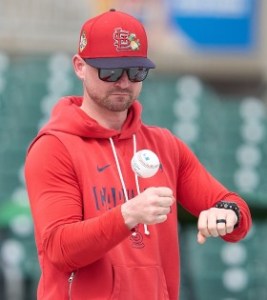 “He’s such a positive person which is a big reason he is so good as a hitting coach,” Bell said. “He was so focused and grateful for opportunities.
“He has the knowledge to help hitters and also develop people but probably more important than anything else – I really believe people that are around him, hitters who are around him, can see how much he cares. You can’t fake that and because of that, there’s a lot of trust that can be built.”
Chenoweth was working for the Diamondbacks when Covid canceled the 2020 minor-league season. He used that time to take on-line psychology classes at Yale and a class entitled ‘How to Learn,” from UC-San Diego.
Married in 2021 and living in Arkansas, Chenoweth and his wife also decided he should try to see if any teams from the Midwest had openings for a hitting coach. One team did – the Cardinals.
“He wants to teach but he wants to learn too”
Chenoweth was hired as the hitting coach for high Class A Peoria in 2023. A year later he was promoted to Double A Springfield, where he had the chance to work not only with most of the organization’s top prospects, but also major-leaguers going through rehab assignments.
All quickly learned what Bell, Zinter and the hitters Chenoweth had worked with in the past had learned.
“Casey knows hitting and he knows swings but he also knows how to let guys just go through their process and trust in them,” said JJ Wetherholt. “He’s a guy players can have a really good relationship with and also get their work in.”
Joshua Baez also got to know Chenoweth after he was promoted to Springfield last season.
“As soon as I got there he started to get to know me,” Baez said. “We just kind of clicked. He knew what worked for me and what didn’t and he put me in a good spot to hit.”
Jordan Walker worked with Chenoweth when he went to rehab in Springfield.
“He wants to teach but he wants to learn too,” Walker said. “He asked me a bunch of questions my first day I got there, how I worked and things like that, and the next day he had a plan on what I should be doing. I really like working with him.”
Patrick Anderson was the Peoria manager in 2023 and rejoined Chenoweth last season when he took over as the manager in Springfield.
“He’s a hard worker, he gets after it,” Anderson said. “He understands the body, he understands people and he understands all different realms of hitting and relationships. He’s one of the better ones I’ve been around. He does a great job of creating environments for these players to get better.
“I learned a lot from him. He helped me out with some of the analytics information and metrics for me to be able to grow. It was a treat to be able to work with him and I am so proud and happy he is getting this opportunity. The organization is going to get better because of it.”
Rob Cerfolio didn’t know Chenoweth – but had heard his name – before he left the Guardians to become the Cardinals’ assistant general manager in charge of player development in the fall of 2024.
“It’s just fun to watch him go about his work and to get to know him and build a relationship and to hear what players say about him,” Cerfolio said. “He’s a pretty impressive product.”
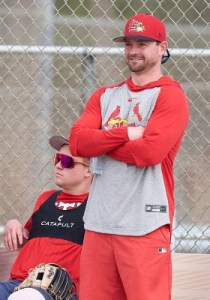 Chenoweth knows he is not a finished product by any means. He is 33 now, the father of 2 ½-year-old and six-month old daughters, and is still learning every day. His goal with the major-league club is to see that growth continue into the future, the same future Bell and Zinter saw in him almost a decade ago.
“When players come up to you and tell you the impact that you had on them, that’s the feel good for me,” Chenoweth said. “You run into all sorts of types of coaches and people in this game. It’s a team game but it’s also a very selfish game.
“Once I got into this role (coaching) I was so young I wanted to seek out and look and see all different styles of teaching because hitting is so hard. There are so many ways to do this and even more ways not to do it. I wanted to study as much as I could.
“I am a very curious person by nature and the brain and mind is super fascinating to me. The body is controlled by the brain and mind.”
Bell was not surprised when Chenoweth called to tell him he was moving up to the major league staff – where he will be flying on chartered jets and staying in five-star hotels.
It was the future Bell expected.
“I think over all these years I’ve learned more from Casey than he’s learned from me,” Bell said. “Looking back it was an honor to be there for him at that time and really build a foundation for a friendship.”
Chenoweth met Bell at the right time in his life and he believes now he is right where he is supposed to be as well.
“I’m super grateful to be here,” he said. “From the day I joined the Cardinals I think I was in the right place at the right time. That’s kind of been the definition of my life.”
Follow Rob Rains on X @RobRains
Cardinals photos by Taka Yanagimoto/St. Louis Cardinals
Springfield photo courtesy of Springfield Cardinals
Photo of Chenoweth and Aaron Judge courtesy of Casey Chenoweth
Cardinals fans, sign up for our free newsletter: CLICK HERE.