By Rob Rains
In Matthew Liberatore’s first professional at-bat, he got an idea of what it looks like to step in the batter’s box and stare out at a lefthanded pitcher on the mound, 60-feet, 6 inches away.
It was in Memphis in 2021, and Nashville’s Aaron Ashby was on the mound.
“He was throwing 95 to 98 with a heavy sinker ball,” Liberatore said. “I didn’t see it.”
Liberatore struck out, as he did 25 times in 29 at-bats that season.
“My favorite rules change was to stop letting pitchers hit,” he said.
 Liberatore much prefers to be on the other side of the pitcher-hitter matchup, and as a lefthanded pitcher, he made an interesting comparison about what it’s like for hitters to face lefthanded pitching.
“It’s kind of like if you go to another country and drive on the opposite side of the road for the first time,” he said. “You know how to do it, but it is weird and it does feel uncomfortable.”
There have been times in his career when Liberatore was the only lefthanded starter on the roster, sometimes one of the few lefthanders in the organization, but those days may be changing for the Cardinals.
He will be the first lefthander to start on opening day for the Cardinals in Thursday’s game against the Rays at Busch Stadium since Donovan Osborne started the opener in 1999, the same year Liberatore was born. He is only the second to draw that assignment since Joe Magrane started three openers in a row from 1988 to 1990.
As Liberatore looked around at all the pitchers in the Cardinals clubhouse during spring training, he was surrounded by fellow lefthanders no matter which way he turned.
The Cardinals say it was not an intentional strategy to load up on lefthanded pitchers but now that it has happened, they hope that going forward it will give them an advantage.
“Generally, the advantage that lefthanders have is that hitters see them less frequently and are not as used to seeing the shapes of pitches from that side,” said Rob Cerfolio, the Cardinals’ assistant general manager in charge of player development and yes, a former lefthanded pitcher himself at Yale.
As Liberatore looked around the clubhouse, he knew that he is the only current lefthander in the starting rotation, but that might not be the case for long.
Using the prospect rankings of both MLB Pipeline and Baseball America, eight of the Cardinals top 30 prospects are lefthanded starters, including one – Liam Doyle, their top pick in last year’s amateur draft – who wasn’t even in the big-league camp this spring, working on the minor-league side.
Doyle is ranked as the number two prospect in the organization, behind JJ Wetherholt, and is followed in the rankings by fellow lefthanders Quinn Mathews, Brycen Mautz, Brandon Clarke, Ixan Henderson, Cooper Hjerpe, Cade Crossland and Braden Davis.
How rare is it to have that many top prospects who are lefthanded pitchers? One way to answer that is to look at the top 30 prospect rankings of the other five NL Central teams as this season begins. There are a combined total of seven lefthanded pitchers in that group, out of 150 ranked players, one less than the Cardinals’ have in their top 30.
Matt Pierpont was hired as the Cardinals director of pitching last season and immediately noticed when he arrived that the team had several lefthanded prospects.
“Seeing all of them it was like, ‘This is cool,’” Pierpont said. “Then we go into the draft and make trades and get more. It’s not like we’re intentionally looking for lefthanded pitching, that’s just kind of the way it is.”
Pierpont said he had not studied the list of top lefthanded prospects in other organizations and was surprised the Cardinals had such a big advantage, especially compared to the other teams in their division.
“That’s crazy to think about,” he said. “We do have a bunch. It’s interesting. I knew it was different but hadn’t really looked at other teams.”
It hasn’t always been that way.
Where were the lefties?
After Jaime Garcia left the Cardinals following the 2016 season, the drought of lefthanded starters began. Beginning with the 2017 opener, through the final game of the 2020 regular season, the Cardinals played 544 games.
Twenty-eight of those games, or about 5 percent, were started by a lefthander. More than half of those starts, 15, came from Austin Gomber.
The 2021 rotation included Kwang Hyun Kim at the beginning of the season, and the Cardinals added Jon Lester and J.A. Happ at the trading deadline, and combined, had 52 starts that season by lefthanders.
In the last two seasons, the Cardinals have had 46 games started by a lefthander, 35 of them by Liberatore, out of 324 games, about 14 percent of the games in 2024 and 2025.
“You see it less often so by default it comes at a premium,” Liberatore said. “I think it’s a frequency thing, it’s an angle thing, it’s a shape thing. You don’t see it as often; it comes from a different angle and the way the ball moves is the opposite of what hitters are used to seeing.”
A survey of hitters in the Cardinals’ clubhouse produced the same conclusion.
The Cardinals registered 6,069 plate appearances in 2025 and just 28 percent of them, 1,682, came against a lefthanded pitcher.
“As a lefthanded hitter the ball just gets on you quicker,” said Nolan Gorman. “You don’t see as many of them, and there’s a little timing difference. Sometimes they don’t throw as hard, and that also becomes a timing issue.”
Even before he reached the major leagues, Jordan Walker said he didn’t remember facing very many lefthanded pitchers.
“The ball just looks different coming out of the pitcher’s hand,” he said. “There are so many things you have to think about when you are hitting – spin, stuff like that. It (the ball) is coming from a different side, and you just aren’t as used to it.”
In the little more than a year that JJ Wetherholt has spent in professional baseball, he has seen how lefthanders try to attack him differently than righthanders.
“What they are really trying to work on is the sinker in, which is tough sometimes if they execute it well and get it in on your hands,” Wetherholt said. “Then they go soft away with sliders. For me, I usually try to stick to my strengths and try to hit mistakes out over the plate.
“It’s never going to be my best matchup, but I just try to stay focused and if they make a mistake, I need to hit it.”
It’s been 36 years since lefthander Ricky Horton last threw a pitch in the major leagues, in 1990, but he has been watching the Cardinals ever since as one of the team’s broadcasters.
One thing that he has noticed, which he believes will help give the Cardinals an edge going forward, is if they do have more than one lefthanded starter.
“I still think about how close Ken Dayley and I were,” Horton said. “Even though he was a reliever, we would have our own meetings about how to face guys on the other team. Generally, we had the same approach.
“How did Darryl Strawberry react to the fastball in? We’d have a team meeting, and then a pitcher’s meeting, and then I would meet with Ken. It was priceless for me to watch (John) Tudor do what he did. Greg Mathews was similar to me and we were always sharing information.”
Horton believes that it is still an uncomfortable at-bat for many hitters, both righthanded hitters and lefthanded hitters alike, when they face a lefthander.
“George Hendrick used to say that he didn’t want to hit against lefthanders,” Horton said. “He said, ‘All they do is throw tables and chairs at you.’ I didn’t know what that meant, but that’s what George would say. He wanted to face a righthander that he was used to seeing on a daily basis.”
Even after he started broadcasting, Horton was still called upon in the early 2000s to throw batting practice when the team was on the road.
“I was throwing to Albert (Pujols), Scott Rolen, (Jim) Edmonds, (Mike) Matheny, that era,” Horton said. “All the coaches were righthanded. I was glad to do that.”
Horton has always maintained that lefthanders are “just different.”
“People don’t even like playing catch with lefthanders because the ball had movement to it,” he said. “It just seems like the natural way the ball finishes, it’s running a certain way. I can’t prove the spin rate is different but I wouldn’t be surprised.”
Here come the lefthanders
The transition to having more left-handed starters was evident last season at Double A Springfield. En route to winning the Texas League championship, the Cardinals had a combined 76 starts in their 138 games from the lefthanded trio of Mautz, Henderson and Pete Hanson. Mathews made 22 starts at Memphis.
 Doyle was a starter at Tennessee last spring before he was drafted by the Cardinals in July with the fifth overall selection. He likely will begin this season at Springfield, but the Cardinals have not announced the opening-day rosters for their minor-league affiliates.
The Memphis rotation is expected to include at least two of the organization’s top prospects to begin the season, Mathews and Mautz. Mathews, 25, is looking to have a bounce-back season this year after struggling with his control last year. In 2024, he was Baseball America’s Minor League Pitcher of the Year in his first pro season after he was drafted out of Stanford in the fourth round in 2023.
Mautz, 24, spent last season at Springfield, where he finished third in the league ERA race. He was the Cardinals’ second-round pick out of the University of San Diego in 2022.
The Springfield rotation also could include Crossland and Davis, both 22-year-olds and drafted out of Oklahoma, Davis in the fifth round in 2024 and Crossland in the fourth round last year.
Davis split last season between Palm Beach and Peoria, recording 153 strikeouts in 110 innings. Crossland did not pitch after last year’s draft.
Two of the other top left-handed prospects, Henderson and Clarke, are expected to open the year on the injured list. Henderson, who had the lowest ERA in the Texas League last season, did not pitch in the major-league spring camp after suffering a strained flexor tendon. When he is healthy, Henderson, 24, likely will be part of the Memphis rotation. He was an eighth-round selection in the 2023 draft out of Fresno State.
Clarke, acquired from the Red Sox over the winter, is recovering from surgery to relieve numbness in his fingers. The 22-year-old Clarke likely will begin in Peoria when he is ready to pitch.
Hjerpe, the Cardinals’ first-round selection in the 2022 draft, is recovering from Tommy John surgery and is expected to resume pitching later this summer.
One more prospect ranked just outside of the top 30, Mason Molina, is another name to watch. The 22-year-old finished last year at Peoria after he was acquired in the trade that sent Phil Maton to the Rangers last summer. He could return to Peoria to begin the season or perhaps move up to Springfield, depending on other roster decisions.
With six of the top 86 picks in the amateur draft this summer, it’s quite possible the Cardinals could add even another lefthanded prospect to their group.
 Mathews and Mautz both like the fact that the organization has so many promising lefthanders.
“You just don’t see it,” Mautz said. “A lot of times you are the only lefthander in the rotation. You don’t get the same reads from hitters. But when you watch two other guys (lefthanders) throw, you get a better idea of where hitters are.
“When you have so many lefthanders in the system, the odds that you are going to get all of them to the big leagues is probably pretty small.”
Still, from what Mathews has seen of the group, he likes their chances – and he also thinks it could soon give the Cardinals an edge over their opponents.
“It’s definitely a premium (position),” Mathews said. “Not all of these guys were top two (round) draft picks so it’s a credit to all of us. It’s definitely an asset.”
Not to be forgotten, however, is the fact that all of the lefthanders will be competing for roster spots with a pretty strong group of righthanders as well, including current starters Michael McGreevy and Kyle Leahy, who figure to be part of the team’s future, along with Richard Fitts, Hunter Dobbins, Tekoah Roby, Tanner Franklin, Jurrangelo Cijntje (who also throws lefthanded too), Tink Hence and Chen-Wei Lin.
“Having a lot of great pitchers is more of the advantage whether they are righthanders or lefthanders,” Pierpont said. “We’re just trying to continue to bring the best talent into this organization and allow them to compete against each other.”
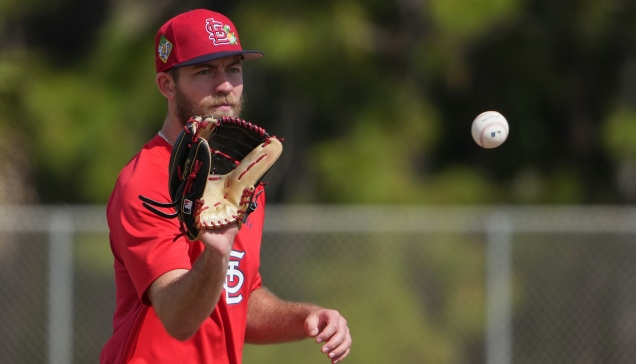
Photo of Matthew Liberatore by The Associated Press
Inside photos of Liam Doyle and Quinn Mathews
Follow Rob Rains on X @RobRains