
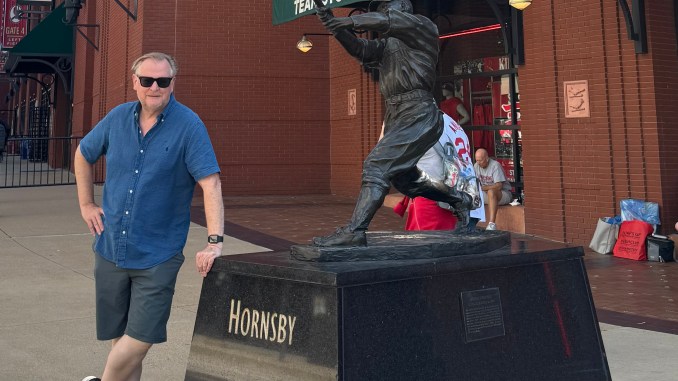
By Sally Tippett Rains
Terry Lemons’ life has gone full circle. He started out in St. Louis, went off and had an exciting life and now has penned a book about the Cardinals that’s been released just in time for Father’s Day. His book is as interesting as his life has been so far.
Lemons grew up in St. Louis as a Cardinals fan and has deep ties to the area. His mother was long-time food writer Ann Lemons Pollack. His stepfather was the well-known writer Joe Pollack, who was the public relations director for the football Cardinals in the 1960s and then had a long career as a food and entertainment critic at the St. Louis Post-Dispatch.
His mother wrote five books, two by herself and three others co-authored with her husband. These were regional guidebooks about food. So writing a book would seem to be second-nature to Terry Lemons.
His new book, The Year St. Louis Became a Baseball Town: The Cardinals, Babe Ruth, and the 1926 World Series (published by The History Press) explores over 192 pages how the legendary 1926 World Series upset sparked St. Louis’s enduring baseball obsession. With a legacy of 11 World Series wins, the Cardinals are intertwined with the culture of the St. Louis region.
Lemons said the city’s famous baseball obsession can be directly traced back 100 years to an epic season and dramatic World Series that riveted St. Louis and large parts of the country. Like many other fans, Lemons said he grew up surrounded by Cardinal culture.
Always a Cardinals fan
“I’ve always been a Cardinals fan,” said Lemons. “Back in the 1960s, one of my earliest memories was lying in bed listening to the Cardinals on a very staticky KMOX as noisy thunderstorms rolled through.”
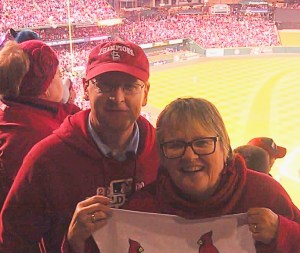
He remembers the first two Cardinals games he went to. It was 1971 and the first one was with a babysitter, and the next one was with his mother. Over the years, there have been other games with his mom even though he has lived outside of St. Louis for many of them. They are shown in the photo at a game together.
“With both of those first two trips to Busch Stadium, I was ecstatic to see Bob Gibson pitch,” he said. “Naturally, with him pitching, the Cards won both games. So I was hooked as a fan.”
He had several favorite players; both were pitchers.
“Gibson was my childhood hero,” he said. “It was always a special day for me when I saw in the newspapers that he was pitching. As an adult, I admired John Tudor and how he bounced back from a 1-7 start in 1995 to finish 21-8. Both Gibson and Tudor are, in their own ways, profiles in resilience.”
Growing up in St. Louis, he loved to watch and listen on the radio to all the exciting Cardinals baseball. As with all St. Louisans, loving the 1960s and ‘80s teams and just making it through the 1970’s.
After high school, he did what many journalism-bound students do: He attended the University of Missouri, getting his degree in 1985.
Lemons says Joe Pollack was a big influence on his journalism career – even before Joe met his mother. At the old Southwest High School in St. Louis, Lemons used one of his future’s stepfather’s Post-Dispatch articles as a template on how to write a movie review for his first article in the school newspaper.
“Later, Joe was gracious enough to connect me in 1984 with Bill McClellan as I was getting ready to be a summer reporting intern at the Phoenix Gazette; Bill had been out there working before he came to the Post,” Lemons said.
So in between his junior and senior year at Mizzou, he did an internship in Phoenix. He got his first job right after graduation.
“I went to the Springfield News-Leader that summer to work as a general assignment reporter,” Lemons said.
As fans remember, 1985 was a big year in Cardinals history, but he didn’t miss it by being in Springfield.
“In many ways, Springfield is just as baseball crazy as St. Louis,” Lemons said. “You have both Cards and Royals fans there. So the 1985 World Series was a huge deal. I lucked out into going to Kansas City to do a color piece on Game 1 of the I-70 Series. The opening for my book is from that day. It’s an anecdote about Cardinal fans literally trying to trade their car for World Series tickets. I found that same kind of passion back in 1926.”
Though he was raised around well-known people, they were just parents to him. So covering the 1985 World Series at a young age was a big thrill.
“I had to pinch myself when I passed Jack Buck in the hallway in the media center,” Lemons said. “That was a big surge of adrenaline.”
Jack Buck would not be the most famous person he worked around for long because his next job was in Little Rock at the Arkansas Democrat-Gazette as a news reporter.
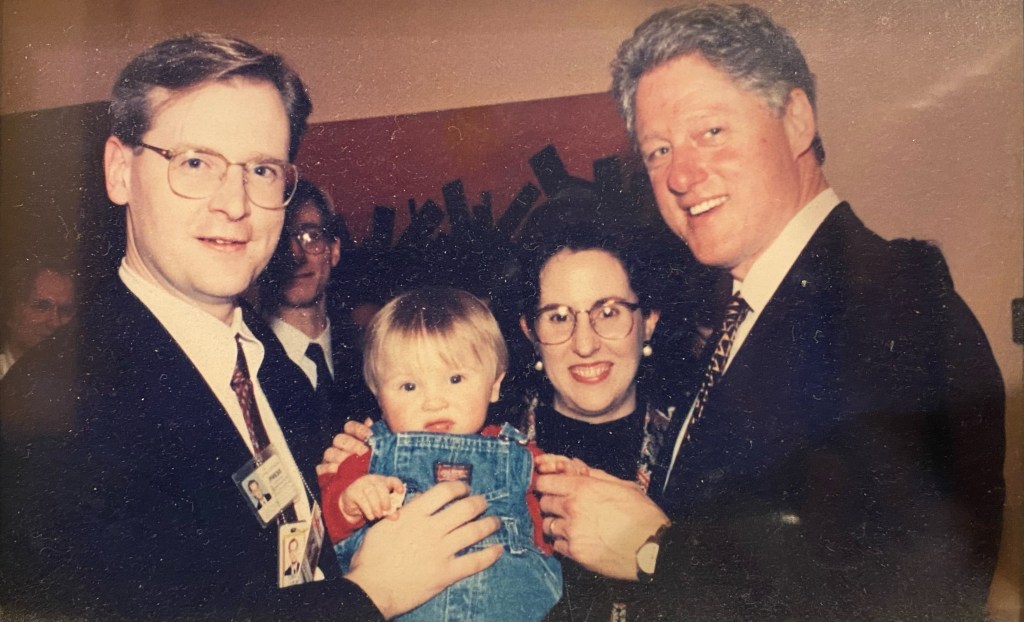
This was during the time Bill Clinton was governor of Arkansas. Shortly after Lemons and his reporter wife, Jane Fullerton, arrived in Little Rock at the Democrat-Gazette, Clinton decided to run for president.
Years with Bill Clinton
“We got in on the ground floor of covering the Clinton presidential campaign in 1991,” he said. “After that, things really took off!”
Clinton is known for being a sports fan. Growing up in Arkansas, he was a Cardinals fan as a youngster. He listened to Harry Caray on his transistor radio at night, and according to reports would take the train to St. Louis to watch Cardinals games. Once he met Chicago native Hillary Rodham, he toned down his Cardinals fandom a notch and started to embrace the Cubs as well.
“He’s an avid sports fan, and he carried that with him to Washington,” said Lemons. “That balancing act of being a Cards fan and Hillary’s Cubs attachment is a reflection of his political skills.”
Clinton also continued to embrace the Arkansas Razorbacks. Though he was born in Hope, Arkansas, he got his bachelor’s degree at Georgetown and later went to Rhodes and Yale, but he maintained his home-state love for the Razorbacks.
As Clinton made the move to Washington, D.C. so did Lemons where he covered Congress and the Clinton White House.
“There was lots of excitement at the White House with all the Arkansas people in Washington when the Razorbacks won the 1994 NCAA Tournament,” Lemons recalled. “Clinton would frequently make sports-related comments. In some ways, he was just as versed in sports as international issues.”
Lemons noted it could be hard to trade baseball stories with a governor or president: “When you’re in a competitive news environment and you have a chance to interview a governor or a president, it’s tough to chit-chat about sports when you’re trying to quickly ask questions to make news”
After covering Clinton, there came a time when Lemons started noticing the newspaper climate around the country changing. With the Clinton administration starting to wind down, he talked to his mom and Joe about the challenging situation given their media experience. Lemons decided to make a career change to stay in Washington, so he took a communications job at the IRS and finished his journalism career there until his planned retirement last year —or so he thought before he got the book idea.
“Joe was literally the last person I talked to before making my career change in 1998 to jump from the Arkansas Democrat-Gazette to start doing public relations for the IRS in Washington,” he said. “He agreed with my assessment that newspapers were struggling, and it was a better move for me and my family to reinvent myself on my own terms.”
He later spent 25 years running national communications for the Internal Revenue Service in Washington. As he prepared for his IRS retirement, he got the idea to do the book. Now when he says he’s the author of a book about the Cardinals, he might be a little more welcome than when he said he was with the IRS.
“It was a nice change of pace to shift my focus on taxes away from government and how the Cardinals’ hitters taxed opposing pitchers in 1926,” Lemons said. “But even in 1926 I couldn’t escape taxes completely. City leaders were quite focused on collecting taxes from World Series ticket scalping in 1926.”
His book focuses on the 1926 World Series, but it’s more than just what happened on the field. It’s also about what happened around the games and how fans reacted to the season and the championship. The book shows how 1926 changed the culture of St. Louis, creating the city’s obsession with baseball.
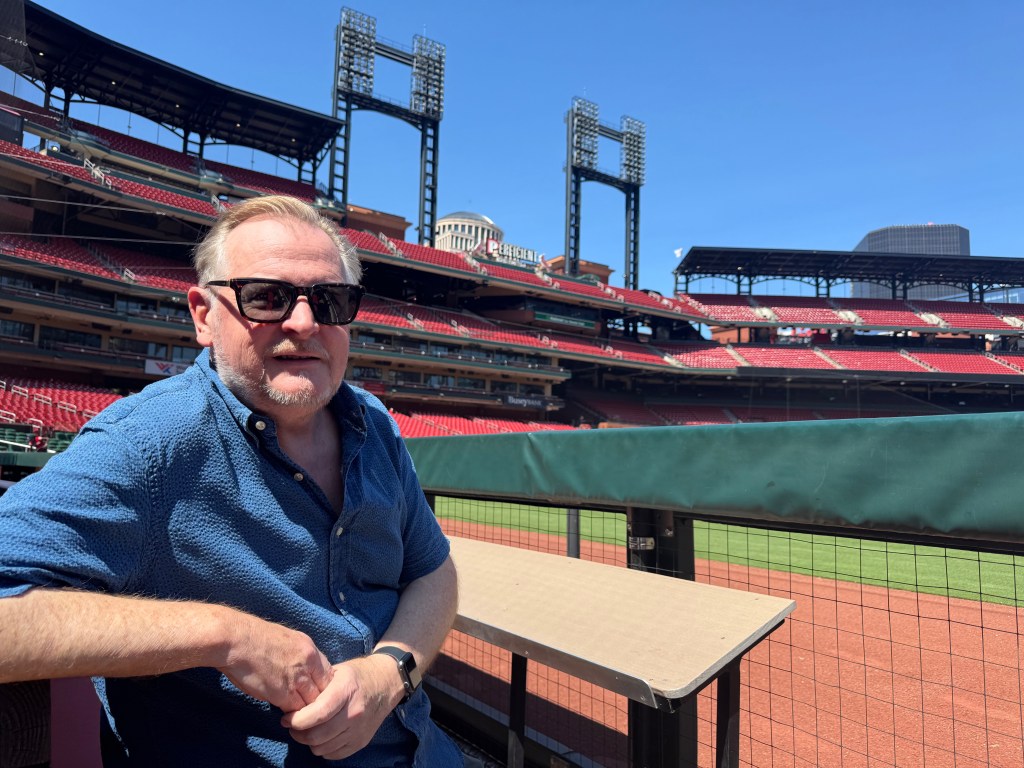 “Like many fans, I knew some of the basics about the classic 1926 World Series with Grover Cleveland Alexander’s dramatic performance and Babe Ruth getting caught stealing second base to end Game Seven,” he said.
“After I did a little initial research a few years ago, I realized there were even more fabulous stories about 1926 that had been forgotten. And those stories were not just on the field, but equally interesting was what happened off the field for fans. It really changed the culture of St. Louis and for fans across a huge part of the country, and you can still see the after-effects today.”
About the book
“The Year St. Louis Became A Baseball Town” is set at a pivotal juncture in the nation’s history, and surprising nuggets emerge in the book:
- Some 100,000 fans jammed downtown St. Louis streets repeatedly throughout the fall for boisterous celebrations as the Cardinals pursued their first World Series win.
- The book shares a new revelation and details about pioneering aviator Charles Lindbergh’s role with the Cardinals and the World Series.
- Radio plays a central role as well. St. Louis radio stations like KMOX aired the first Cardinals games in 1926. Nationally, other radio stations banded together to cover the World Series in a group that would be transformed into the NBC Radio network just a few weeks after the games concluded.
- Massive crowds gathered outside newspaper offices across Missouri, Illinois and from coast-to-coast to track the World Series results, turning large parts of the nation into “Cardinal country.”
More details are available at his website, www.1926baseball.com
Where the book is available: Published on June 9, the book will be available in Missouri and Illinois at bookstores, Target, Walgreens and other locations where Arcadia Publishing books are carried. The book is also available online in both hardcover and softcover at Arcadia Publishing, Amazon, Barnes & Noble and other locations.
Book signing: And in a homecoming for Lemons, The Royale will host a book launch and signing party for him on Saturday, July 11. The event – open to the public – will be from 4-7 p.m. at the South St. Louis bar and restaurant, located at 3132 S. Kingshighway.
Author
-

Sally Tippett Rains started her sports media career at KMOX Radio Sports (writing/producing for Bob Costas, Jack Buck, Bill Wilkerson) in the late 1970′s, early ’80′s then switched to book writing and charity work while raising their children.
 Currently she is content manager for STLSportsPage.com and author of 11 books, many in the sports genre.
She also wrote "Choose Happy; Find Contentment in Any Situation," which comes in Black & White or Color versions.