

By Terry Lemons
With the Cardinals Hall of Fame induction weekend approaching, fans shouldn’t overlook a vital piece of baseball history right next to the ballpark. That’s the actual Cardinals Hall of Fame and Museum.
Located in Ballpark Village, the museum galleries hold artifacts from across the team’s history stretching from the franchise’s early years up through accomplishments of the three newest Cardinals Hall of Fame inductees. Albert Pujols, Yadier Molina and Bill “Wee Willie” Sherdel will be inducted at Busch Stadium on Saturday, Sept. 12.
The 8,000-square-foot gallery is packed with a treasure trove of game-used relics. Fans may not realize that the museum collection includes more than 25,000 pieces of memorabilia, the largest of any Major League Baseball franchise and second only to the National Baseball Hall of Fame and Museum in Cooperstown, N.Y.
“We have an amazing number of pieces in the collection, and there’s so many that we can’t display them all at one time,” said Museum Curator Amy Berra. “That means we can rotate the pieces and update displays on a regular basis.”
That also means that if fans haven’t visited in a while, they’re going to see different things on a return visit.
This year, two special exhibits are featured.
The museum has a special “2006” exhibit that celebrates the 20th anniversary of the Cardinals’ unexpected October surge in the playoffs in the first year of Busch Stadium III. Anchored by Pujols, Molina, and World Series MVP David Eckstein, the Cardinals emerged from a dramatic seven-game National League Championship Series against the New York Mets to defeat the Detroit Tigers in 5 games.
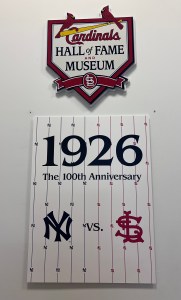
And to mark the 100th anniversary of the first Cardinals’ championship, Berra and the museum team have assembled a detailed array of memorabilia around the Cardinals’ 1926 World Series against Babe Ruth and the New York Yankees.
“This started the legacy of great Cardinals teams,” Berra explained.
The items, some on loan from Cooperstown, run the gamut of the seven games played in the 1926 World Series. There’s the first ball used in Game 1 of the World Series, thrown to Cardinal outfielder Taylor Douthit.
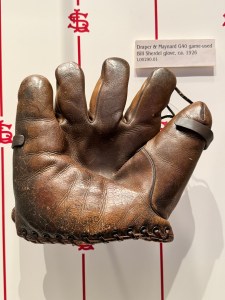
And there’s the baseball glove of Sherdel, the St. Louis starter for the opening game and Game 5. Sherdel’s glove served him well during his career, topping Cardinals history with 153 wins by a left-hander.
Many of the artifacts in the museum – like Sherdel’s glove – were donated by family members.
“We sent a number of items to the museum, including the glove,” explained John Sherdel, who will deliver the Hall of Fame induction speech for his grandfather.
The exhibit reflects the Yankees as well, with Ruth as a focal point. Ruth’s Game 4 was one for the history books, as he unleashed a World Series record of three home runs.
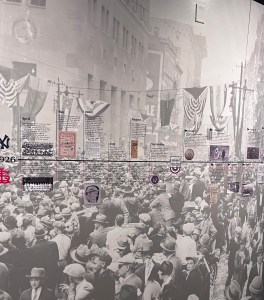
Just as Ruth’s famed presence hovered over the games, a panoramic shot of Sportsman’s Park on the outfielder’s famous day overlays part of the exhibit. The black and white picture was taken from the right field stands, a few minutes after Ruth hit a towering shot over the photographer’s location and out of the stadium. The ball bounced off Grand Boulevard and shattered the window of the Wells Motor Company across the street from the ballpark.
But much of the exhibit focuses on the Cardinals, including the World Series ring presented to pitcher Grover Cleveland Alexander.
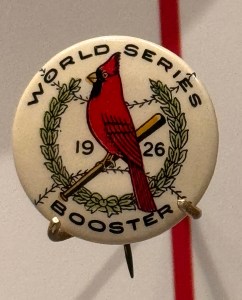
The aging alcoholic pitcher, cast-off mid-season by the Cubs, emerged as the pitching star of the Series. He won Games 2 and 6. Potentially sporting a hangover after celebrating his Game 6 win, Alexander was summoned from the bullpen in Game 7 to escape a bases-loaded jam in the seventh inning with St. Louis clinging to a one-run lead. Alexander stayed in the game in the eighth and ninth inning. After Alexander walked Ruth with two outs in the ninth, the Bambino made a shocking decision and tried to steal second base – only to be tagged out by Cardinal second baseman and manager Rogers Hornsby for the final out.
The victory set off a joyous celebration in St. Louis and locations across the country, which can also be glimpsed in the exhibit. The museum captures the unbridled passion fans unleashed for the first Cardinals’ World Series win through photos showing the fans crowding the downtown St. Louis streets, a scene repeated several times during the 1926 title drive.
A century later, the Cardinals Hall of Fame and Museum continues to capture the passion and history first put on display by the Cardinals in 1926.
More about the Cardinals Hall of Fame and Museum: Tickets to the museum are $12. Hours are 10 a.m. to 6 p.m. daily, but the museum is also open until the 7th inning on home game days. The Hall of Fame, located outside the museum entrance, is free. It’s located on the second floor of Cardinals Nation in Ballpark Village across from Busch Stadium. After the season ends, people should check www.cardinals.com/museum for hours.
More about the 1926 World Series: Terry Lemons is the author of “The Year St. Louis Became A Baseball Town: the Cardinals, Babe Ruth & The 1926 World Series.” More details on the Arcadia Publishing book are available at www.1926baseball.com
Author
-
 Terry Lemons, is a former White House reporter and St. Louis native. After graduating from the University of Missouri, he worked as a newspaper reporter for the Springfield News-Leader and the Arkansas Democrat-Gazette, later moving to Washington, D.C., in the 1990s to cover the Clinton White House and Congress.
He is the author of “The Year St. Louis Became A Baseball Town: The Cardinals, Babe Ruth & The 1926 World Series," published by Arcadia Publishing.

