By Rob Rains
SPRINGFIELD, Mo. – Whether it was a game of Scrabble or a different board game, a family bowling outing or another activity, Remy Mathews was keenly aware of one fact about her younger brother Quinn from an early age.
If it was a competition and somebody was keeping score, he wanted to win.
“Anything you could compete in, our family probably fought over it at some point in my life,” Quinn Mathews said.
His sister, nearly two years older than Mathews, realizes now how those family contests as they were growing up have carried over to her brother’s baseball career – in a good, positive way.
“Every member of the family is competitive and we kind of all feed off each other; we’re all trying to win – it doesn’t matter what the game is,” Remy Mathews said. “Scrabble was the big one because we all think we can be the smartest person in the room so we are all going out there competing.”
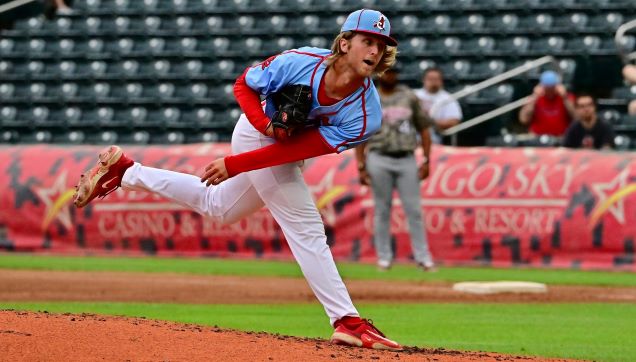
Now that Mathews is the fastest rising prospect in the Cardinals’ minor-league organization, that desire to compete and win hasn’t changed. A major factor in his success, Mathews insists, is a result of his relationship with his sister.
“She has always been the rock, the role model, the standard setter for me,” Mathews said. “She always said that you need to be really, really smart and really good, and you also need to be ultra-competitive.
“She’s impacted my life probably more than she could ever imagine. She’s made me the person I am today.”
 The competitiveness that Mathews takes with him into every start is what helps drive the lefthanded pitcher’s desire to be successful – no matter what he is doing.
“Success is not an option in his mind, it’s mandatory,” Remy Mathews said. “He requires success of himself. He gets it intuitively of what he has to do to be successful.”
It was true in those family Scrabble games, it was true when he went to Stanford, where it was on display in the classroom, on the baseball field or going up against some of his friends and teammates playing the Settlers of Catan board game.
To try to grasp what it is that has fueled Mathews’ fast rise to the Double A level in the Cardinals system, including representing the organization in the Futures Game on Saturday less than a year after he was drafted and just three months after throwing his first pitch as a professional, it helps to go back to when he, Remy and their parents Bob and Susan were sitting around a game table in the family’s home in southern California.
That’s where his competitiveness, that desire to win, began.
Family arguments and flipped game boards
Both Mathews and his sister, who played college soccer at Rice, recently graduated from law school and is now studying for the California bar exam, remember the family battles over the years.
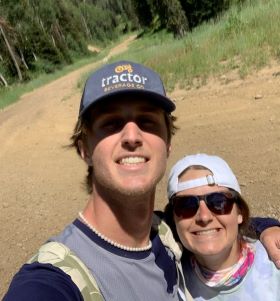 “Our family is uber-competitive,” Mathews said. “It’s like one of those families where you can’t really have fun playing anything. We went through a really bad Scrabble phase which ended in some arguments. My dad loves to always find a way to make it interesting where he’s doing some shady stuff.
“My sister is using some weird words and then my mom, who is either up by a lot or down by a lot, is trying to stay out of it because she knows it’s not going to end well for anybody.
“We probably haven’t bowled in five years because of it. Bowling used to be real confrontational because you’d have re-dos and stuff like that. Miniature golf was kind of the same way.”
Remy Mathews said the Scrabble games reached a point where she and Quinn were going up against each other even before the game began.
“We learned that we need to agree on which dictionary we are going to use for the game before we start the game,” Remy said, or otherwise “I am pulling up one, he is pulling up a different one. … The guy challenges me on every word in Scrabble. It’s ridiculous.
“I think he flipped the board at one point when I did a word he didn’t agree with and his word got disqualified.
“We did puzzles, we built Lego sets, we played board games. Any kind of trivia games were big. We like to think we are smarter than each other. We like being around each other, we like competing with each other.”
That competition even included trying to see who could win the most prizes at county fairs, Remy Mathews said.
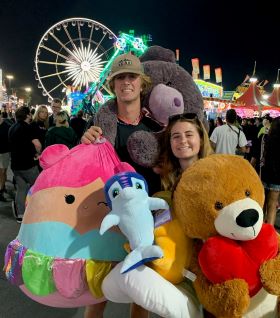 “We used to go really hard,” she said. “We didn’t do the rides because we were just trying to win as many games as possible. The head-to-head games got really competitive.
“At the end of the night though I think Quinn just loves being able to give the prizes away to as many little kids as he could.”
At a fair one night, the two engaged in a pitching accuracy contest – and Remy Mathews won.
“I don’t think I’ll let him hear the end of that one now,” she said.
Of course her bother has a comeback ready when that happens.
“He played soccer in high school along with baseball,” Remy Mathews said. “His team won the CIF championship. I was never able to do that as a high school soccer player and I went to college to play soccer. He was so competitive he still brings it up to this day; ‘You never won a CIF championship.’ I’m like OK, you got me on that one.
“We’re still competitive even today over what the other is doing. I think the great part about our relationship is that despite that competitiveness, we both really want the other to succeed. I know that’s how he feels about me and that he wants me to succeed in everything I do, and I feel exactly the same way about him. I love seeing him be as successful as he has been so far.
“He’s pushed me to be better and hopefully he feels that way too.”
Mathews’ desire to find success, academically as well as athletically, is what led him to Stanford after high school.
A life outside baseball
Stanford has a policy of not allowing freshmen athletes to room with other athletes. They are mixed in with the general student population and required to live in a dormitory.
“Initially I kind of thought it would stink because they wouldn’t be on the same schedule as me, but it was the greatest thing I think that happened to me,” Mathews said. “I just got lucky to be around the right people at the right time.”
At a freshman dorm bonding activity, Mathews met Sohit Gatiganti, who was from Singapore and lived down the hall.
“You had to go around and tell everyone a fun fact about yourself and we were just kind of randomly assigned,” Gatiganti said. “I think he made some stupid joke and I thought it was funny and we just kept talking.”
The two ended up rooming together in the same pod, along with other friends, for the next four years. Only Mathews played baseball.
Gatiganti, in fact, didn’t know anything about baseball. He admits he didn’t know what ERA stood for, having grown up half a world away, where cricket was his sport of choice.
“Most of the baseball team and athletes in general tended to room with other athletes,” Gatiganti said. “Quinn was the exception to that. I think it speaks to his personality about what he values and prioritizes. He also wants to have a life outside baseball.
“He worked exceptionally hard academically. He would go to practice, go to the games on the weekend, then come back and be up until 2 or 3 a.m. working on our group project.
“He honestly likes learning in general. He would be interested in my schoolwork or some of the finance stuff I was learning. He always wanted to learn about random stuff. I taught him cricket and he taught me baseball.”
Gatiganti saw Mathews’ competitiveness on the baseball field, but also remembered another night out with some of their friends – going bowling.
“He bowls with his right hand, and he would handicap himself and that was his excuse for not winning sometimes,” Gatiganti said. “We were giving him a lot of flack for not bowling well, so on that night he bowled with his left hand and absolutely destroyed us.”
The story probably wouldn’t surprise Stanford coach David Esquer, who saw first-hand over Mathews’ years at Stanford how that competitiveness drove him to be successful.
When Mathews wasn’t happy that he was drafted by the Tampa Bay Rays in the 19th round after his junior season, he came back to Stanford as a senior – with something to prove.
“One of his arguments for not coming out of a game was, ‘I didn’t come back here as a senior to let someone else decide whether or not we were going to Omaha (College World Series),’” said Esquer.
One of the games that was going to decide whether that happened or not came in the super regionals against Texas, a game that would garner national attention for Mathews, who threw 156 pitches in the complete-game victory.
“He was not coming out of that game,” Esquer said. “I had to fall on the sword a little bit for it, but he’s just that type of guy. He wants to win. The thing about him is that he is a gamesman. He likes to compete. He likes to win. That’s just kind of how he is wired.”
 Mathews still believes the attention placed on how many pitches he threw in the game was unwarranted. He had thrown more than 120 pitches in a game three times that year, and he was in shape to do it.
“I wanted the ball,” Mathews said. “In that moment the team needed a win. I didn’t want them (Texas) getting a look at a bullpen arm that we were going to 100 percent need the next day.”
Esquer knows what would happened had he gone to the mound and asked for the ball.
“It was probably one of the greatest games ever pitched here,” Esquer said. “I appreciated the way he went about the game. If I had taken the ball from him, he would have been mad at me, which he has been before. But if we had not won that game, I don’t know if he would have ever talked to me again.”
Esquer also is a former Stanford player, and he saw some similarities between Mathews and former major-leaguer Jack McDowell, who was Esquer’s college teammate.
“The biggest compliment I gave Jack was he pitched on Friday night and he wanted to win desperately,” Esquer said. “But he wanted to win pretty much just as bad on Saturday and Sunday when he wasn’t pitching but his teammates were still playing.
“We were a lot tougher as a group playing behind Jack McDowell and I saw Quinn kind of take that to the next step … Quinn enjoys winning, even on days he doesn’t pitch. He’s got a little nastiness to him too. He’s not just this nice boy that gets good grades and went to Stanford. He’s got a little edge to him. … We were really lucky and blessed to get him for that extra year.”
Mathews didn’t know what to expect in the draft last year, but Esquer was surprised that he lasted until the Cardinals selected him in the fourth round. Mathews believes the primary reason why so many teams passed on him was his age – he already was a 22-year-old college senior.
He wanted to start proving that those teams made a mistake immediately, only to find out days after the draft that the Cardinals did not want him to pitch last summer because of all of the innings he had thrown at Stanford during the spring, a pattern they have followed with many of their college pitching selections in recent years.
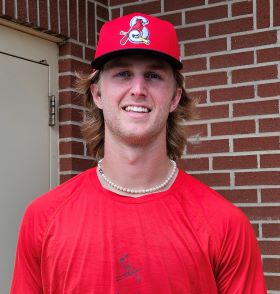 “It was definitely frustrating at that moment because the big narrative on me was how old I was,” Mathews said. “I think that caused the big deduction in the draft. I wanted to go out there and make an impact as quickly as possible.”
Mathews used the time to get bigger and stronger, estimating he has gained about 27 or 28 pounds since he was drafted. He prioritized gaining velocity as another goal in the off-season, which he did.
He also found another role model to follow.
“There’s an athlete, Amon-Ra St. Brown, with the Detroit Lions,” Mathews said. “He’s a SoCal kid who went to USC. I kind of went back and looked at a lot of the stuff he talked about when he went through his draft process and how he was kind of overlooked.
“Now he is like my role model in life even though I’ve never talked to him or met him. He kind of had the same issue I had where people didn’t value what he did on the field because he didn’t fit the analytical profile of the elite player. He wasn’t the biggest or fastest guy and he slipped to the fourth round – and now he’s arguably the best wide receiver in the NFL.
“I just kind of took that mindset of just having to go harder at the end of the day than everyone else, no matter what people are telling you that you can or can’t do. You are the one taking the field. When you go out there and perform, it kind of silences everybody.”
A quick rise to Double A
Mathews made his pro debut on April 5 for Class A Palm Beach. He battled his control in his first game in 10 months, walking five. In his next start a week later, he allowed one hit over five shutout innings, did not walk a batter and struck out 11.
After starting four more games, Mathews was promoted to high A Peoria, where he made seven starts before earning his second promotion in six weeks to Springfield.
 “It’s been a little bit of a roller coaster with good weeks and bad weeks, physically and mentally,” Mathews said. “One week you pitch really well and the next week you don’t pitch as well. You have to learn from both. It’s really easy to learn from the bad but you also have to learn from the good.
“I’ve enjoyed the process. Baseball without school is definitely different. It’s the first time in my life where I am not focusing on something educational.”
Mathews has tried to use that extra time he isn’t used to having to try to find out how to improve as a pitcher, how to take advantage of what he is learning, trying to understand what he has to do to get the more experienced and advanced hitters out.
He will dissect a game and question his pitch selection during a particular at-bat, putting in into his memory bank for the next time that situation comes up. Even though he believes he is stronger and has more tools in his arsenal now, other aspects of his approach to pitching have not changed.
“Honestly I’m the same pitcher,” he said. “I wish I would change a little more because I think the stuff would probably allow me to do so, but I’m pretty stubborn in my ways. I’ve always pitched my entire life not throwing very hard, like a lefty who just knows how to get guys out.”
With such an emphasis on velocity in baseball today, Mathews can hit the mid 90s with his fastball but not 100. That doesn’t matter to him.
“Ultimately I think it just buys you grace,” Mathews said about pitchers who can throw triple digits. “The word grace is the perfect word because there are guys at the lowest levels of rookie ball who throw 100 so clearly velocity is not the only thing. There is a reason why the guys at the top do throw hard but the pitchability and ability to locate, mix speeds and also change the shape of your pitches and stuff like that also makes them the elite guys versus the guy that just throws 100 miles per hour.”
Scouts who have watched Mathews this season confidently project that he will be a middle of the rotation starter in the major leagues, perhaps sooner rather than later.
There is no question Springfield manager Jose Leger wonders how long Mathews will remain in Springfield.
“When you watch him pitch he is in control,” Leger said. “He knows what he wants to do. I really like how he pitches and on top of that his stuff plays anywhere. It will definitely play in the big leagues. I like everything about him so far.”
Playing in the majors wasn’t a dream
Mathews will step onto the national stage again in Saturday’s Futures Game in Arlington, Texas. He views it as a “cool opportunity,” even though he took the news that he had been selected for the game in a low-key manner.
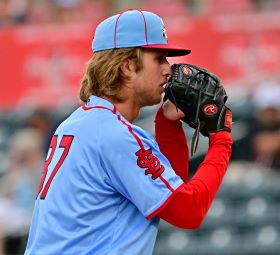 “I broke the news to him that he was going to the Futures Game and he was like, ‘OK,’” Leger said. “There was zero excitement. I said, ‘You know this is a big deal, right?’ and he was like, ‘OK, thank you.’”
That reaction did not surprise either Remy Mathews or Gatiganti, who is going to fly to Texas from Stanford – where he just completed his master’s degree – to watch Mathews pitch in the game.
“I think he tries to keep it low key,” Remy Mathews said. “That’s part of his grounding of being more than just a baseball player. That’s a normal Quinn response.”
Added Gatiganti, “Even when he is internally super happy, he doesn’t show it.”
Part of the reason for that might be traced to the fact that unlike a lot of kids, Mathews said he never had a dream of playing in the major leagues.
“Honestly, it was never really a dream or even a goal,” he said. “I didn’t think it was possible so I just kind of wrote it off.
“The biggest thing I want to do in my life is impact children as much as possible. I’ve always loved working with kids. Once all this is over, financially if I am able to, the end goal is to impact and influence as many kids as possible. Having a role model can change a person’s life, but specifically a kid’s life.
“If you can change one kid’s life for the rest of their life and it makes them a better person and they are able to go impact more people I would deem my life a success.”
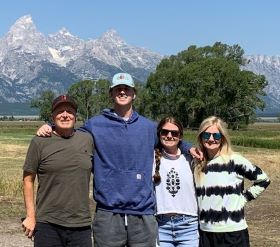 That was a lesson Mathews said he has learned over the years, from his sister and parents, from his friends, and from his teammates.
“I just got lucky through life and always found the right people at the right time when I needed them most,” he said. “I don’t think most people have the luxury of doing that and getting that help. … I’m super grateful. I wouldn’t be here without all of them and I need each and every one of them at a different moment in time. I’m blessed and lucky to have them.
“For whatever reason throughout life the experiences I have had, I’ve come to appreciate that, the impact people have made on my life. When you get up in the morning you are not the same person you were the day before. I hope to change for the better, to keep progressing as a human being.
“Whatever job, whatever craft you are doing in life, you just hope that you get a little better in that every day too.”
Follow Rob Rains on Twitter @RobRains
Main photo by Don Jones courtesy of Springfield Cardinals. Other photos courtesy of Remy Mathews, Springfield Cardinals, Peoria Chiefs and Stanford athletics