By Rob Rains
MEMPHIS – One of the time-trusted statements that people make about baseball is that it’s the same game, no matter the level of play.
The game might be the same, but there is one important element of the game that is different between Double A and Triple A. Young pitchers such as Cardinals prospects Tekoah Roby and Quinn Mathews have found that out as they moved up from Springfield to Memphis.
What’s different? The baseball.
Games at the Triple A level are played with the same baseball that is used in the major leagues, while games at the Double A level and farther down in the minors are played with what is referred to as the minor-league ball.
“It’s a real thing,” said Rob Cerfolio, the Cardinals’ assistant general manager in charge of player development. “For a lot of guys it takes multiple outings to adjust to the ball. You will see maybe a three to four game learning effect for efficient fastball guys.”
 Mathews and Roby can personally attest to the fact that it takes a while to learn how to pitch with the different baseball, and the effect it has had on their performance at Triple A.
“The minor league balls are not as tightly wound so it’s easier to dig your fingers in and easier to grip the ball a little bit,” Roby said. “With the major-league ball it’s harder to get your fingers into it. You’ve got to be really good at manipulating the ball.”
Finally healthy after two injury-filled years, Roby breezed through Double A to begin this season and was promoted to Memphis on June 9. His first two starts with the Redbirds provided an example of the “learning curve” that Cerfolio described.
In those two games, Roby worked a combined 10 1/3 innings, allowing 15 hits and 12 runs.
Roby made his third Triple A start on Sunday – and tossed six shutout innings against Norfolk, allowing only three hits and one walk.
“Roby’s first game was one of his worst command games of the year,” Cerfolio said. “The pitch shape and spin was different. The expectation for that first outing was that he would struggle.”
Both Roby and Mathews said that part of their process of learning to pitch effectively with the major-league ball includes making better use of rosin.
“The ability to use rosin the right way is becoming way more important,” Roby said. “Typically with a minor league ball a little moisture makes it stickier but here it’s either too dry or too wet, so you’ve got to use rosin the right way.”
Mathews got a lesson in how to use rosin when he was the Cardinals’ major-league camp this spring.
“Early on in spring training Sonny Gray talked to me and gave me a very quick lesson on how to use rosin,” Mathews said. “Even just sitting here now talking, I’m dripping in sweat because of the moisture and humidity in the air. You need a little extra dryness to hold the grip.”
Mathews first experienced his growing pains in Triple A at the end of last season, when he made four starts and allowed 18 hits and walked 14 in 16 2/3 innings, leading to 12 earned runs.
He took the major-league baseballs home with him to California so he could try to work with them over the winter.
“That was part of the buildup to this season,” Mathews said. “I tried to learn and unfortunately the pitch shapes do change a little bit. I lost a little hop on my fastball. It’s part of the learning curve.”
Mathews also had some issues at the beginning of this year with his shoulder that slowed his march toward a spot in the major-league rotation.
What Mathews has experienced throwing the major-league baseball is that there is not as much vertical break on his fastball as there was with the minor-league ball, going from 17 inches to 14-15 inches.
“Part of the learning curve is how do I get it to spin at 17 instead of 14 and 15?” Mathews said. “Two inches doesn’t sound like that big of a difference, but you go from above-average to basically average.”
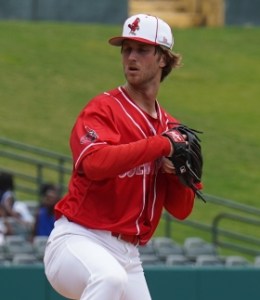 Mathews said that the difference comes from how the baseball is spinning when it comes out of his hand; the truer the spin, the higher the number.
Both Mathews and Roby were able to throw the major league baseball this spring, but Roby said that wasn’t the same because of the difference in the Florida weather in March and the July weather in Memphis and how that affects the baseball.
“In the spring it’s a little easier to just use the tiniest bit of moisture to make it sticky, but in the humidity and how much you sweat here, you can get a new ball and it’s really dry on one side and you try to rub it up and then it’s a little too wet,” Roby said.
“That’s why using rosin the right way is important It’s one thing I am picking people’s brains about.”
Cerfolio said the Cardinals also try to have their pitchers work with the major-league baseball in bullpen sessions and while playing catch, “so the first time they are touching it is not in Triple A competition.”
“The biggest impact is how pitches move across all types of pitches,” said Cerfolio, a former pitcher at Yale. “The major-league ball moves and spins a little less because the drag force is different. You see guys throwing a very efficient curveball or sweeper or four-seam fastball (in Double A) and you can generally expect the break to decrease a little bit with the major-league ball.”
The biggest reason why there are two different baseballs is cost. Both are made by Rawlings, with the minor-league ball manufactured in China while the factory that produces the major league ball is in Costa Rica.
“I wish they would use the major-league ball in Double A,” Roby said. “Major league teams sometimes call guys up from Double A. I know they are more expensive, I get it. But I definitely felt more comfortable my second outing (in Triple A) than I did the first one.”
Mathews is adjusting to the ball as well.
Since returning from the injured list, Mathews has made three starts and worked a combined 13 innings, allowing only eight hits and two earned runs. He issued six walks, four in one game, and recorded 17 strikeouts.
In his last start against Norfolk, Mathews allowed just one hit over five scoreless innings, earning him the International League pitcher of the week award. His next start is scheduled for Tuesday night in Durham.
“I’m definitely moving in the right direction but still have a ways to go,” Mathews said. “I would say we definitely are progressing in certain areas but maybe not as much as we would like in others.
“There are 100 things to work on. I’m learning that as soon as you think you’ve solved one issue you find five new ones right behind it.”
The Cardinals are closely monitoring the progress of the 24-year-old Mathews and 23-year-old Roby as the July 31 trading deadline gets closer, knowing there is a possibility they could move one or more of the pitchers on the major-league roster who will become free agents at the end of the season.
That could free up a spot in the rotation for Michael McGreevy, who already has made spot starts in the majors, and perhaps Mathews and Roby later this summer.
 “I think my next step is to basically take everything I was doing at Double A, executing and getting ahead in the counts, and doing it here,” Roby said. “It’s a byproduct of hammering down my routine and sticking to the process and every day do what I’ve been doing and not really adapt to the level as much as bring what I’ve been doing to this level.”
Facing more experienced hitters in Triple A, including those who have spent time in the major leagues, also is helping both Mathews and Roby refine and improve their game.
“The guys up here know the zone really well,” Mathews said. “They have faced the best pitchers in the world and you might not get a swing and miss or a chase early in the count. You can’t pitch to these lineups being behind in the count. There is something to be said about throwing the first pitch for a strike and getting to two strikes as quickly as possible.”
Memphis manager Ben Johnson has heard suggestons, often on social media, that question the Cardinals’ depth of starting pitching candidates behind the current major-league starters.
Those people must be watching different pitchers than he is watching, Johnson said.
“We’ve got some really good young arms here that are close to being major-league ready,” Johnson said. “I’d take this staff over any Triple A staff, and you know Tink (Hence) is on the way too.”
Hence, another of the organization’s top pitching prospects, missed the first two months of the year because of a rib-cage injury. He made his first non-rehab start last Friday for Springfield and worked 4 1/3 innings without allowing a hit while striking out eight.
“Quinn is making tremendous strides in the right direction; he’s a special young talent and someone who could help our big-league club sooner than later,Johnson said. “And Roby’s stuff is so electric. I really like what I have seen from him.”
While Mathews and Roby are certainly aware that it might not be long before they find themselves promoted to the Cardinals, they both are trying to avoid thinking about that possibility.
“I think everyone here is ready for that,” Mathews said. “I don’t think too much about it. I’m not smart enough to understand what goes into all of that. We’re just here to do our jobs and if they say it’s our time to go up it’s our time.”
Added Roby, “I know I am on the 40-man, I know I am in Triple A, but I don’t think about it They want to see me healthy and there is a right way to go about it. I’m being patient. My history with injuries has given me a pretty good perspective on the fact that a lot of that is out of my control.”
Photos courtesy of Memphis Redbirds
Follow Rob Rains on X @RobRains