By Rob Rains
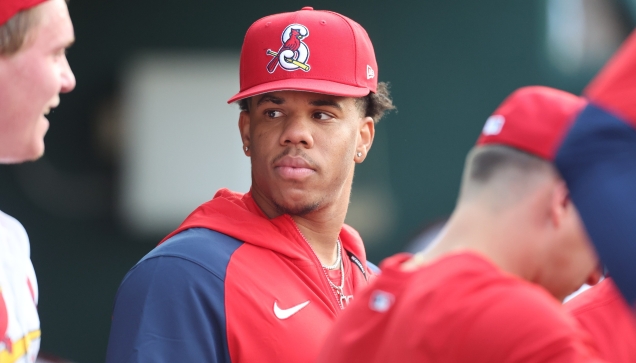
SPRINGFIELD, Mo. – Jurrangelo Cijntje might be the most interesting player in baseball.
He can throw a baseball with either hand at close to 100 miles per hour, a skill that is perhaps unprecedented. While that alone is impressive, it’s not the only unique quality that Cijntje, a Cardinals prospect now in Double A, possesses.
Add the fact that the 23-year-old Cijntje also can speak four languages – Papiamento (the native language of the island of Curacao), Dutch, Spanish and English – and it becomes a little clearer why Cijntje is different than other players in either the major or minor leagues.
He also is only 5-foot-11 inches tall, not the typical height for a pitcher who can throw with that velocity – with one hand.
 More impressive than all of that, however, could be that Cijntje doesn’t consider any of this to be anything special. It’s just what he has always done, part of who he’s always been.
“To be honest, I don’t think about this stuff,” Cijntje said. “I’ve been doing it a long time.”
Jorge Aguas knows Cijntje’s journey better than most after coaching him for three years in high school in Miami. He needs only two words to describe what stands out most to him about Cijntje: “He’s different,” Aguas said.
“It takes time to figure him out,” Aguas added, “how much talent he has, and his baseball IQ is through the roof. I think even part of his journey through the minors right now is trying to understand the kid.”
That’s where the Cardinals find themselves.
“A lot of our questions initially were, ‘How do you view yourself? Who do you want to be? Where do you picture yourself in the big leagues?’” said Rob Cerfolio, the Cardinals’ assistant general manager who oversees the organization’s player development and performance.
“I think part of his identity, at least for right now, is that he wants to be able to selectively get out left-handed hitters as a left-handed pitcher … That’s who he sees himself as, which is important to us.”
The Cardinals have quickly come to learn that Cijntje, acquired from the Mariners in a February trade for Brendan Donovan, also is a highly competitive, highly motivated pitcher – with the desire to prove he can be a switch-pitcher at the highest level of the game.
 “People always want to talk me out of it,” Cijntje said. “It’s a lot of noise. I don’t worry much about it.”
That’s the way he’s always been.
“I had no idea who this kid was”
To begin to understand why Cijntje became a switch pitcher in the first place, it’s best to start at the beginning of his story, when he was born in the Netherlands.
His father, Mechangelo, was a catcher and of course threw right-handed. Cijntje is a natural left-hander, but he started throwing right-handed when he was only a few years old because he wanted to be like his father, and be able to use his father’s glove. He wanted to be a position player, like his father, in addition to pitching.
The family moved to Curacao when Cijntje was six. His father hung up a tire in the back yard for a target, and Cijntje would aim at it as he threw with both hands. When Cijntje was 13, he was the shortstop on the Curacao team that played in the Little League World Series.
Throwing so much righthanded because of his work as a position player naturally developed his right arm much more than his left arm.
“I always pitched since I was a kid, but then I stopped and started working more on playing middle infield,” Cijntje said.
Cijntje wanted to sign with an MLB team as an international free agent, but he was only 5-foot-5 when teams began to sign that year’s class of 16-year-olds and Cijntje went unsigned. His family came up with a new plan – let Cijntje move to the U.S., where he had three older cousins living in Miami.
One of those cousins, Zack Braafhart, had a connection to Aguas, at the time the coach at Champagnat Catholic High School and he called Aguas to tell him about Cijntje.
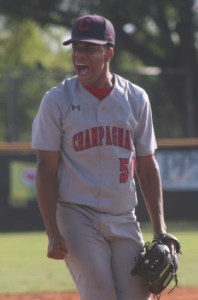 “I had no idea who this kid was,” Aguas said. “Nobody really knew who he has. He was just a scrawny small kid from the island; maybe weighed 130 pounds soaking wet.
“My first impression when I saw him was that he looked athletic but was a short guy. He told me he threw with two arms and I was like, ‘OK, that’s interesting.’”
Aguas decided to take a chance on Cijntje and find out what kind of player he could become. When he wasn’t pitching, he had Cijntje played all over the field so he could keep his bat in the lineup. Aguas remembers at least one game when Cijnthe played center field as a left-handed thrower, moved to shortstop and switched to the right side, then came in to pitch. He also happened to be a switch-hitter.
Aguas told Cijntje that if he was serious about becoming a switch pitcher, he was going to have to work at it.
“The left side was virgin for three years because he basically stopped throwing because he wanted to focus on the right as an infielder so he could sign as an international player,” Aguas said. “We got him on the bump and I said, ‘Whatever you are going to do from the right side you are going to do from the left side – no ifs, ands or buts about it. It was the only way to make it happen.
“The velo started climbing on the left side and I was just stunned. Everything he was doing was just getting better and better. He was getting bigger and stronger.”
In games, even though Cijntje was a better pitcher from the right side, Aguas tried to find spots when he could switch to the left side.
There were two problems when that happened, however.
“When he faced a switch-hitter, nobody knew the rules,” Aguas said. “Who had to declare first? We had to explain it before every game.”
Cijntje also did not have a six-finger glove that he could use on either hand, so when he switched to the left side, the coach had to call time and flip him a different glove.
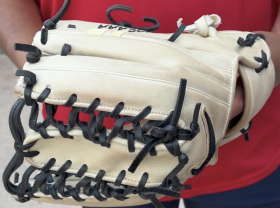 As Cijntje started to become better known, he was invited to a showcase event in Georgia in September of 2020. Aguas told the tournament officials that Cijntje would need a six-finger glove, and they arranged to have one made.
Cijntje ended up being on a team with the sons of former major-leaguers CC Sabathia and Andruw Jones, and both were in the stands when Cijntje came out of the bullpen with the bases loaded and nobody out.
Aguas was there too, and watched as Cijntje proceeded to strike out the next three batters, two from the right side and one from the left. Sabathia and Jones were among those in the crowd who gave Cijntje a standing ovation.
“That was a big break for him,” Aguas said. “That’s when you know that something impressive is about to happen.”
What Aguas and Cijntje learned, however, was that a lot of scouts and coaches at both the professional and college level really didn’t care about him being a switch pitcher. They saw the explosiveness from the right side, and wanted him to scrap throwing from the left side.
They also questioned his physical stature.
“We stood behind his talent,” Aguas said. “A lot of people said he was too small and too short.”
The Brewers liked him better as an infielder. After conducting a private workout, they selected him in the 18th round of the 2022 draft – as a shortstop. Cijntje, however, wanted to pitch, and chose not to sign.
He had committed to Stetson at an early age, but Aguas found out that Mississippi State was interested in him, so Cijntje de-committed from Stetson and signed with Mississippi State – a school that said it was willing to let him continue to throw with both hands.
“That kid is special”
Justin Parker was the pitching coach at South Carolina when Cijntje arrived as a freshman in Starkville. He had seen him pitch in high school, but knowing Cijntje was committed to Stetson at the time, Parker didn’t spend much time watching him.
On the night of March 30, 2023, Parker was with the South Carolina team for a road series at Mississippi State. Cijntje was the opposing starter, a freshman facing a team that was 25-2 at the time and one of the top-ranked teams in the country.
Even though Cijntje only pitched right-handed in that game, he struck out nine in five innings. Parker came away impressed.
“You could see how special he had a chance to become and could see how talented and dynamic he was,” Parker said.
Months later, in part because of what Parker saw in Cijntje, he accepted an offer to become the Mississippi State pitching coach.
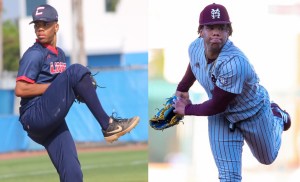 “That kid is special and has a chance to be a big-time arm, and as a coach you are only as good as your players,” Parker said. “It was a big part of making my decision to come here. He’s a special kid, with a special mind, a special competitor and a special talent.
“There are a lot of different ways to deploy what he does and I think that’s what makes him really, really interesting and certainly unique.”
As he looked into Cijntje’s freshman season, before he became his coach, Parker saw that Cijntje’s ERA was 8.10. With Cijntje’s ability, he wondered, how could that be the case?
“I don’t know that anybody has a playbook for this,” Parker said. “Why is this guy, as talented as he is, not more productive? It was because of switching back and forth. He would fall behind in the count almost every time, from either the right or left side. He never got into any type of rhythm or flow. It was very disjointed.
“He had done it his whole life, but all of his numbers indicated he was a better righthanded pitcher than as a lefthander. But it’s also part of who he’s been. I wanted him to pitch just righthanded. I just couldn’t tell him that.”
What Parker and the Mississippi State coaches decided to do was much the same as what the Cardinals have done this season – identify some batters in the opposing lineup where it might make sense for him to pitch from the left side, but not to constantly be flipping from one side to the other every time a left-handed batter came up to the plate.
One of his starts that season, on April 13, 2024, was against in-state rival Mississippi. Starting for the Rebels was Liam Doyle, now his Springfield teammate.
“I think he only faced one batter from the left side,” Doyle recalled. “It’s a big weapon. It’s a big deal; maybe it isn’t to him because he’s been doing it for so long, doing it since he was a kid, but not many people can do what he does.”
It was such a rare ability that a lot of major-league teams weren’t certain how to evaluate Cijntje before the 2024 amateur draft. Many wanted him to abandon pitching from the left side in favor of just pitching right-handed. Cijntje wanted to keep doing both.
“It’s part of who he has become,” Parker said. “He’s determined to make it to the big leagues and do it in the big leagues.”
The Mariners selected Cijntje in the first round, the 15th overall choice in the draft. He made his professional debut in high A in 2025 before finishing the season at Double A Arkansas.
After 23 starts between the two levels, the Mariners had to decide if they were going to let Cijntje continue pitching from both sides. Then, as spring training neared and the trade talks with the Cardinals progressed, it suddenly wasn’t something the Mariners had to worry about any longer.
“He’s got intent in his eyes”
The Cardinals had multiple connections with people in the Mariners organization. Matt Pierpont, the Cardinals’ director of pitching, was working for Seattle when Cijntje was drafted before he was hired by the Cardinals. Cerfolio’s former hitting coach in Cleveland was then Seattle’s farm director.
“The back story from Seattle was they were going to remove it (pitching left-handed) from his repertoire this season,” Cerfolio said. “We kind of learned that right before the trade.”
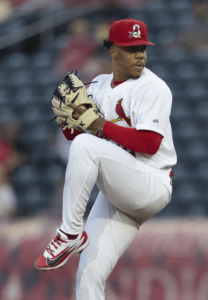 What the Cardinals didn’t know at the time was how Cijntje felt about that decision.
“We wanted to sit down and hear his version of the story because partnering with the player is really important for us strategy wise,” Cerfolio said. “We wanted to know if it was something he wasn’t excited about or if he wanted to keep doing it, and that was something we learned in our conversation.
“We wanted to at least tap into that and see if it’s possible.”
Much like Parker did at Mississippi State, through Cijntje’s first 13 starts, the Cardinals have pre-selected certain hitters or situations in a game when they will tell Cijntje to pitch from the left side.
It has been very limited. He has not faced more than three batters as a left-handed pitcher in any of his starts, and out of the 267 batters he has faced, only 17 of them – 6 percent – have been from the left side.
In those 17 plate appearances, Cijntje has struck out four, walked five, hit one and given up three hits, all singles. One interesting note is that there have been two occasions where he struck out the same batter twice in a game, once pitching right-handed and the other time pitching left-handed.
In 59 2/3 innings, Cijntje has struck out 74 batters, which ranks fifth in the Texas League.
“He’s got intent in his eyes,” said Springfield manager Patrick Anderson. “Personally, I think he wants to prove a lot of people wrong. Anybody can see how good he is from the right side, how electric it is.
“We’re just excited to see what he can do from outing to outing, and to see where it goes from here.”
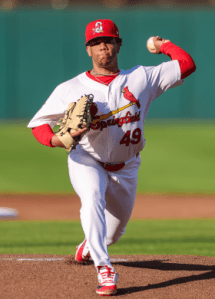 The Cardinals have data that can measure Cijntje’s performance beyond what shows up in the box scores. The trends are moving in the right direction, Cerfolio said.
“The zone rates and the stuff quality from the left side have been trending up,” Cerfolio said, “maximizing our reps on catch play and bullpen days and all that fun stuff. It’s been a learning opportunity for all of us, but I think we are seeing some positive trend lines.”
The Cardinals have added a slider to Cijntje’s pitch options from the left side, giving him a third choice to go with a sweeper and sinker, which they believe has helped with his development.
“We are trying to leverage that interest and identity (from the left side) and make it productive,” Cerfolio said. “We’re doing a lot of work with him away from the game … It’s critical, and one of our number one objectives, is that he is great versus lefties as a righty because we think he can hopefully be a front-end starter as a right-handed pitcher and have the ability to flip over on a tough lefty when he needs to do that. That was kind of the plan.”
Cerfolio estimates that Cijntje’s workload is about 10 to 15 percent more on non-game days than if he was only pitching with one hand.
“We are putting in the work now to see if he can harness the skills where that is something he can do in a real major-league game,” Cerfolio said.
Cijntje believes what he needs the most at the moment is just increased reps from the left side. He said he has hit 101 mph from the right side this season, and 97 mph as a left-hander.
“People say the left side isn’t good, the right side is better, and that I should focus on the right side,” Cijntje said. “People will say whatever they want to say.
“I think the left side is getting way better than it used to be.”
“It’s unbelievable”
The ability to throw a baseball with either hand is part of what makes Cijntje unique, but it’s only a part of his story, about what it is that makes him so interesting.
He said he writes right-handed, but can only shoot a basketball with his left hand. When it comes to eating, he said he can use a fork with either hand.
As far as which language he is speaking, it all depends on the situation.
“In Curacao they teach all of the languages,” Cijntje said. “All of the lessons are in Dutch, so if you want to succeed in class you have to know Dutch.”
Said Anderson, “He said something the other day and I was like, ‘What language is that?’ This kid is very smart, very intent with his work. He’s an uber competitor.
“He’s very humble. He doesn’t want it to all be about him or his situation. He just wants to be able to maximize everything he’s got.”
His teammates have been impressed.
“It’s unbelievable,” said left-handed reliever Michael Watson. “All credit to him because he works his tail off to be successful from both sides. He’s one of one.
“He’s one of my favorite people to play catch with because he throws a left-handed sinker that tails off like crazy and then he switches to the right side and throws a curve ball. It’s impressive what he can do with a baseball. If you’re not paying close attention you don’t even notice him flipping the glove over. Then he goes out and does it in a game.”
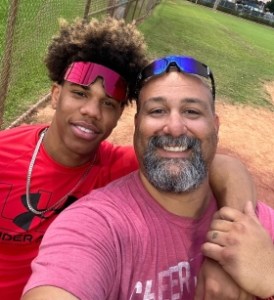 If Cijntje continues to develop his unique talent, he could one day be flipping from throwing right-handed to left-handed in a major-league game. His former coaches are among those who look forward to seeing that happen.
“He’s a wonderful kid,” Parker said. “He’s so humble for as talented as he is. He’s driven, he’s mature and he’s just very impressive.”
Aguas remembers back to the day he met a 16-year-old, 5-foot-5 Cijntje – with no idea where Cijntje’s journey was going to take him.
“Our relationship goes beyond the game of baseball,” Aguas said. “He can call me Dad in the United States. That’s the relationship that we have. He earned that as a person, the human being that he is.”
Follow Rob Rains on X @RobRains
Springfield photos by PJ Maigi courtesy of the Springfield Cardinals
Other photos courtesy of Jorge Aguas
**To watch a video of how Jurrangelo Cijntje switches from his right hand to the left hand when pitching, CLICK HERE.