
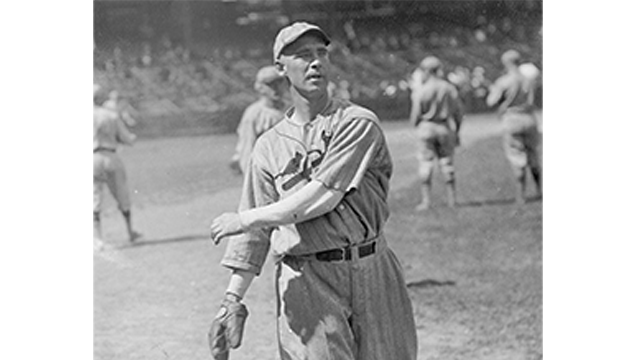
A Century Later, Overlooked Hero Bill Sherdel Joins Cardinals Greats
“Wee Willie” Baffled Babe Ruth, Led St. Louis to 1926, 1928 World Series
By Terry Lemons
Author of “The Year St. Louis Became A Baseball Town: The Cardinals, Babe Ruth & The 1926 World Series”
With the Cardinals Hall of Fame induction weekend approaching, there’s a forgotten name alongside the two superstars synonymous with St. Louis success in the last quarter-century.
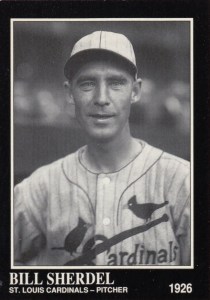 But in many ways, pitcher Bill “Wee Willie” Sherdel is just as important to Cardinals’ history as fellow honorees Yadier Molina and Albert Pujols. The thin-framed left-handed pitcher played a critical role elevating the team to its first World Series win in 1926, helping establish a National League baseball dynasty and setting the stage for a century of St. Louis baseball success.
While the monumental feats of Pujols and Molina are fresh in the minds of fans, Sherdel’s accomplishments have been lost in time for many. But they remain remarkable 100 years later. And just like Sherdel’s famous “slow ball” took time to reach home plate, it’s taken some time for the Pennsylvania native to be enshrined into the Cardinals Hall of Fame.
So who is Bill Sherdel?
On the field, he performed marquee accomplishments. Spending 14 of his 15 seasons with the Cardinals, Sherdel holds the team record for most wins by a left-handed pitcher with 153. That’s good enough all time for fifth behind right-handers Bob Gibson (251 wins), teammate Jesse Haines (210), Adam Wainwright (200) and Bob Forsch (163). And Sherdel stepped up in big moments, winning the pennant-clinching games for the Cardinals in both 1926 and 1928 and delivering strong World Series performances.
The pinnacle of Sherdel’s career spanned 1922 through 1928, when he averaged more than 15 wins a season, ultimately winning 109 games and losing 75. A bit like a 1920s version of John Tudor, the soft-tossing Sherdel was one of the league’s most successful left-handers. During that seven-year stretch, Sherdel tossed 108 complete games across 1,551 innings, relying more on finesse and ground balls than his modest 457 strikeouts.
Frequently, he would be called on for dual roles, not only starting an average of 25 games but also saving 17 games during that span. Although not an official statistic at the time, Sherdel led the league in saves with 6 in 1927 and 5 in 1928.
“He was durable. He was always ready when the team needed him, whether starting or in relief,” explained his grandson John Sherdel, who will deliver the Sept. 12 Hall of Fame induction speech at Busch Stadium for his grandfather.
The numbers tell just part of “Wee Willie” Sherdel’s story, the forgotten Cardinal who didn’t brag about his accomplishments.
Sherdel Adjusts Pitching Style To Stymie Hitters
The humble son of German immigrants, William Henry Sherdel was born on Aug. 15, 1896 in Hanover, Pennsylvania – about 14 miles from Gettysburg near the Maryland state line. As a child, he started as a catcher, but as a teenager switched to become a hard-throwing left-handed pitcher.
His pitching caught attention, and he moved into pro ball in 1915 in the Blue Ridge League. As the Society for American Baseball Research has noted, Sherdel caught the eye of the Milwaukee Brewers – then an American Association league – who purchased his services. While playing alongside players like Olympian Jim Thorpe, Sherdel realized his fastball was not a match for the more seasoned hitters. So he went to work developing his slow ball approach, mixing off-speed pitches and slow curves.

“They said he had a slow ball, a slower ball and then a slow, slow ball,” explained John Sherdel, who co-authored a book along with John G. Coulson. “Wee Willie Sherdel: The Cardinals’ Winningest Left-Hander,” was published in 2018 by FriesenPress.
The Wee Willie nickname came from his slight frame: The pencil-thin Sherdel was 5 feet and 8 inches and in his playing days was generally regarded as weighing around 150 pounds.
Branch Rickey Discovers Sherdel
Despite his size, Sherdel’s rubber arm and slow pitches helped him master minor league hitters, and it drew the attention of Cardinals General Manager Branch Rickey in 1917. Rickey, a shrewd judge of developing talent, signed Sherdel. And in 1918, he had his first taste of the major leagues, finishing 6-12 for the last-place Cardinals despite a 2.71 earned run average.
During the next several seasons, the left-hander saw a mixture of long relief and spot starts. In 1920, he won 11 games, closed out 30 games and saved 6 games, the most in the league.
“At first, they called him ‘Rickey’s Ready Relief,’” John Sherdel recalled. “He was always ready when the team needed him.”
But Sherdel emerged as a force in the starting staff in 1922, going 17-13 while throwing 242 innings. He followed up with a 15-13 season in 1923, but Rickey – now the Cardinals’ manager – worried that Sherdel gave up too many hits, averaging nearly 11 per game. The southpaw’s name came up in offseason trade rumors though nothing materialized.
In 1924, a rough start to the season saw Rickey relegate Sherdel to the bullpen, where he found himself in long relief and low-leverage situations accompanied with a disappointing 8-9 record.
Rogers Hornsby Unlocks Sherdel’s Potential
Sherdel remained stuck in the bullpen early in 1925, but his fortunes changed around Memorial Day when Rickey lost his managerial duties. With Rickey now focused solely on the Cardinals’ front office, star second baseman Rogers Hornsby became the new manager. That created an immediate impact on Sherdel’s career.
“When Rogers Hornsby got to be manager, he told him that he saw what he could do as a pitcher,” John Sherdel said. “And he made it clear he wanted him as a starting pitcher.”
With the faith of the new manager behind him, Sherdel flowered on the mound during the season’s final four months as his slow ball increasingly befuddled hitters. Sherdel went 14-6, including winning seven straight games as the resurgent Cardinals climbed from 13 games under .500 with Rickey as manager to finishing the year with a winning record under Hornsby.

Sherdel Key to Cardinals’ First Pennant in 1926
That set the stage for 1926 – and a historic year for Sherdel and the Cardinals. Throughout 1926, Sherdel stepped up and had a knack for doing well in big games:
- On Aug. 19, he defeated Brooklyn 6-2 to put the Cardinals in a first-place tie for the first time since April.
- On Aug. 31, he won the first game of a double-header against the defending champion Pittsburgh Pirates. That, coupled with a sweep in the second game, put the Cardinals in first place again, a spot they narrowly held throughout most of September over the Cincinnati Reds.
But Sherdel’s signature moment came on Sept. 24, the final Friday of the season. With the Cardinals clinging to a two-game lead over the Reds with three games to play, they faced the New York Giants on the road.
The Cardinals sent out Flint Rhem, a 20-game winner. With anxious Cardinals fans crowding the downtown St. Louis streets listening to the game on radio loudspeakers, the Giants jumped on Rhem in the first inning. Right fielder Bill Terry delivered a monstrous blow to the upper deck to give New York a 3-0 lead.
But as they had done throughout the year, the Cardinals battled back. In the second inning, they scored 5 runs – highlighted by a 2-run homer from a jubilant right fielder Billy Southworth against the team that traded him earlier in the year.
With the season on the line, Hornsby called in Sherdel in the second inning to protect the 5-3 lead. With young Giants fans in the stands urging Sherdel and the Cardinals to clinch the pennant, Wee Willie delivered eight innings of sparkling pitching, giving up just one run. Sherdel got his 16th win of the season, and the 6-4 pennant-clinching victory set off a raucous celebration across St. Louis that lasted until after midnight.

Slow Ball Baffles Murderers’ Row
It set up the first St. Louis World Series appearance. And for the opening game in New York against the Yankees, Hornsby trusted Sherdel to take the mound. The manager strategized that Sherdel’s slow ball could counter the fastball-loving Yankees and their fearsome “Murderers’ Row” lineup that included Babe Ruth and Lou Gehrig. The Yankees offered their own left-handed version of Sherdel, 23-game winner Herb Pennock.
In Game 1, the Cardinals took a 1-0 lead in the first inning. On the road facing an enormous crowd of 61,658 at cavernous Yankee Stadium, Sherdel struggled in the opening inning and walked the bases loaded, but escaped with the Yankees scraping out just a run to tie the game. A pitcher’s dual developed. The game’s final run came in the sixth inning when the Yankees patched together a single by Ruth, a sacrifice bunt and a Gehrig single to win the game 2-1.
Despite the loss, Hornsby credited Sherdel for giving the Cardinals a boost on the Yankees’ home turf. The Cardinals came back to win the next day.
New York sportswriters were amazed at Sherdel’s slow ball. The New York Daily News’ Paul Gallico called him a “dangerous thrower.”
“The thing defies the laws of gravitation,” Gallico wrote. “By all that’s sensible it ought to drop to the ground half way to the plate and roll the rest of the distance. But it doesn’t.”
Tough Luck Loss in Game 5
By the time Game 5 arrived, the Series was tied at 2 games apiece with Sherdel facing Pennock again in a rematch. Sherdel again pitched masterfully, holding a 2-1 lead going into the ninth inning. But a misplayed flyball between Cardinal shortstop Tommy Thevenow and left fielder Chick Hafey led to an unearned run to tie the game. Heartbroken fans saw the Yankees win the game in the 10th on a sacrifice fly.
With the Cards down 3-2 in the series, it set up a dramatic finish in New York as the Cardinals captured their first World Series win with Grover Cleveland Alexander winning Game 6 and heroically saving Game 7. The celebration erupted in St. Louis and even reached Sherdel’s hometown of McSherrystown, Pennsylvania, where hundreds paraded in the streets.
After the game, Alexander praised Sherdel’s pitching performance, wistfully wishing that he wanted to give one of his wins – and some of the Cardinals runs scored for him – to Sherdel.
John Sherdel recounted that Ruth – who later visited his grandfather at his Pennsylvania home – complained that he couldn’t hit “those soft ones” thrown by the Cardinal pitcher.
Indeed, if the Cardinals’ hitters had squeezed out a few more runs in Games 1 and 5, Sherdel would have won two games – and the Cardinals would have won the series in 5 games. And Sherdel, not Alexander, would have been the Cardinals’ pitching hero.
Sherdel Excels in 1927 and 1928
Sherdel followed up his 16-12 season in 1926 with another standout year in 1927, going 17-12 for the second-place Cardinals. And 1928 was even better. It turned out to be Sherdel’s career year as he went 21-10 with a glittering 2.86 ERA, again playing a central role getting the Cardinals to the World Series.
And once again, Sherdel pitched the pennant-clinching game in 1928. This time, he pitched on the next-to-last game of the season, climaxing an epic pennant race with the Giants. Sherdel faced the Boston Braves and breezed through the game for a 3-1 win, clinching the pennant and sending happy fans again into the St. Louis streets.
“It was Sherdel’s twenty-first win of the season, making the Cardinals’ second pennant year the greatest in the career of the little lefthander,” wrote J. Roy Stockton of the St. Louis Post-Dispatch.
The 1928 World Series and a Controversial Call
The 1928 World Series rematch with the Yankees was not kind to the Cardinals. Sherdel started Game 1 again, and pitched well, but a 2-run home run by Bob Meusel put the Yankees up 3-0. The Cardinals eventually lost 4-1.
With the underdog Yankees taking a 3-0 lead in the Series, the desperate Cardinals turned to Sherdel to start Game 4. The Cardinals led 2-1 going into the seventh inning when a controversial call rattled Sherdel.
Ruth, who had homered earlier in the game, was at the plate with a count of no balls and two strikes. Sherdel quickly delivered another pitch to the legendary Ruth for what appeared to be strike three, but umpire Cy Pfirman declared the pitch a “dead ball” because he mysteriously had called time. Sherdel and the Cardinals angrily protested the call around home plate for several minutes to no avail.
When play resumed, the ruckus clearly rattled Sherdel. A bemused Ruth had been watching the whole scene. When play resumed, the Babe blasted a home run to tie the game. Gehrig, up next, hit another homer off Sherdel to put the Yankees up 3-2. Sherdel was done after giving up another hit. But Ruth wasn’t done, going on to hit a third home run off Alexander later in the game, and the Yankees finished their shocking series sweep.
Impressive Pitching, Hitting Numbers Mark Career
Like all pitchers, the magic eventually fades. In 1929, Sherdel could not match his previous numbers, going 10-15 for the Cardinals. And the in the middle of the 1930 season, he was traded to the Boston Braves. Arm troubles set in while in Boston, eventually leading to a brief return to St. Louis in 1932 to end his career.

By retirement, Sherdel finished with numbers that make an impressive bottom line on the back of any baseball card. As a Cardinal, he went 153-131 with a 3.64 ERA, 145 complete games, 11 shutouts with 25 saves. And he was also one of the best Cardinals hitters of all time, smacking 9 home runs – fourth best in St. Louis history — and his 80 RBI top every Cardinal pitcher except for Gibson.
For John Sherdel and others who have reflected on Bill Sherdel’s career, they’re left to wonder about what might have been – if Rickey had more faith in him as a starting pitcher or if the Cardinals had provided more World Series runs.
“If he had been a starter earlier, he would have had some really good numbers,” John Sherdel said.
In a syndicated column after the 1928 Series, an incredulous Ruth described Sherdel as the “tough luck champion” from the 1926 and 1928 games. “I wouldn’t have believed it possible for any pitcher to pitch four such games as he has pitched against the Yankees and lose them all,” Ruth wrote.
No Longer Forgotten, Sherdel Joins Cardinals Greats
But there is a happy ending for Sherdel’s story.
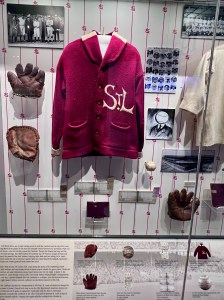
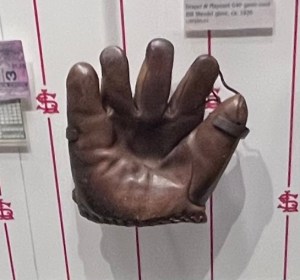
At the Cardinals Hall of Fame and Museum in Ballpark Village, Curator Amy Berra has assembled a tribute to the 1926 World Series team that includes Sherdel’s glove and a team-signed ball as part of a fascinating display of historic mementoes from the Cardinals’ first championship. Sherdel’s red sweater – worn by Cardinals pitchers of the era — will be highlighted in his Hall of Fame induction case.
 And at the Sept. 14 Hall of Fame induction ceremony, 46 family members from Pennsylvania, Florida, Washington state and West Virginia will watch John Sherdel recount his grandfather’s accomplishments that set the stage for a generation of Cardinal baseball greatness that stretched into the 1930s, 1940s and beyond.
Wee Willie Sherdel, a humble man and small of stature, will finally take his place among the giants of Cardinals’ history.
————–
Terry Lemons will conduct a book signing at Ballpark Village’s Baseballism Store, 761 Clark Ave., on Saturday, Aug. 29 from 11 a.m. until after the game. More information on the book is at www.1926baseball.com
Author
-
 Terry Lemons, is a former White House reporter and St. Louis native. After graduating from the University of Missouri, he worked as a newspaper reporter for the Springfield News-Leader and the Arkansas Democrat-Gazette, later moving to Washington, D.C., in the 1990s to cover the Clinton White House and Congress.
He is the author of “The Year St. Louis Became A Baseball Town: The Cardinals, Babe Ruth & The 1926 World Series," published by Arcadia Publishing.

