
By Terry Lemons
A century ago this week, the St. Louis Cardinals ended years of franchise frustration by capping off a hard-fought pennant race with a dramatic road win on the season’s final Friday.
The first National League championship for the Cardinals came on Sept. 24, 1926. They battled back from a 3-0 deficit at the Polo Grounds against the New York Giants, the team that cast off Billy Southworth in a mid-season trade.
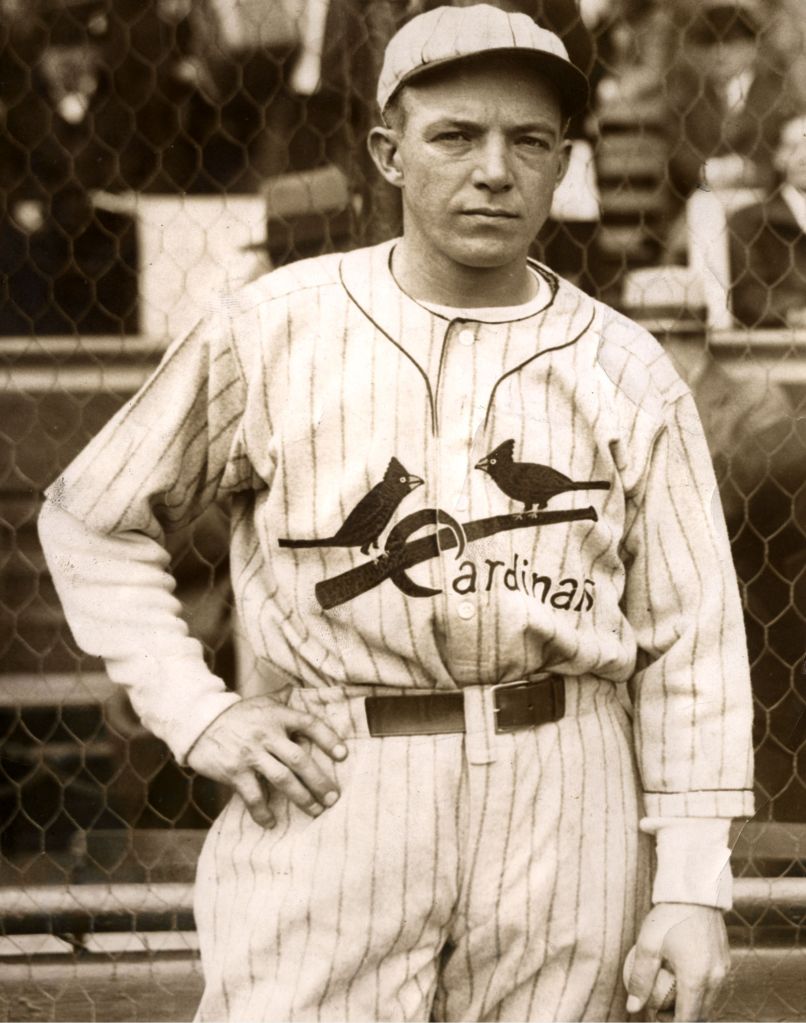
The right fielder shown in the photo, flourished in St. Louis and enacted revenge against his former team with a tie-breaking two run homer to send the Cardinals to a 6-4 win.The victory triggered a raucous celebration in the downtown St. Louis streets as a snowstorm of paper cascaded out of office windows. For some nine hours and long past midnight, 100,000 fans jammed the downtown area in a joyous celebration in a city desperate for a championship season after years of disappointment.
The win 100 years ago sent the team to the World Series for the first time, where they faced Babe Ruth’s Yankees. It marked the beginning of an era of greatness for the Cardinals franchise.
With the Cardinals of 2026 out of the pennant race and looking to the future, the current youthful team can find inspiration in the 1926 team, another club full of in-house talent that blossomed quickly and exceeded expectations.
Setting the Stage: Cards Battle The Reds, Pirates
Throughout much of the season, Cincinnati led the league, holding first place from May 15 until July 25 before slipping behind Pittsburgh, which commanded first place through the end of July and into late August.
After falling as many as eight games back in May, the Cardinals caught fire in mid-season following two key acquisitions that change the course of the season – and the franchise’s history.
On June 14, the Cardinals traded for talented outfielder Billy Southworth from the Giants. The natural right fielder had tangled with legendary Giants Manager John McGraw after being unhappy with a move to play center field. Weary of the tension, McGraw shipped Southworth off to the Cardinals for young center fielder Heinie Mueller.
Eight days later, the Cardinals made another key pick up. The Chicago Cubs lost patience with veteran pitcher Grover Cleveland Alexander’s heavy drinking and released the pitcher, prompting the Cardinals to quickly pounce on the future Hall of Famer.
Both players blossomed, turning into anchors for the team’s hitting and pitching. As the summer progressed, the Cardinals crept up in the standings – and fans in St. Louis started to sense something special taking place.
The Cardinals wrapped up their final homestand on Sept. 1 following a dramatic win in the “Little World Series” against the defending champion Pirates. While the Cardinals’ series win essentially doomed the Pirates to a third-place finish, St. Louis clung to a narrow lead against the Cincinnati Reds for most of the month.
To complicate matters for the Cardinals, the team endured a road trip that no modern team sees these days. As the team furthest west and south in the majors, the Cardinals spent the final 24 games of the season on the road as they traveled by train to the seven other National League cities.

The race remained tight into September, and the Reds even captured a half-game lead on Sept. 14 and 15. But the Cardinals climbed back into the lead on Sept. 17. Bill “Wee Willie” Sherdel – newly inducted into the Cardinals Hall of Fame on Sept. 12 – stepped up as he did numerous times in 1926 and delivered a critical performance in the 10-1 win over the Philadelphia Phillies.
In the days to come, Cardinals couldn’t quite put away the Reds, despite the depleted Cincinnati pitching staff. The Reds remained alive going into the final weekend of the season.
Sept. 24: The Deciding Day
While the Cardinals remained on the road, businesses in downtown St. Louis and across the city started setting up loudspeakers to broadcast the game results being shared on radio stations like KMOX. Fans increasingly gathered on street corners to listen to the game results as the pennant race remained tight and excitement intensified.
On Sept. 24, the Cardinals found themselves in New York to face the Giants on the season’s final weekend with three games to play. Meanwhile, the Reds played a doubleheader in Philadelphia.
The day began with the Reds 2.5 games behind the Cardinals, but the double-header meant Philadelphia still had a chance to close the gap to one game by day’s end. Complicating matters further: Sunday’s final game of the season would be a road game for the Cardinals in Cincinnati.
The day did not start off well. The Cardinals sent up Flint Rhem, their 20-game winner and drinking buddy of Alexander. The Giants lit up Rhem in the first inning with six hits, including a towering three-run homer into the upper deck by Giants’ right fielder Bill Terry to quickly given New York a 3-0 lead.
But the 1926 Cardinals were resilient. Buoying the mood of both the Cardinals in New York and the fans in the St. Louis streets was the result of the first Reds’ game. Cheers went up in downtown St. Louis as word spread the Phillies won the first game of the double-header by a score of 9-2. The Cincinnati loss meant a Cardinals win or another loss in the Reds’ nightcap would clinch the pennant for St. Louis.
As the Reds score was posted on the New York scoreboard, the Cardinals responded immediately in the second inning.
Third baseman Les Bell, a hitting star for the Cardinals in 1926, slammed a double into right field just after the Reds’ final was posted. A past ball, a single by catcher Bob O’Farrell and a double by shortstop Tommy Thevenow left the Cardinals down 3-1 with runners on second and third.
That brought up the pitcher’s spot. Rogers Horsnby, the Cardinals manager and second baseman, decided to pinch hit for the sluggish Rhem. So he sent in George Toporcer as a pinch hitter. Toporcer, nicknamed “Specs” because he was among a handful of players to wear glasses, responded with a two-run double to tie the game.
That created a dramatic moment for Southworth against his former Giants teammates. With a runner on, Southworth hit a “bullseye wallop” out of the park, the St. Louis Globe-Democrat noted.
“Southworth who was not ‘strong enough’ to be a Giant, slammed a terrific liner into the upper rightfield grandstand, which gave the Cardinals a lead,” observed The New York Times’s Ik Shuman.
Southworth gleefully circled the bases while looking into the Giants’ dugout as his former manager McGraw sneered back.
With the Cardinals up 5-3 in the second inning, the Cardinals turned to Sherdel for eight innings of relief. And to avoid distracting the Cardinals with “scoreboard watching,” Hornsby convinced the Giants’ scorekeeper not to show the score of the second Reds-Phillies game. The Cardinals and Sherdel held onto the lead, adding another run in the seventh.
St. Louis Star Sports Editor James M. Gould praised Sherdel’s grace under pressure: “Of all the courageous figures on the Hornsby roster, none can claim more ‘heart’ than ‘Sherry” and he came through beautifully.”
The Cardinals won 6-4 to clinch the pennant, triggering pandemonium in the downtown St. Louis Streets.
St. Louis Holds Baseball’s Biggest Pennant Party
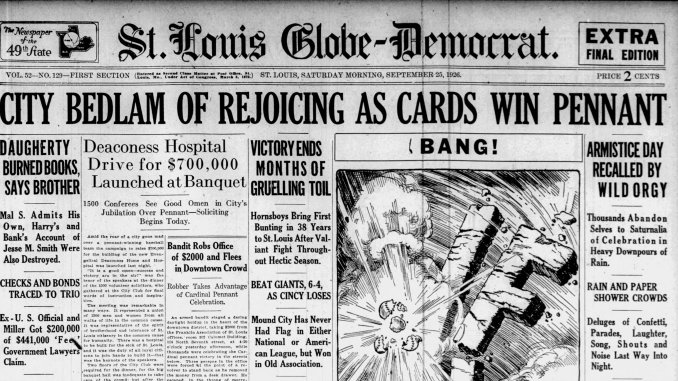
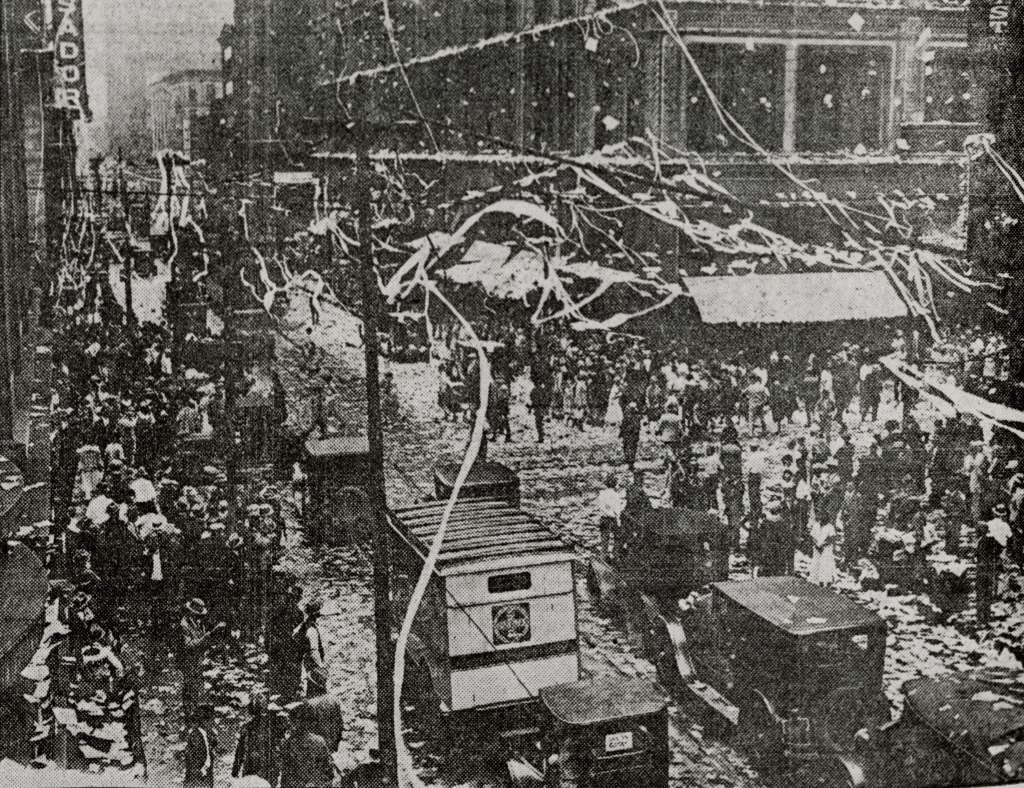
The final out at 3:15 p.m. local time signaled the start of a night of revelry, a pennant party unmatched by any other city to that point. Thousands of office workers in downtown St. Louis streamed into the streets as waves of confetti and ticker tape streamed from windows. Special editions of newspapers hit the streets.
“Bedlam Loosed as Pennant-Mad Fans Celebrate,” the St. Louis Post-Dispatch trumpeted in a headline.
The St. Louis Star described it this way: “It was a frenzied mob of hero-worshippers which serpentine through the traffic-choked thoroughfares of the city, wildly singing the praises of the might Hornsby and his victorious Cardinals.”
And the celebration wasn’t just limited to St. Louis. In a sign of the club’s future fan base outside of St. Louis, the festivities “trickled beyond the city, into the small towns of Missouri and Illinois, into the South and Southwest,” the Post-Dispatch noted.
In St. Louis, a torrential downpour didn’t slow the party down. Into the evening, more and more people gathered in the downtown streets.
“Far into the night raged the riot. … It was past 2 a.m. before a majority of the celebrants – joy-fatigued and deliriously happy – gave themselves up to sleep,” The Star recounted. “A few exuberant hundreds continued wild rejoicing long after dawn.”
And the newspapers noted another history-changing feature for St. Louis: As the evening wore on, people didn’t just show up to celebrate, they came dressed in red.
The night of the Cardinals pennant win showed the culture of St. Louis was fundamentally changing. The city’s favorite color would become Cardinal red – and the scene in the downtown streets would foreshadow similar crimson-themed celebrations for World Series wins in the future where fans sported red buttons, caps and shirts.
That would be the case about two weeks later when the Cardinals defeated the Yankees in a dramatic seven-game World Series, prompting another delirious celebration in St. Louis and states across the Midwest and South. And it would be the case 10 more times in the decades to come as Cardinals fans celebrated future World Series wins.
A century ago, the 1926 season created the roots of Cardinal culture. It inspired a city’s obsession with baseball that continues today.
—–
Terry Lemons will be a featured speaker at 2 p.m. Oct. 4 during the opening weekend of the Missouri History Museum’s “St. Louis At Bat: 100 Moments in Baseball History.”
You can find more information in his book “The Year St. Louis Became A Baseball Town: The Cardinals, Babe Ruth & The 1926 World Series.” at www.1926baseball.com .

Author
-
 Terry Lemons, is a former White House reporter and St. Louis native. After graduating from the University of Missouri, he worked as a newspaper reporter for the Springfield News-Leader and the Arkansas Democrat-Gazette, later moving to Washington, D.C., in the 1990s to cover the Clinton White House and Congress.
He is the author of “The Year St. Louis Became A Baseball Town: The Cardinals, Babe Ruth & The 1926 World Series," published by Arcadia Publishing.

